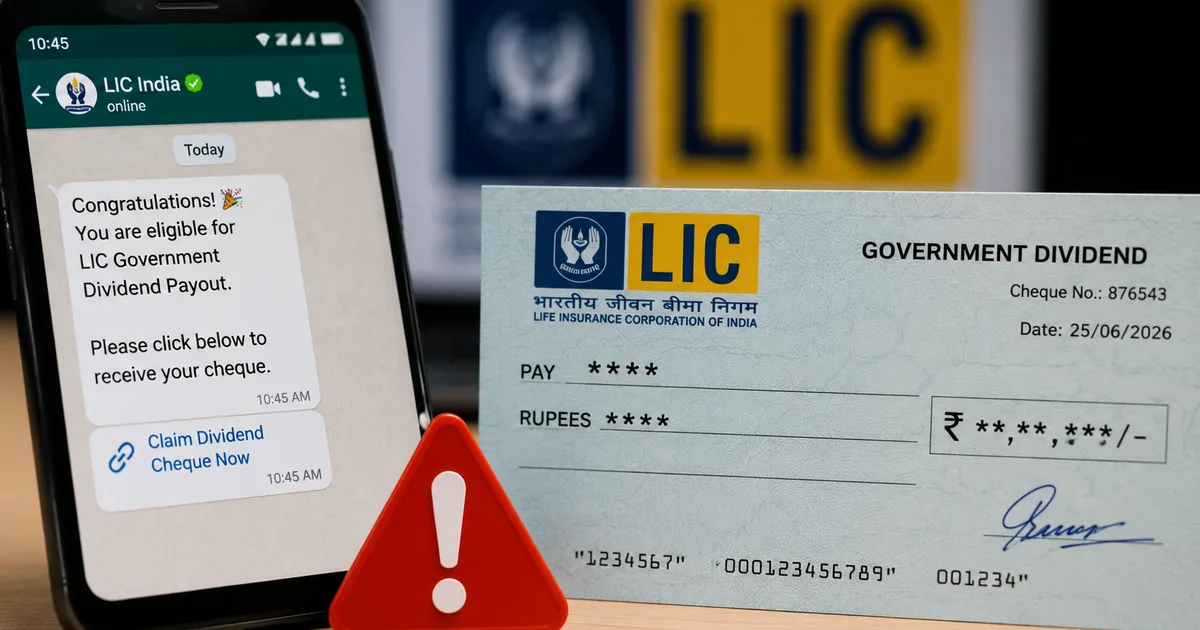
A few days ago, Finance Minister Nirmala Sitharaman received a massive Rs 12,207 crore dividend cheque from LIC for the financial year 2025-26. It was covered by every major news channel and newspaper. And predictably, scammers are already using this real news to empty bank accounts across India.
If you use WhatsApp, you need to know about the fake LIC government dividend cheque WhatsApp scam. It's spreading fast. Honestly, it looks surprisingly convincing to a lot of people who aren't usually targeted by these things.
Here's the deal. Scammers track the news closely. When something big involving thousands of crores and the government happens, they create a trap. Right now, people are getting messages claiming the government is distributing a portion of this LIC dividend to ordinary citizens. It sounds completely ridiculous when you say it out loud. But when your uncle forwards you a message with official-looking logos and real news links (which is super sketchy), it catches you off guard.
I've seen variations of this message floating around family groups all week. They're similar to other financial fraud campaigns we've covered recently. They usually claim you are eligible for Rs 5,000 or Rs 10,000 as part of a "citizen welfare distribution" from the LIC profits. Let me be clear right now. There is no such distribution. The government doesn't randomly send dividend money to citizens on WhatsApp.
Why scammers use LIC and government news
You might wonder why they bother making up these elaborate stories instead of just sending a generic fake link. It comes down to trust. LIC is a household name in India. I think almost every family has an LIC policy. Or they know someone who does. When scammers attach their fraud to a trusted brand like LIC, half the battle is already won.
Adding the government angle makes it even stronger. People read the real news about the Rs 12,207 crore cheque handed to the Finance Minister. The scammers just piggyback on that legitimacy, much like we see in recent banking alerts. They mix a real fact with a complete lie about a citizen payout. This makes the scam incredibly dangerous for older folks who trust the news but might not understand how digital fraud works.
Think about it.
If someone sends you a message saying you won a lottery you never entered, you delete it. But if they say the government is giving back tax money or sharing profits from a state-owned company, it sounds plausible enough to make you pause. And that pause is all they need.
What exactly is the fake LIC dividend scam?
This is a classic phishing and advance-fee fraud wrapped in current events. The scammers are banking on the fact that you might have seen the headline about the Rs 12,207 crore cheque on Google News or TV. I'm not sure exactly why it works so well, but tying their scam to a real event bypasses your initial skepticism.
They want your banking details. Or they want you to authorize a UPI payment. Sometimes they just want to get your Aadhaar and PAN details for identity theft. The bait is the promise of a government payout. The hook is a malicious link sent via WhatsApp or sometimes SMS. Basically, they cast a wide net hoping that out of a thousand messages sent, ten people will click.
How the LIC dividend scam works step by step
Understanding the mechanics of this fraud is the best way to spot it. These criminals follow a very specific playbook. They rarely deviate from it because it works so well.
Step 1: the urgent WhatsApp forward
It always starts with a message. You'll receive a WhatsApp text claiming the Ministry of Finance is releasing funds from the LIC dividend to the public. The message will include a link. To make it look legitimate, they'll often include a link to a real news article about the dividend handover right above their fake link. This is a clever trick. You click the real news link, see it is true, and then trust the fake link completely.
Step 2: the fake registration portal
If you click the malicious link, you're taken to a website that looks exactly like a government portal or the official LIC website. It has the state emblem and pictures of politicians. The site asks you to check your eligibility for the dividend payout. They might even have a fake timer counting down to make you panic and rush through the process.
Step 3: collecting your personal data
The site asks you to enter your phone number and Aadhaar number so they can supposedly transfer the funds to you. Some of these sites are bold enough to ask for your debit card number and CVV. At this point, if you enter the details, the scammers have everything they need to start compromising your accounts.
Step 4: the final trap with UPI or processing fees
This is where the actual theft happens. In many cases, the site says you're eligible for Rs 10,000. But you need to pay a small "verification fee" of Rs 99 or Rs 150 to process the transaction. They'll ask you to pay via UPI. Or they might send a UPI collect request to your phone, claiming you need to enter your UPI PIN to "receive" the money.
Never enter your UPI PIN to receive money. Your PIN is only for sending money. This is the golden rule of digital payments in India. Scammers rely on people forgetting it in the heat of the moment.
Why WhatsApp is the preferred tool for these scams
You rarely see these scams on Twitter or LinkedIn. They live on WhatsApp. There's a very specific reason for that. WhatsApp in India isn't just a messaging app. It is our primary mode of communication for everything. We use it for work, for family, for local community updates, and for casual chats.
Because we trust the people we talk to on WhatsApp, we tend to drop our guard. When a message comes from an unknown number, we are naturally suspicious. But when the same message is forwarded by your college friend in a family group, that suspicion vanishes. Scammers exploit this chain of trust. They only need to trick one person in a group. That person forwards it, thinking they are helping everyone out. Suddenly the scam reaches fifty new victims with an unearned seal of approval.
Plus, WhatsApp's end-to-end encryption means the platform itself can't easily scan and block these malicious links the way email spam filters do. The responsibility falls entirely on you to spot the fake. You can read more about how scammers manipulate current events in our detailed teardowns of social engineering tactics.
Warning signs you should never ignore
You don't need to be a cybersecurity expert to spot these scams. You just need to look for the red flags. I've listed the most common ones below.
- If you get unsolicited offers of money, ignore them. The government does not distribute thousands of rupees via WhatsApp links. If you did not apply for a specific scheme through an official channel, you are not getting money.
- Watch out for fake urgency and deadlines. The messages almost always say the offer is valid for only 24 hours or for the first 10,000 users. Scammers create this panic so you act before you think.
- Look closely at the link URL. An official government website will end in .gov.in or .nic.in. The official LIC website is licindia.in. If the link is something like lic-dividend-2026.com or gov-funds-xyz.in, it is an absolute fake.
- Never trust any request for your UPI PIN. As I mentioned earlier, if a site asks for your UPI PIN to send you funds, it is a scam.
- Pay attention to grammar and spelling. While scammers are getting better, many of these messages still contain awkward phrasing or obvious spelling mistakes.
How to protect yourself and your bank account
The Indian Computer Emergency Response Team (CERT-In) regularly warns about these types of phishing campaigns. Protecting yourself comes down to a few basic habits.
First, be deeply skeptical of forwarded messages in family groups. Just because your uncle forwarded it doesn't make it true. Don't click on links promising free money or jobs. It's always better to assume a forward is fake until proven otherwise.
Second, verify everything independently. If you hear about a government scheme, open your browser and search for it yourself. Go directly to official websites. Don't rely on links sent in chat apps. If a scheme is real, you'll find information about it on the official portals.
Third, keep your digital hygiene tight. Never share your OTP, UPI PIN, ATM PIN, or CVV with anyone. No bank or government official will ever ask for these details. If you use a lot of banking apps, consider securing them with biometrics or strong passwords. If you need help setting up secure passwords, take a look at our security tutorials.
Since these scams often try to get your ID documents, you should also be careful about where you share your Aadhaar card. Only use official services like DigiLocker for document verification. And consider using a masked Aadhaar when possible to protect your identity (which makes sense, actually).
And finally, talk to the older people in your family. Seniors are often the primary targets for these scams. They might not be as familiar with digital red flags. Sit down with your parents and explain that government benefits don't come through random WhatsApp links. Show them what a fake link looks like.
What to do if you get scammed
Look, mistakes happen. These scams are designed to trick smart people. If you realize you've clicked a bad link and shared your details, you need to act immediately. Don't wait.
Call your bank right away. Block your cards and freeze your account. Every second counts when scammers have your details.
Immediately report the fraud to the National Cyber Crime Reporting Portal. You can do this by calling the helpline number 1930 or visiting cybercrime.gov.in.
When you call 1930, they can often coordinate with banks to freeze the stolen funds if you report it quickly enough. And you should file a formal complaint on the website with all the details. In my experience, screenshots of the WhatsApp message and the phone numbers involved are really helpful.
Don't delete the scam messages immediately. Take screenshots first. That evidence is useful for the police. Once you've reported it, tell your friends and family so they don't fall for the same trick.
Scammers will always try to use the latest news to steal from people. The LIC dividend is just the latest excuse. Next month they'll find something else to lie about. Just stay alert and keep your PINs to yourself.