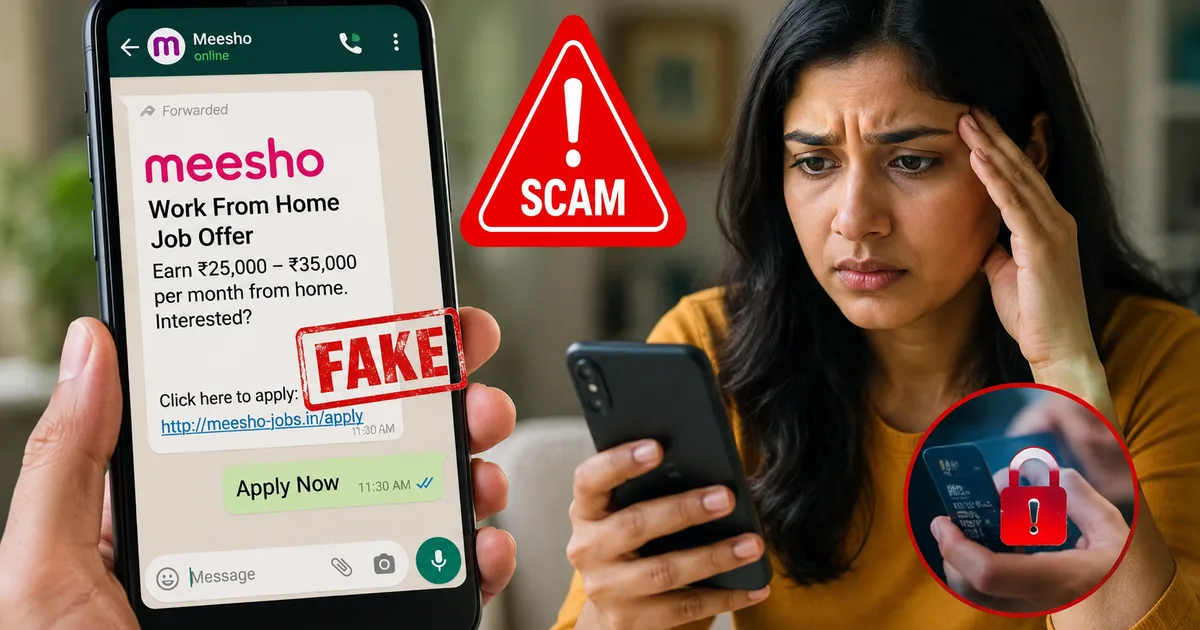
Look, times are tough, and everyone could use a little extra cash. We've all seen the news about inflation, rising costs of living, and an uncertain job market. So when your phone buzzes on a Tuesday afternoon with a WhatsApp message offering ₹2000 to ₹5000 a day just to like some products online, you might think it's your lucky day. You might think the universe is finally throwing you a bone. Don't fall for it. The Fake Meesho Work From Home Job Offer WhatsApp Scam 2026 is wiping out bank accounts faster than you can blink. Honestly, this is one of the most ruthless financial traps running right now in India, and they are specifically targeting regular internet users who just want an honest side hustle.
This isn't some sketchy Nigerian prince email from 2005. The criminals behind this are highly organised and well-funded. They understand exactly how we think. Just recently, a youth in Mangaluru lost ₹1.23 lakh to an identical online job fraud. And honestly, the headlines are full of stories about multi-state cyber fraud networks getting busted in places like Hyderabad. Police arrested 19 people there in a single week. These gangs use the name of a trusted e-commerce brand like Meesho to lower your guard. But let's get one thing straight right now. Meesho has absolutely nothing to do with this.
What exactly is the Meesho task scam?
Let me break the scam down for you. You get a text from an unknown number on WhatsApp. Sometimes it's an Indian number. Other times it starts with +92 or +62, or even +254. The sender usually claims they are an HR recruiter for Meesho. Or maybe a digital marketing agency working with the platform. They offer you a work from home opportunity. Your only job? Rate products and leave positive reviews. They promise daily payouts straight to your UPI or bank account. They say you don't need to invest anything and it only takes an hour.
Sounds too good to be true, right? That's because the whole thing is completely fabricated. They aren't looking for employees at all. They are hunting for victims. Thing is, they play on your desire for financial security. This is especially true when you hear about PM Modi's recent advisory urging people to work from home amid global geopolitical tensions. In my experience, scammers love to use real world events to make their fake jobs seem legitimate. It makes the trap harder to spot.
How the trap closes around you (step-by-step)
Understanding how they hook you is the only way to stay safe. We cover a lot of scams on this site. These syndicates operate with a very specific playbook (which makes sense, actually). They don't ask for your life savings on day one. They groom you. If you ask me, this grooming is the scariest part.
Step 1: The WhatsApp approach
It always starts with an unsolicited message. "Hello, I am recruiting for part-time Meesho work. Earn ₹1500 to ₹5000 daily. Can I share the details?" If you reply, they are extremely polite. They use proper English or perfectly translated Hindi. And they will generate fake offering letters on stolen company letterheads. These even have forged signatures from real executives they found on LinkedIn. They might send you a fake company ID card just to build trust. It comes complete with a barcode and a corporate address in Bengaluru or Gurugram.
It looks incredibly real.
Step 2: The bait and first payout
This is the trickiest part. It's why so many smart people get fooled. They actually pay you. They send you links to cheap Meesho products and ask you to take screenshots after adding them to your wishlist. Once you send the photos, they ask for your UPI ID. Then they send you ₹150 or ₹200 immediately. You hear that UPI notification chime. You think, "Wow, this is real! I just made ₹200 in five minutes." Your guard drops completely. Basically, this small payment is just an investment for the scammers.
Step 3: Moving to Telegram
Once you trust them, they tell you task allocation happens on Telegram. They ask you to download the app and message a "Receptionist" or "Task Manager". Why Telegram? Because it's heavily encrypted and easier for them to hide. They can delete messages for everyone and run automated bots. Inside this Telegram group, you see dozens of other people posting screenshots of massive earnings. Most of those are ₹10,000 or ₹50,000. A few even hit ₹1 Lakh. But almost everyone in that group is a scammer using fake accounts. They want to create a false sense of success. It's a staged play. And you are the only real audience member.
Step 4: The prepaid premium tasks
Here is where the scam really begins. After a day of free tasks, the manager announces a premium task. To participate and earn higher commissions, you need to recharge your account. They start small. You pay ₹1000 to unlock the task, complete it, and get ₹1500 back. And surprisingly, they might actually pay you back this first time. This completely cements your trust in the system.
Step 5: The final financial squeeze
Now you are fully invested. The next task requires a ₹10,000 deposit, so you pay it. Then they tell you this is a "bundled task". You have to complete three more tasks. These require deposits of ₹25,000 and ₹50,000. And then a final one for ₹1 Lakh before you can withdraw anything. When you try to get your money, an "error" occurs on their fake dashboard. The manager tells you your credit score dropped or you made a typo. Now you need to pay a ₹50,000 penalty fee to unlock your frozen funds. If you pay this penalty, you will never see that money again. They just keep inventing new fees and taxes until your bank account is totally empty. Or until you finally realise what is happening.
Warning signs you absolutely cannot ignore
You need to know the red flags. If you see any of these, block the number immediately. Then warn your family.
- Unsolicited WhatsApp messages. Legitimate companies like Meesho do not recruit people for part-time jobs via random WhatsApp texts. Period.
- Paying to work. If you have to pay money to do a job, it is a scam. Always. Real jobs pay you for your time and skills. You should never have to buy your own salary.
- Moving to Telegram. Shifting communication from WhatsApp to Telegram for task management or finance clearance is a massive red flag used by almost all task fraud syndicates.
- Crypto payments. If they ask you to convert your INR to cryptocurrency on Binance or WazirX to complete a task, you are dealing with advanced, professional cybercriminals. When it comes to the crypto payments twist, they often instruct victims to buy USDT (Tether) and transfer it to an unknown wallet address. Once cryptocurrency leaves your wallet, it is virtually impossible to trace or recover. The blockchain doesn't have a customer service desk you can call for a refund. Techies in Bengaluru have lost up to ₹43 lakh falling for this exact crypto twist on the job scam.
- High pressure tactics. They give you strict time limits to complete prepaid tasks to prevent you from thinking clearly, doing research, or talking to a sensible family member.
"If you have to pay money to receive a salary or unlock task commissions, you are not an employee. You are a victim of financial fraud. Real companies pay you for your work, they never ask you to buy your income."
The psychology behind the fraud
Why do smart people fall for this? Because scammers hack your brain. They use the sunk cost fallacy against you. Once you put ₹20,000 into their fake system, walking away with nothing is painful. So they ask for another ₹10,000 to release your funds. Your brain tricks you into paying it. You just hope you can get your original money back and quit.
They also isolate you. The Telegram groups are designed to make you feel like everyone else is getting rich while you hesitate. It creates intense FOMO. And they push you to act fast. That way you don't have time to read any of our explainers on how these things work.
The numbers here are a bit fuzzy, but we know thousands fall for this every week.
How to protect your bank account and data
Look, the internet is full of traps. But you can keep yourself safe with a few basic habits. You can read our full guides on digital hygiene, but here is the short version.
First, never reply to unknown international numbers offering jobs on WhatsApp. Just report and block them. WhatsApp has a built-in feature for this, so use it aggressively.
Second, be extremely careful with your personal data (annoying, I know). Do not send your Aadhaar card or PAN card photos to random recruiters on WhatsApp just because they ask for KYC. If you need to share documents with a real employer, use the government's official DigiLocker app. It is one of the safest tools available for Indian citizens. Only share with verified entities through official portals.
Third, understand exactly how UPI works. You only need to enter your UPI PIN to send money from your account. You never need to enter your PIN to receive money. If someone tells you to enter your PIN to receive a salary, they are robbing you right then and there.
And keep up with official advisories. The Indian Computer Emergency Response Team (CERT-In) regularly publishes warnings about new types of phishing attacks targeting Indian users. Read them. Stay informed.
What is Meesho doing about this?
Meesho isn't ignoring the problem. The company has faced major issues with fraud on multiple fronts. This includes a massive case where a Surat gang cheated the platform out of ₹5.5 crore through fake bot orders. Meesho's legal and security teams are actively hunting down these fake accounts to clean up their ecosystem. They frequently issue public warnings stating they do not offer these types of part-time rating jobs.
But the reality is a mess. Scammers just change their profile pictures, buy new SIM cards, and start again the next day. A corporate legal team can't protect your wallet. You have to be your own first line of defence.
What to do if you already lost money
If you are reading this and realise you're in the middle of this scam, stop communicating with them right this second. Do not pay another single rupee, no matter what they threaten you with. They can't arrest you. They can't freeze your real bank account. They can't send the police to your house. They are criminals sitting in a boiler room. They are likely somewhere in Southeast Asia or a remote part of India.
Take screenshots of every chat and every fake ID they sent. Grab every transaction ID and every phone number involved. Do not delete the chats yet.
Then, you need to act fast. Call the national cybercrime helpline at 1930 immediately. Do not wait until tomorrow morning. The faster you call, the higher the chance your bank can freeze the fraudulent account before the scammers withdraw the cash.
After calling 1930, go to the official portal cybercrime.gov.in and file a detailed complaint. When you file your complaint, be prepared to write a clear timeline of events. The police need to know exactly when the first contact was made. They need to know exactly when the first payment was sent. They also need the exact UPI IDs or bank account numbers the scammers used. The more organised your evidence is, the faster the cyber cell can act. Provide all the screenshots, bank statements, and UPI reference numbers. Inform your local bank branch manager too. But the 1930 call is the absolute most important first step.
I think getting scammed is an awful experience. It comes with a lot of shame and anger. But you are not alone. And you are not stupid for falling for it. These criminals are professional manipulators who do this for a living. Share this information with your parents. Post it in your family WhatsApp groups and warn your colleagues. The only way we stop these gangs from draining Indian bank accounts is by making sure everyone knows exactly how their playbook works.
Stay sharp, verify everything twice, and keep your hard-earned rupees safe.