Look, you probably got a text message this week about your government benefits. I did. Half the people I know did. But here's the deal. That message asking you to verify your identity is almost certainly the fake PM Kisan Samman Nidhi 2026 KYC update SMS scam. And it's completely emptying bank accounts across India right now.
Honestly, I track a lot of digital frauds. Most are painfully obvious. They have terrible spelling. Or they come from bizarre international numbers. But this one is different.
It targets everyday farmers and families who legitimately rely on that 6,000 rupees a year from the government. The 23rd installment is expected soon. Scammers know you're waiting for it. They're using that anticipation to steal everything you have. In my experience, this timing is very deliberate.
Text message frauds in India have jumped by 146 percent recently. That's a massive spike. And a huge chunk of that is these malicious APK files hiding behind government schemes (which makes sense, actually).
The trap: what exactly is this scam?
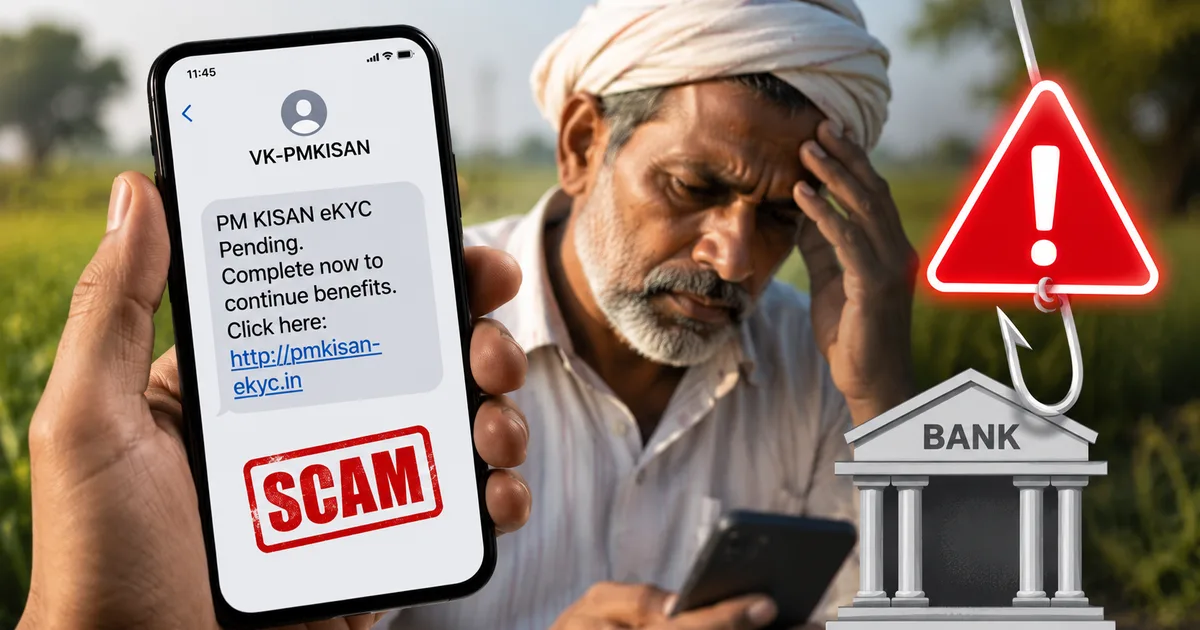
You receive a standard-looking SMS. It claims your PM-KISAN account is suspended. Or it says your upcoming 2,000 rupee installment is blocked. The message always creates panic. It tells you your KYC is pending and gives you a link to update it immediately. If you read our other news updates, you know scammers love urgency. They don't want you to think. They just want you to click.
The message often looks official. It might have a header mimicking a government sender ID. But the link inside doesn't go to the real pmkisan.gov.in website. Instead, it prompts you to download an app. They call it the PM Kisan KYC App or something similar.
This is a complete lie. The government doesn't send you random apps via SMS. If you ask me, this should be the biggest red flag.
How the fake PM Kisan APK actually works
This is where things get technical. But stay with me. The fraud relies entirely on you installing an application outside the Google Play Store.
You click the link in the SMS. Your phone browser downloads a file ending in .apk. This stands for Android Package Kit. It's just an installer file. Nagaland Police recently issued a specific alert about this exact malicious PM Kisan Yojana APK file spreading rapidly.
Your Android phone will actually warn you. It'll say install unknown apps is disabled. The scam page provides helpful instructions on how to go into your settings and turn off this protection. They're literally walking you through disabling your own security. It's a mess.
Once installed, the app asks for permissions. It wants to read your text messages. It wants to view your contacts. It wants to make and manage phone calls. You hit allow because you think it needs these for the KYC process (annoying, I know).
Basically, the app is a remote access trojan. It hides in the background. When you open your real banking app, the scammers log your password. When your bank sends an OTP via SMS to verify a transfer, the fake app intercepts the message. Then it sends it to the scammers. And it deletes it from your phone before you even see it.
People in Vizag recently lost over 25 lakh rupees to this exact method. Just gone. Poof. Because of one fake app. I think people underestimate how fast this happens.
Real stories from the ground
I'm not just making these scenarios up to scare you. The police reports are piling up right now.
In Bihar, authorities recently arrested two cybercriminals in Bhagalpur specifically for duping PM-Kisan beneficiaries. They were sending these exact SMS blasts. The good news is that Kishanganj police actually managed to recover some funds from a similar APK scam recently. But recovery is rare. Once the money hits a scammer's account, it's quickly broken up. Then it's moved through dozens of mule accounts.
You might think you're too smart to fall for this. But the scammers are getting better. They use official logos. They copy the exact color schemes of government websites. They even set up fake customer support numbers. Honestly, I'm not sure exactly why telecom companies can't block these faster.
Warning signs you cannot ignore
You need to know how to spot this garbage before it ruins your month. In my experience, memorizing these rules saves you a lot of grief.
- If the link says pmkisan-update-kyc.in or a random string of letters instead of pmkisan.gov.in, it is a complete fake.
- Genuine PM-KISAN KYC happens entirely on the official web portal using your Aadhaar OTP. You never have to download a random APK file.
- A legitimate government scheme app will never ask for permissions to read all your personal text messages.
- The government doesn't send official KYC warnings through random ten-digit WhatsApp numbers. If you get a WhatsApp message with an APK file, delete it instantly.
How to protect your bank account right now
Look, I can't stress this enough. Your digital safety is entirely in your own hands. You've got to be paranoid.
First, go to your Android settings right now. Search for install unknown apps. Make sure it's turned off for every single app. Especially your web browser and WhatsApp. This simple toggle stops these APK scams dead in their tracks.
Second, if you genuinely need to check your PM-KISAN status, type the address manually. Open Chrome and type pmkisan.gov.in. Use the official farmer corner on the right side of the screen. You can check your beneficiary status or complete e-KYC right there using your Aadhaar number.
Third, share this information. Talk to your parents. Talk to your grandparents. A lot of older folks in rural areas depend on this money. They're the prime targets. If you read our guides on digital literacy, you know that educating your family is the best defense. I think it's the only real solution long-term.
Never click on links in unsolicited SMS messages claiming your account will be blocked. Government agencies do not operate this way. Always verify through official portals.
CERT-In, India's cybersecurity agency, constantly warns about these exact smishing attacks. They recommend never opening attachments from unknown sources.
The Aadhaar and NPCI confusion
Since the PM-Kisan scheme is linked to Aadhaar and directly deposits money into bank accounts via Direct Benefit Transfer, the scammers use this technical reality to confuse people.
They tell you your Aadhaar mapping has failed. They say your bank account is no longer seeded with NPCI. These are real technical terms that the government uses. When a farmer hears that their NPCI seeding failed, they panic. The scammers use this legitimate jargon to build trust.
I've seen messages that say your PM KISAN Samman Nidhi 23rd installment is stopped due to pending Aadhaar e-KYC. Then they ask you to download the security app to complete Aadhaar verification today. It sounds so plausible. But it's a trap.
There actually is a real PM-Kisan mobile app. But you don't get it from an SMS link. You get it directly from the Google Play Store (which is much safer, obviously). It's developed by the National Informatics Centre. If the developer listed isn't the NIC, you're looking at a fake.
And what about the permissions? The real app asks for location and camera for face authentication features. It doesn't ask to read your SMS. It doesn't ask to control your phone calls. That's the dead giveaway. If an app wants to read your texts, it wants your OTPs. Period. If you ask me, checking app permissions is mandatory these days.
The changing landscape of cybercrime in India
We've seen a massive shift. A few years ago, it was just fake call center guys asking for your CVV. Now, they're writing custom Android malware. They're buying bulk SMS gateways to send millions of texts. These look like they come from VM-Kisan or BZ-Govt.
They manipulate the sender IDs so the messages drop right into the same text thread as your genuine bank alerts. This makes it incredibly hard for the average person to tell what's real and what's fake. The numbers here are a bit fuzzy, but the success rate is clearly huge.
The telecom regulator has been trying to crack down on these fake sender IDs. But the scammers always find loopholes. They register fake companies to get access to these SMS routes.
So you can't trust a text message just because it says it's from the government. You have to verify the action independently.
If you read our tools section, we always recommend having a secondary phone for banking if you can afford it. Keep your banking apps on a device that you don't use for random browsing or downloading WhatsApp forwards. I know that isn't practical for everyone, but it's the safest route. I think people need to separate their digital lives more.
What to do if you already downloaded the fake app
If you're reading this because you already clicked the link and installed the app, you need to move fast. Don't wait for your money to disappear.
Turn on airplane mode immediately. Swipe down and hit the airplane icon. This cuts off the scammer's connection to your phone. They can't steal your OTPs if your phone has no network.
Next, delete the app. Go to your settings. Find the apps list. Locate the fake PM Kisan app. And uninstall it.
Then change your passwords. Get on a different device and change your UPI PIN and net banking passwords immediately. In my experience, doing this from a clean device is crucial.
Call the helpline. Dial the national cybercrime reporting helpline at 1930. Do this from another phone. Tell them you installed a malicious APK and your account is compromised.
File a report. Go to cybercrime.gov.in and file an official complaint. The sooner you do this, the higher the chance your bank can freeze the stolen funds.
The harsh reality of refunds
If you're a student or a young professional reading this, you're the designated IT support for your family. You've got to take the lead here. Take five minutes this weekend to sit down with your parents. Check their phones. Look at what apps they have installed. Delete anything you don't recognize.
Warn them about these SMS links. Tell them the government will never cancel their benefits via a random text message link. It's better to have an uncomfortable conversation now than to spend three months fighting with the bank trying to recover stolen money.
The banks are getting stricter about refunds. If you willingly install an app and give it permission to read your OTPs, the bank often argues you compromised your own security. They might refuse to refund the money.
That's the harsh reality. You're on your own out there. The cyber police do what they can. But the volume of these crimes is overwhelming (scary, I know). The 1930 helpline gets thousands of calls a day.
So be skeptical. Be slow. When a message tells you to hurry, that's your signal to stop. Take a breath. Go to the official website. Check things manually. Don't let these thieves take the money you worked hard to earn. Thing is, it's the only way to stay safe.