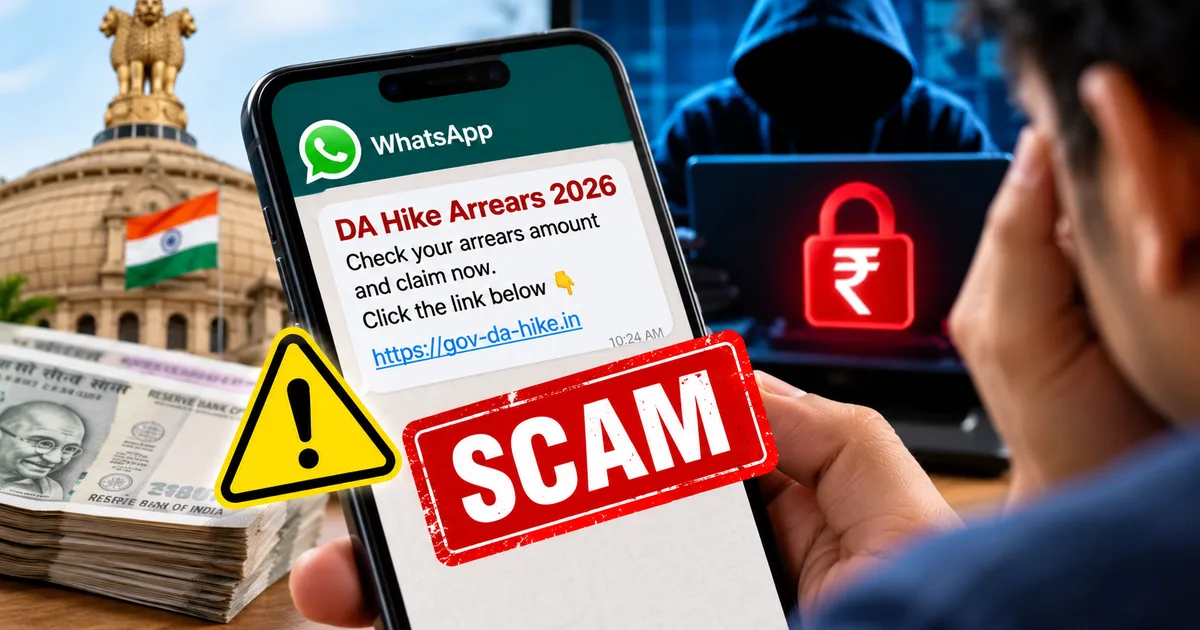
So the government recently announced the Dearness Allowance hike for central government employees and pensioners for 2026. Good news, right? We all could use a little extra money with prices going up. But scammers are already treating this announcement like their personal Diwali bonus. They're blasting out messages that lead straight into the fake DA hike arrears 2026 claim WhatsApp link scam. Honestly, this is one of the more vicious frauds I've seen this year. It specifically targets older employees and pensioners who might just be trying to figure out how much their salary or pension is going up.
I know people usually ignore spam messages. But this one looks incredibly real. Scammers use official logos. They mention exact government orders and use the correct technical terms for salary calculation. A chartered accountant recently lost Rs 1.70 lakh to a similar WhatsApp scam just by replying 'NO' to a fake alert. When smart financial professionals are getting duped, the average person doesn't stand much of a chance without knowing the exact warning signs. So you need to be extremely careful with any message talking about your arrears.
Let me explain exactly what this scam is and how these criminals are emptying bank accounts. The core hook is simple. They want you to click a link to claim your arrears or calculate your new salary under the 8th Pay Commission discussions. See, calculating DA arrears is inherently confusing. You have basic pay, the current DA percentage, the revised percentage, and the months of back pay. Most people can't calculate this in their heads. So when a helpful-looking message offers an automated calculator or a direct claim link, people click it without thinking. It feels like a convenience. But it's a carefully designed trap.
What the fake DA hike arrears 2026 WhatsApp scam actually is
This fraud relies on a very simple human emotion. Greed mixed with a bit of bureaucratic confusion. You get a message on WhatsApp. It claims you have pending arrears from the recent DA hike. Or maybe it says you need to update your bank details to get the new revised salary. The message usually includes a link that looks like a government portal. And sometimes it ends in something like "gov-in-update.com" instead of the real ".gov.in" domain. I'm not sure exactly why people fall for the domain trick so easily, but they do.
Thing is, these scammers do their homework. They time these messages perfectly with real news cycles. When the news channels are debating the DA hike taking effect, your phone pings with a link to claim it. It feels logical. You might even think your department sent it. But the government never sends WhatsApp links asking you to claim your salary arrears. Your department accounts office handles all of that automatically. Your pay slip just updates one month. Then the arrears are credited directly to your salary account. There is no manual claim process via a random web link.
If you want to read more about similar tactics, you should check out our guide on the Fake 8th Pay Commission Arrears Calculator WhatsApp Scam 2026: Protect Your Bank Account. The methods are almost identical. They create a false sense of urgency so you stop thinking rationally.
How the DA arrears claim fraud works step by step
Let's break down the exact sequence of events. I want you to recognize this pattern the second it happens to you or someone in your family.
First, you get a WhatsApp message from an unknown number. It might have a profile picture of a government building or the Indian emblem. The text is written in formal Hindi or English. It says your DA arrears for 2026 have been approved but are stuck due to a KYC mismatch or a missing PAN update.
Second, the message gives a link to fix the issue. It usually says something like "Account closes in 2 hours" or "Arrears will lapse by midnight". This is the trap. They want you to panic.
Third, you click the link. It takes you to a fake website that looks exactly like the real Income Tax portal or your bank's net banking login page. Here, they ask you to enter your Aadhaar number, PAN card details, and bank account number (which makes sense, actually, if you think you are logging in).
Fourth, the site prompts you to download a security application or an arrears calculator tool. This is actually a malicious APK file. If you install it on your Android phone, it grants the scammers full access to your SMS messages. Some of these apps are so sneaky they even hide their icon after installation. They run silently in the background. You won't notice anything wrong until it's too late. The app sits there. It monitors your incoming messages. And it waits for that one specific text from your bank.
Then they initiate a money transfer from your account. Your bank sends an OTP to approve the transaction. But because you installed their malware, the scammers read the OTP directly from your incoming messages. They delete the SMS before you even see it. Your bank account gets drained, and you only find out when you check your balance days later. Sometimes they don't just empty the account. They take out pre-approved instant loans in your name using the banking app, transferring that money out as well. It is a complete financial nightmare.
This isn't an isolated issue. WhatsApp recently banned over 9,400 accounts used for various digital scams. The scale of this operation is massive. We track these trends closely in our Scam Alerts & Safety section, and the scammers are just getting smarter.
Warning signs of the WhatsApp arrears link scam
You can spot these fakes if you know what to look for. But the problem is that most people are too busy or stressed to check the details. Honestly, in my experience, people just click first and ask questions later.
Look at the URL carefully. Official Indian government websites always end in "gov.in" or "nic.in". If the link says something like "claim-da-arrears-2026.in" or "sbi-kyc-update.com", it's definitely a scam. I can't stress this enough.
Check the phone number. Government departments don't send official financial links from standard 10-digit mobile numbers. Especially not international numbers starting with +92 or +84. If you get a message like this from a random number, block it immediately.
Watch out for extreme urgency. True government processes are notoriously slow. Nobody in the finance ministry is going to cancel your hard-earned arrears because you didn't click a link within two hours. Bureaucracy moves at its own pace. If the message threatens you with immediate financial loss or account closure, you're talking to a scammer. They use panic to bypass your logical brain.
They ask for your ATM PIN or UPI PIN. Never enter your UPI PIN to receive money. You only need a UPI PIN to send money. If a website asks for your PIN to deposit your DA arrears, stop right there. The same goes for your ATM PIN or CVV number. Government departments don't need your ATM PIN to deposit your salary. Anyone asking for this information is trying to rob you.
Also, pay attention to the language and grammar. While some scams have gotten better, many still use strange phrasing or incorrect Hindi and English. Official communications are drafted by professionals and go through multiple checks. If a message has glaring typos or weird capitalization, that's a huge red flag.
How to protect yourself from fake government links
Prevention is entirely about slowing down. Don't let the promise of quick money override your common sense.
Don't click links in unsolicited WhatsApp messages. I know this sounds basic. But it's the single most effective way to stay safe. If you think you might actually have a problem with your salary account, open your browser and type the bank's website address yourself. Don't use the link provided in the message.
Never download APK files sent over WhatsApp or SMS. Stick to the official Google Play Store or Apple App Store. Even then, read the reviews. If you download a fake app, it can bypass all your bank's security measures. This happened recently with the Fake LIC Government Dividend Cheque WhatsApp Scam 2026: Protect Your Bank Account, where victims unknowingly installed SMS-reading malware. If your phone asks you to enable installing from unknown sources for an app someone sent you, decline it immediately.
Keep your bank alerts turned on. Ensure you receive both SMS and email notifications for all transactions. Scammers might intercept your SMS. But they rarely have access to your email account at the same time. This simple redundancy can give you the warning you need to block your account before they take everything.
Use DigiLocker for official documents. Don't send photos of your Aadhaar or PAN card to random WhatsApp numbers claiming to be KYC verification for your arrears. The government provides DigiLocker for secure document sharing. If someone demands a photo over WhatsApp, ignore them.
Sometimes the scam doesn't stop with just a WhatsApp message. We're seeing a rise in follow-up phone calls. If you ignore the initial link, you might get a call from someone claiming to be from the treasury department. They'll sound very professional. They might even know your name and your department. They'll claim your arrears are blocked and offer to guide you through the process over the phone. They'll ask you to download a screen-sharing app like AnyDesk or TeamViewer. If you do this, they can see everything on your screen, including your passwords and OTPs (annoying, I know). I've heard stories of people losing their entire retirement corpus this way. It's absolutely devastating. Never share your screen with someone claiming to be a government official or bank representative.
Talk to your older relatives. They're the primary targets for pension and DA arrears scams. Spend ten minutes explaining that the government will never ask for their OTP over a WhatsApp link. That ten-minute conversation could save them their life savings.
Where to report DA arrears fraud in India
If you clicked the link and gave away your details, you need to act fast. Every minute counts.
- Call the national cyber crime helpline at 1930 immediately. This helpline is specifically designed to freeze fraudulent transactions before the money leaves the banking system. Have your account details ready when you call.
- Call your bank and block your account and all associated debit cards. Tell them your phone might be compromised.
- Register an official complaint on cybercrime.gov.in. You'll need screenshots of the WhatsApp message, the phone number of the scammer, and your bank statement showing the unauthorized debit. Keep all this evidence safe.
You should also report the scam message on WhatsApp itself before blocking the number. Tap on the contact, scroll down, and select the report option. This helps WhatsApp ban these numbers faster.
Consider reporting malicious links to CERT-In. They track and take down phishing infrastructure across the country. The reality is that recovering lost money from cyber fraud is incredibly difficult in India. The scammers transfer the funds through multiple accounts and withdraw it as cash or cryptocurrency within hours. Your best defense is simply knowing how the trick works and refusing to play their game. Stay alert, ignore those random WhatsApp links, and keep your hard-earned money safe.