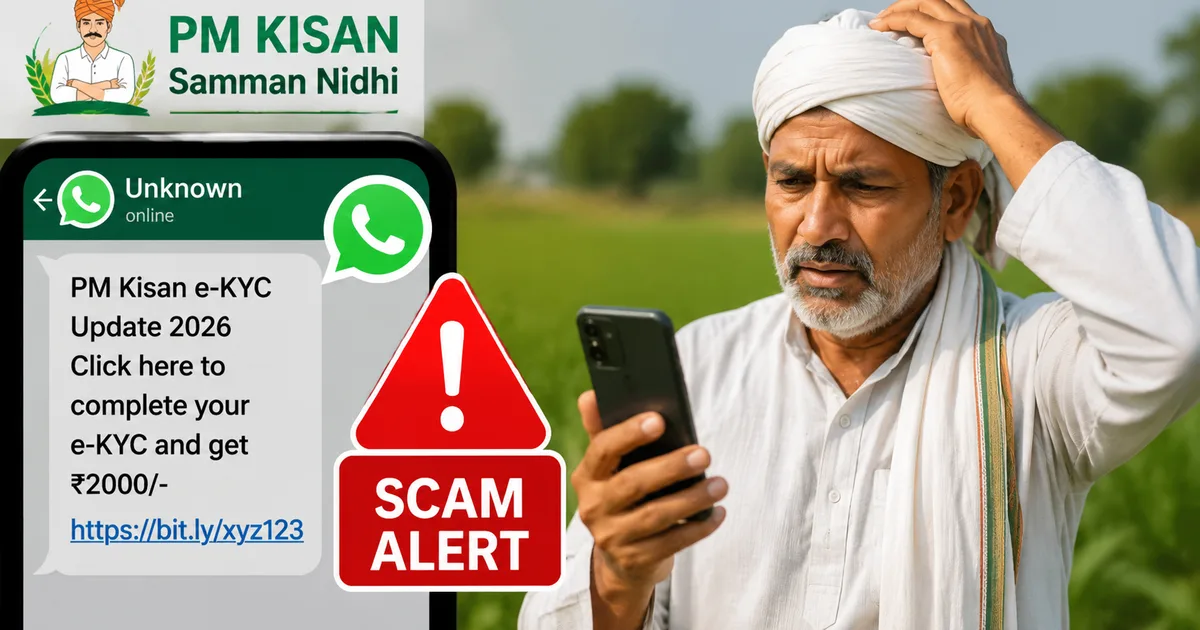
Look, we've got to talk about the Fake PM Kisan Samman Nidhi 2026 e-KYC WhatsApp Scam that's currently ruining lives across India. Honest farmers and everyday folks are losing their hard-earned money in minutes. Scammers are taking advantage of a government scheme meant to help the poorest, which, for the record, I think is absolutely disgusting. And the worst part's how simple the trap is. You'll get a message on WhatsApp. It tells you to update your e-KYC to get your next installment. You click the link, and suddenly your bank account's empty.
Honestly, this is one of the more vicious scams I've seen recently. A farmer lost Rs 3.9 lakh after clicking a fake PM Kisan e-KYC link. Think about that amount for a second. That's life-changing money for most people in our country. Gone because of one wrong tap on a smartphone. Another victim lost Rs 1.95 lakh after downloading a fake app. Scammers in Rajasthan even ran a whole network defrauding government welfare schemes of crores. They're out there and they're highly organized.
I couldn't find a clear official answer on exactly how many people have fallen for this. The numbers here are a bit fuzzy. But it's probably a lot.
I'll explain what this scam is and how it works. I'll also cover the warning signs. And I'll tell you exactly what you should do if you fall for it. Because waiting around isn't an option.
What is the PM Kisan e-KYC WhatsApp scam?
The Pradhan Mantri Kisan Samman Nidhi scheme gives eligible farmers Rs 6000 a year. It comes in three installments of Rs 2000 each. The government recently announced the 23rd installment, and they made it mandatory for beneficiaries to complete their e-KYC. This is where the scammers step in. They know people are waiting for their Rs 2000. They also know people are stressed about getting their e-KYC done. So they send messages pretending to be government officials or bank staff. (Which makes sense, actually, given the panic it creates).
They'll send you a text or a WhatsApp message saying your 23rd installment is blocked. They tell you that you must update your e-KYC right now. And they provide a link. This link is the trap. It looks official. But it isn't. Sometimes it asks for your Aadhaar details and OTP. Other times, it asks you to download an APK file. Basically, that is just an Android app installation file.
The fake APK file danger
This is where things get really bad. If they send an APK file, they usually call it something like PM-Kisan-Update.apk. When you install this app, it asks for permissions on your phone. It wants to read your SMS and see your screen. If you click yes, the scammers have full control. They can see the OTPs your bank sends you. They can drain your account without you even knowing until it's too late. This is not some made-up threat. Cybercriminals are using these fake APK files to empty bank accounts within minutes. If you ask me, it's terrifying how fast they work.
How the scam works step by step
You need to know their playbook so you can spot the trap.
- First, you receive an urgent WhatsApp message or SMS. It says your PM Kisan 2026 payment is suspended because your e-KYC is incomplete.
- Second, they create panic. They say you've got only 24 hours to fix it or you lose the money forever. This stops you from thinking clearly.
- Third, the message includes a link. It usually has words like pmkisan or gov mixed with strange letters or numbers. It's not the real government website.
- Fourth, when you click the link, one of two things happens. Either you go to a fake website that looks exactly like the official PM Kisan portal, or you're prompted to download an APK file.
- Fifth, if it's a website, they ask for your Aadhaar number, PAN card, and bank details. Then they ask for the OTP sent to your phone. If it's an app, the app steals the OTP automatically from your incoming messages.
- Finally, once they have your OTP, they transfer funds from your bank account to theirs. They empty it fast.
Warning signs you should never ignore
You can protect yourself if you know what to look for.
- The government won't send you a WhatsApp message demanding you complete e-KYC within 24 hours or lose your benefits. Urgency is a massive red flag.
- Official government departments rarely send direct links for e-KYC over WhatsApp. You should always go directly to the official portal yourself.
- The government won't ask you to download an app from a random link. Official apps are always on the Google Play Store or Apple App Store.
- No government official, bank employee, or customer care agent will ever ask you to share your OTP. Hang up the moment someone asks for it.
- The official website is pmkisan.gov.in. Scammers use fake addresses like pm-kisan-update-online.com. Always check the URL carefully.
Never trust an APK file sent via WhatsApp. Official apps like Umang or DigiLocker must only be downloaded from official app stores. Sideloading apps is the fastest way to lose your savings.
How to protect yourself from digital fraud
Staying safe requires a bit of effort. But it's way better than losing everything.
First, verify the source. If you want to check your PM-Kisan status, open your browser and type the official URL yourself. Don't click links in messages. The official portal is pmkisan.gov.in.
Second, finish your e-KYC through safe methods. You can do it on the official portal using Aadhaar-based OTP verification. You can get the official PM-Kisan mobile app from the Google Play Store and use the face authentication. Or you can just visit your nearest Common Service Centre (CSC) and do the biometric authentication there.
Third, stop downloading APKs from unknown sources. Go to your phone settings right now. Search for 'Install unknown apps' and make sure it's turned off for Chrome and WhatsApp. Turn it off for your file manager too. This simple step can stop malware fast.
Fourth, be careful with your Aadhaar details. You can use the biometric lock feature on the UIDAI website to lock your biometrics when you aren't using them. The mAadhaar app has this feature as well. This stops scammers from using your thumbprint data if they somehow get their hands on it. (Which is annoying to set up, I know, but completely worth the effort).
And finally, talk to the elders in your family. Most victims of this scam are older farmers who might not know their way around a smartphone. Explain this to them. Show them what a fake link looks like. Tell them to call you before they click anything about their bank account.
What to do if you've been scammed
If you realize you've clicked a bad link or shared an OTP, don't panic. But act immediately. Every single minute matters.
- Call 1930 immediately. This is the national cybercrime helpline. Call them the second you realize money is gone.
- Block your bank account by calling your bank's customer care number or using your banking app. Stop any further transactions.
- Go to cybercrime.gov.in and file a detailed complaint. Provide the phone number that messaged you, the link, and the transaction IDs.
- Delete the fake app immediately if you downloaded an APK, then restart your phone. Do a factory reset if you want to be completely safe.
- Take a screenshot of the scam message and put it on your WhatsApp status to warn your friends and family.
The bigger picture of digital fraud in India
This PM Kisan scam isn't happening in a vacuum. Digital fraud is exploding right now across the country. We're seeing a massive wave of different scams targeting Indian internet users. You've probably heard about the 'digital arrest' scam. Fake police officers call you on video. They claim a package in your name has drugs in it. Then they force you to transfer money to clear your name. That's India’s fastest-growing scam right now. It relies on the exact same psychological tricks as the PM Kisan fraud. The scammers use panic and a deep fear of the government to steal your money.
Then there's the RTO e-challan scam. It's exactly the same playbook. Scammers send a text saying you have an unpaid traffic fine. They provide a link. You click it and download a fake APK. Boom, your bank account is empty. They're reusing the same malicious app code. They just change the name and the logo. One day it's PM-Kisan. The next day it's a traffic challan. Sometimes it's a fake electricity bill warning.
Why's this happening so much? Because it works. Millions of people have smartphones and UPI now. But not everyone has the digital skills to spot a fake website. And honestly, the scammers are getting better. They don't send messages full of spelling mistakes anymore. Their fake websites look exactly like the real ones. They copy the government logos and the color schemes. If you aren't paying close attention to the web address at the top of your screen, you'll easily be fooled.
The scale of the problem is massive. In my experience looking at these trends, it only gets worse each year. In Rajasthan alone, police found a network of scamsters who had defrauded government welfare schemes of crores. These are organized gangs. They buy lists of phone numbers from the dark web. They know who gets PM Kisan benefits. They target specific people with specific messages. It's a highly professional criminal enterprise.
The role of CERT-In and law enforcement
The government isn't just sitting around. Though it often feels like they're moving too slowly. The Indian Computer Emergency Response Team, known as CERT-In, frequently issues alerts about these specific threats. If you check their website, you'll find detailed advisories warning farmers not to open unknown links. They also warn you not to download unverified apps. They analyze the malware and try to get the fake domains blocked.
Police departments are also getting more aggressive. The recent arrests in Bhagalpur are a good sign. The authorities are starting to trace the money. They're also tracking down the SIM card sellers who enable these scams. In some cases, the accused are even having their properties seized. The Times of India reported that in PM-Kisan cyber fraud cases, the accused could lose their properties to compensate the victims. That's the kind of strict action we need.
And there's a ray of hope for victims. According to a recent report in The Economic Times, new rules might soon allow you to get up to 85% of your lost amount back. You just have to report the fraud within a specific timeframe and follow the right procedures. This is why calling 1930 immediately is so important. The faster you act, the better your chances of recovery.
Final thoughts on keeping your money safe
You are the last line of defense for your bank account. The banks have security systems in place. The government issues warnings. But if you type your OTP into a fake website, no system can save you in that exact moment.
I know the Rs 2000 installment is important. I know the government rules can be confusing and stressful. But you've got to take a deep breath when you receive these messages. Stop and think for a minute. Ask a younger family member to verify the link. Go to a registered CSC center if you're unsure. The scammers win when you panic. So don't let panic dictate your actions.
Share this information with every farmer you know. Send this article to your family WhatsApp groups. The more people know about this fake PM Kisan e-KYC WhatsApp scam, the harder it'll be for these criminals to steal our money. Always double-check the link.
For more tips on staying safe, check out our guide on how to spot digital scams or learn about the latest online banking safety rules. If you want to know about other current threats, read our latest cyber security news.