Look, everyone wants to cut down their electricity bill. That's exactly why the PM Surya Ghar Muft Bijli Yojana is seeing such massive numbers right now. Gujarat is currently leading the charge in rooftop solar adoption, and nationwide, the scheme recently crossed 40 lakh households. The government wants to hit 75 lakh homes by the end of 2026 (which, for the record, I think is a great goal). This is huge money changing hands. And whenever huge money is moving around India, scammers set up shop right next door.
But there's a dark side. I've been tracking a very specific threat this week, and it's a mess. People are losing their money to the fake PM Surya Ghar Yojana approval SMS scam. It's hitting people in Tier 2 and Tier 3 cities hard. Honestly, anyone can fall for it. You submit your paperwork for the solar panel subsidy. You wait for weeks. Then you get a message saying your money is ready. It feels like good news. But clicking the link in that message might be the most expensive mistake you make this year.
What exactly is this solar subsidy approval scam?
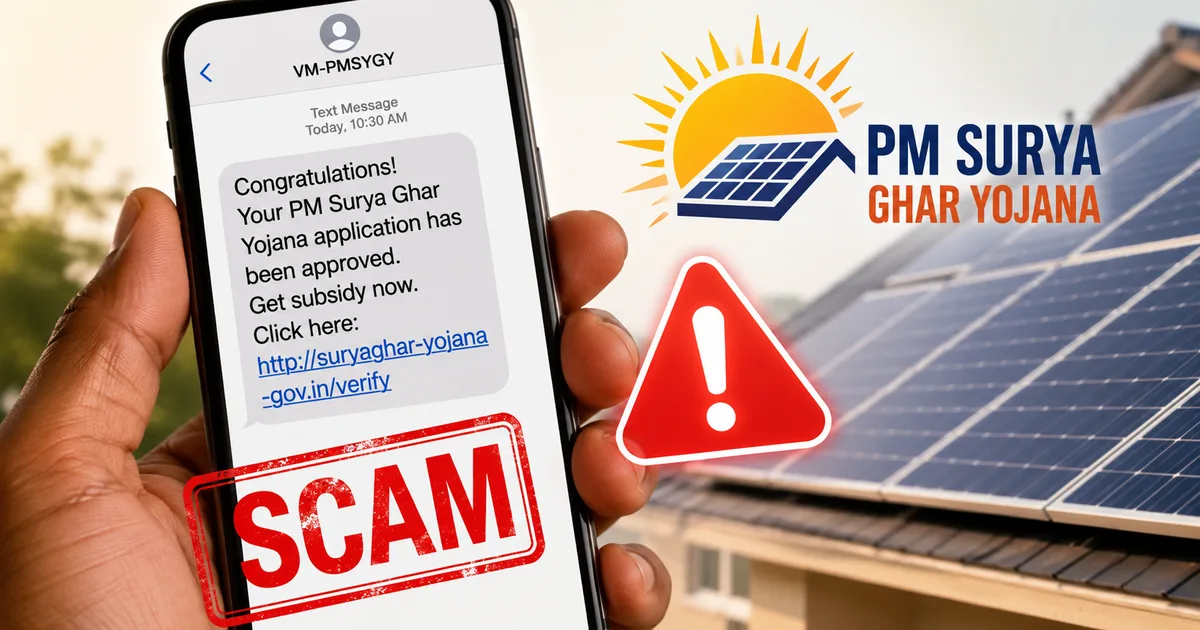
Basically, cybercriminals are sending out bulk text messages and WhatsApp alerts. They pretend to be from the Ministry of New and Renewable Energy. The message usually says something very convincing. It claims your rooftop solar application is approved. And it says your subsidy amount of Rs 78,000 is ready for transfer.
Here's the catch. The message has a link. It tells you to click that link to confirm your bank details. Then they can deposit the money. If you didn't apply for the scheme, you might just ignore it. But millions of Indians are currently registering for solar panels across states like Uttar Pradesh and Maharashtra. So the scammers are playing a numbers game. They know they'll hit thousands of people who are actually waiting for an approval text.
These criminals are smart. They use government logos and exact subsidy figures. That makes the trap look real. They want you to panic just enough to act fast. They want you to think you might lose your place in line if you don't click immediately. You can read more about common online threats in our fraud warning section.
Why scammers are targeting the PM Surya Ghar scheme
You might wonder why they picked this specific government program. Thing is, the payout is large. And the application process takes time.
When you apply for the rooftop solar subsidy, there are multiple steps involved. You have to get feasibility approvals. You hire a registered vendor, and then wait for an inspection. The subsidy is only released after all this is done. Because the process takes several weeks, applicants get anxious. They constantly check their phones for updates. Scammers exploit this waiting period. They know you're expecting a message from the government. So they send you a fake one. In my experience, waiting for government approvals always makes people jumpy.
Many people applying for this scheme are doing so for the first time. They might not know how government digital portals actually work. They might not know that the government never asks for a UPI PIN to send money. This lack of awareness creates a perfect environment for a scam. The numbers here are a bit fuzzy, but a lot of folks fall for it.
How this PM Surya Ghar scam actually works
Understanding the mechanics of this scam is your best defence. The scammers follow a very specific playbook to empty your bank account. Here is the step by step breakdown.
Step 1: The bait message arrives
You get an SMS on your phone. It usually comes from a normal ten digit mobile number. It doesn't come from an official government sender ID. The text will say your PM Surya Ghar application is approved. It creates a sense of urgency. Sometimes they say the funds will expire in 24 hours if you don't claim them.
Step 2: The fake government portal
When you click the link, it opens a website on your browser. This site is a complete clone of the real pmsuryaghar.gov.in portal. It has the Prime Minister's photo and the right colors. But look closely at the URL address bar. It'll be something sketchy like pmsurya-approval-update.in. Or it might be a strange string of letters.
Step 3: Harvesting your personal data
The fake website will ask you to fill out a form. They want your Aadhaar number and your bank account number. (I know, it sounds obviously fake when laid out like this, but in the moment it feels real). They claim this is needed to verify your identity before transferring the subsidy. In reality, they're just collecting your data. This data can later be misused. They might create fake bank accounts or take out loans in your name. If you want to know how to keep your documents safe, check our digital safety guides.
Step 4: The malicious download or OTP request
This is where the actual theft happens. The site might ask you to download a verification app. This app is usually a malicious APK file. If you install it, it gives the scammers full access to your text messages. This means they can read your bank OTPs without you knowing.
Or, the site might ask you to pay a small processing fee of Rs 10 or Rs 50 via UPI to link your bank account. When you enter your UPI PIN, you're actually approving a much larger deduction. Or you're handing over your credentials to the scammer.
Step 5: Your account is emptied
Once they have your OTP or your UPI access, they drain your bank account. They transfer the money to multiple dummy accounts across the country in minutes. By the time you realize the subsidy money isn't coming, your own savings are gone. I'm not sure exactly why banks can't stop these rapid transfers faster, but they don't.
Warning signs you need to watch out for
You've got to stay sharp. The government won't send you a random link asking you to claim money. Here are the biggest red flags that tell you an SMS is a scam.
- Check the sender ID. Official government messages come from specific sender IDs like VD-GOVTIN. They don't come from random personal mobile numbers. If you get an approval message from a regular ten digit number, it's a scam.
- Look at the web address. The only official website for this scheme is pmsuryaghar.gov.in. Nothing else. If the link in the SMS takes you to a site that ends in .xyz, .net, or some complicated variation of the real name, close the tab immediately.
- Watch out for upfront fees. The government doesn't charge you a processing fee to release your subsidy. If a website asks you to pay Rs 50 via UPI to verify your bank account for the solar scheme, you're dealing with criminals.
- Beware of the urgency trick. Scammers always want you to act fast. They'll say your application will be cancelled by midnight if you don't click. The real government process doesn't work like this. They give you proper timelines and official notifications.
How to protect yourself from these fake links
You can keep your money safe. Just follow some basic digital hygiene rules. It isn't difficult. You just need to slow down before you click.
The Ministry of New and Renewable Energy doesn't send out WhatsApp messages or SMS links asking for bank details or UPI payments to process your rooftop solar subsidy. All transactions happen through the official pmsuryaghar.gov.in portal.
First, never click on links in unexpected text messages. If you want to check your PM Surya Ghar application status, open your web browser manually. Type the official website address yourself. Log in with your registered mobile number and check your dashboard. That's the only safe way to see your approval status.
Second, don't install apps from outside the Google Play Store or Apple App Store. The government doesn't force you to download weird APK files from random websites to get your subsidy. If a site asks you to download an app, it's a scam.
Third, read your bank OTP messages carefully. The text usually tells you exactly what the OTP is for. If the message says the OTP is for a transaction of Rs 50,000, stop immediately.
I also suggest keeping up with warnings from CERT-In. They regularly publish alerts about new scams targeting Indian internet users. Staying informed is half the battle (which makes sense, actually). You can also explore our recommended security apps to add an extra layer of protection to your devices.
The broader problem with solar scheme frauds
This SMS scam is just one part of a much larger problem. Criminals are finding all sorts of ways to abuse the PM Surya Ghar initiative.
Authorities recently uncovered a massive fraud in Nagpur. People were actually passing off commercial shops as residential homes. They wanted to grab the government subsidy illegally. In another case, the CBI arrested a bank manager for allegedly taking bribes to approve loans under the solar scheme. It shows how much money is floating around in this sector right now. The government is pushing hard to meet its targets. And the system is under pressure.
This means you've got to be extra careful. Whether it's a fake SMS or a sketchy WhatsApp group offering fast-track approvals, you must verify everything. If someone promises to get your solar subsidy approved faster for a small bribe, walk away. That's not how the system works. If you ask me, looking for shortcuts is how most people get into trouble here.
Where to report these solar subsidy scams
If you get one of these fake approval messages, don't just delete it. You need to report it. Then authorities can take down the sketchy websites and block the phone numbers.
You should report the scam SMS and the link to the National Cyber Crime Reporting Portal at cybercrime.gov.in. They have a specific section for reporting fake links and fake messages.
If you actually clicked the link and lost money, you must act instantly. Call the national cybercrime helpline at 1930 immediately. Don't wait for the next day. The faster you call 1930, the higher the chance they can freeze the stolen funds in the scammer's account before they withdraw it.
After calling the helpline, contact your bank. Tell them your account is compromised. Ask them to block your debit cards and freeze your UPI access. You can always get a new card. But you can't easily get your stolen money back.
We've got a lot of great government schemes in India today. The PM Surya Ghar Yojana is genuinely helping people reduce their power bills. Just handle your applications through the official website. Ignore the noise on your phone.