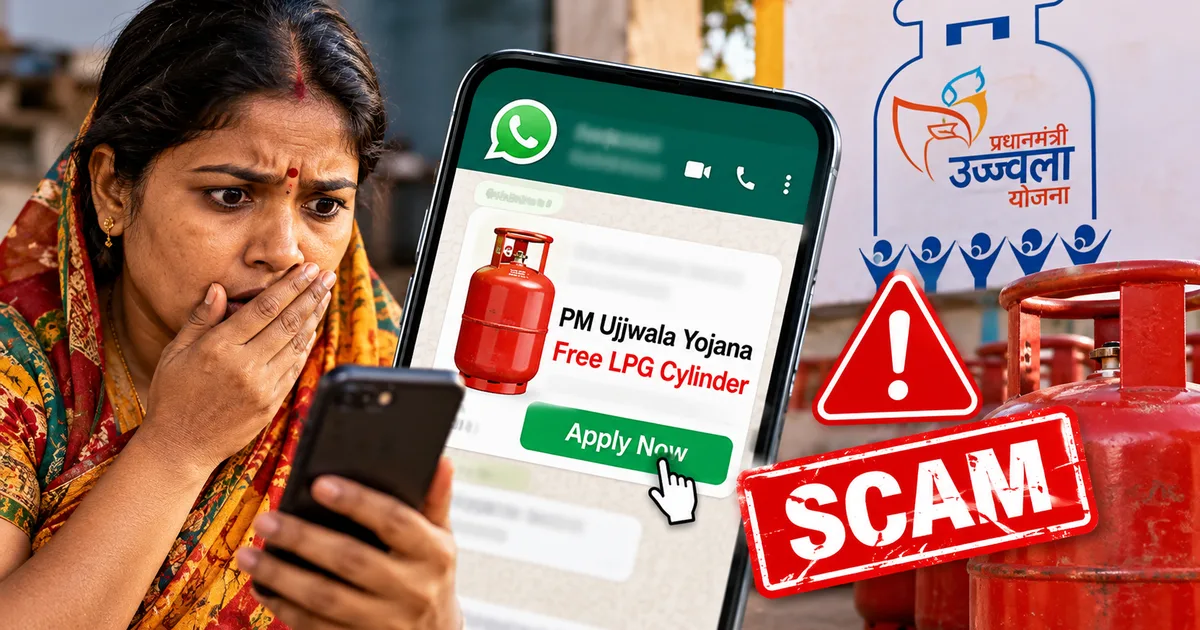
If your family WhatsApp group pinged this morning with a message claiming you can get two free gas cylinders ahead of festival season, don't click that link. The Fake PM Ujjwala Yojana Free LPG Cylinder WhatsApp Scam 2026 is spreading aggressively across Indian chat groups, exploiting recent confusion around mandatory gas agency Aadhaar e-KYC updates and rising household expenses. Fraudsters have paired convincing doctored video clips with deceptive application forms to drain savings accounts, and innocent citizens are losing lakhs within minutes.
I saw one of these forwards in my own neighbourhood society group two days ago. It looked remarkably real at first glance. The message had the official Indian Oil emblem and a picture of the Prime Minister, backed up by a bold promise: fill out an online form to get an immediate subsidy credit of ₹1,600 along with free doorstep cylinder delivery. Look, free cooking gas sounds fantastic when an unsubsidized 14.2 kg domestic LPG cylinder costs upwards of ₹800 in most Indian cities. Who wouldn't want that? But the government simply doesn't hand out welfare benefits through random forwarded links on social media.
Scammers count on rising grocery bills and familiar government logos to mess with people's heads. When folks see neighbours forwarding an offer in a housing society chat, natural skepticism drops fast. (Which makes sense, actually, because nobody expects their own neighbour to forward a trap.)
Honestly, that's why you need to know how this scheme operates before someone at home taps the wrong link and loses real money. I think most people don't realize how quickly a single click can clean out a savings account.
What the fake PM Ujjwala free cylinder offer actually is
The Pradhan Mantri Ujjwala Yojana (PMUY) is a genuine scheme from the Ministry of Petroleum and Natural Gas. It's real. Under the actual program, targeted low-income households get financial help for a deposit-free LPG connection, along with subsidies credited directly through Direct Benefit Transfer (DBT) into Aadhaar-linked bank accounts. Beneficiaries get a ₹300 subsidy per refill on up to 12 cylinders each year. And that money lands straight in their passbook after booking through genuine channels.
In my experience, almost every viral scam starts by hijacking a legitimate welfare program. Fraudsters set up lookalike web portals hosted on sketchy free domains like .top, .live, .xyz, and .site. These fake pages copy the exact branding of Indane, Bharatgas, HP Gas, and Indian Oil. (The logos look identical, which is why people fall for them.) The accompanying WhatsApp texts claim the central government has announced emergency relief distributing free cylinders to every Indian household. Some versions claim the free gas is for festival celebrations, while others blame tensions in global oil markets.
Fact-checking agencies, including Factly and Newschecker, recently debunked viral video clips that showed the Prime Minister supposedly announcing universal free cylinders. The footage was completely fake. It was a manipulated deepfake audio track layered over an old 2019 political rally in Gorakhpur. If you come across sensational announcements like this, check the official PIB Fact Check desk or browse our verified scam alerts and safety guides before believing social media chatter.
Oil marketing companies never distribute subsidized LPG cylinders through WhatsApp links or require third-party Android APK downloads for customer verification.
How the scam works step by step
This fraud isn't a basic spam blast. It's a structured multi-stage attack designed to bypass common sense and compromise Android phones directly.
The viral message and doctored video lure
The attack begins with an unsolicited message sent on WhatsApp or Telegram from unknown mobile numbers. Often, compromised accounts belonging to contacts you already know forward the text automatically. The message uses catchy Hindi or regional phrasing like "Pradhan Mantri Free Gas Cylinder Yojana 2026 Online Registration Open." And it always includes a shortened link that hides the true destination.
To build quick credibility, scammers embed deepfake video snippets or doctored press releases. The visual presentation looks remarkably convincing to senior citizens and homemakers who don't inspect website URLs closely. If you ask me, that's why these links spread so quickly inside family groups.
The phishing registration form
Once you click the link, your mobile browser opens a webpage featuring official government logos and a fake visitor counter showing thousands of people successfully claiming their cylinders. The page asks you to enter personal details:
- Full name and date of birth
- Complete residential address and pin code
- Aadhaar number and linked mobile number
- Current LPG consumer ID and distributor name
- Bank account number and IFSC code
Look at what's happening here. Fraudsters collect your complete identity profile in one single form. That data alone is valuable enough for identity theft and SIM swap fraud.
The malicious APK download trap
After you submit the form, the website doesn't display a simple confirmation slip. Instead, a popup appears stating that your application is 90% complete and requires a mandatory identity verification file. The page prompts you to download a file named something like PM_Ujjwala_Gas_2026.apk or LPG_Subsidy_eKYC.apk.
This is where the real trouble begins. Modern web browsers warn you that APK files downloaded outside Google Play Store can harm your device. But the fake webpage actively instructs users to ignore the security warning and enable "Install from unknown sources" inside device settings.
Once installed, the malicious application asks for broad permissions. It demands access to read SMS messages and control accessibility services. (A total mess for device security, honestly.) Then the malware disguises itself under a bland system icon, or immediately hides itself from your home screen.
Draining your bank account via SMS forwarding
The moment the Trojan gets permission to read SMS, cybercriminals take control of your financial accounts. The background script silently forwards incoming one-time passwords (OTPs) to remote command servers managed by the attackers. Fraudsters initiate unauthorized transactions using UPI or net banking details they gathered from the phishing page.
You never see the bank alert or OTP notification. The malware intercepts and deletes incoming messages before you can read them. By the time you notice missing funds during an evening ATM visit or a UPI balance check, your account is completely drained.
Cybercrime police in Hyderabad recently investigated a case where a victim lost ₹1.95 lakh after installing a fake PM scheme APK, and another resident was duped of ₹4.09 lakh through a similar trap. Honestly, the numbers on total losses nationwide are a bit fuzzy, but Hyderabad police alone handled multiple cases worth lakhs in just a few weeks. Scammers use the exact same playbook across various welfare programs, just like the PM Kisan pension WhatsApp scam targeting rural farmers.
Warning signs of a fraudulent LPG cylinder message
Spotting these fake schemes is straightforward once you recognize the telltale signs of cyber fraud. Government departments follow strict communication protocols that scammers can't replicate.
- The link uses strange web extensions like .xyz, .top, .site, or raw IP addresses rather than official .gov.in or .nic.in domains.
- The message urges immediate action, claiming that only the first 50,000 applicants will receive free cylinders before midnight.
- The webpage requests an upfront processing fee of ₹50 or ₹99 via UPI to process your free cylinder delivery.
- The site asks you to forward the promotional message to ten WhatsApp contacts or five groups to activate your booking.
- The system prompts you to download an APK installation file to complete verification or track your application.
Real public welfare schemes never require chain-forwarding on messaging apps. If you ask me, that viral distribution trick is an unmistakable signature of online fraud, similar to what we tracked with the fake Ladli Behna APK scam circulating earlier this year.
How to protect your bank account and phone
Protecting your household takes digital vigilance and simple practical habits. You don't need an engineering degree to stay safe online.
First and foremost, never download APK files sent through messaging applications or unknown websites. The Indian Computer Emergency Response Team (CERT-In) has repeatedly warned against sideloading unverified Android packages that request SMS and accessibility permissions. If you need to manage your cooking gas connection, rely exclusively on legitimate apps from Google Play Store or Apple App Store, such as IndianOil ONE, HP Pay, Bharat Petroleum Hello BPCL, and official oil company portals. You can also track services using the government UMANG application or DigiLocker.
Second, receiving government subsidies never requires you to enter a UPI PIN or send money. Subsidies under Direct Benefit Transfer move directly into your bank account from the public treasury. If any webpage or caller asks for your UPI PIN or debit card CVV, close it immediately. Legitimate government portals never collect secret transaction codes to disburse benefits.
Third, if you need to complete mandatory LPG e-KYC verification, visit your authorized gas distributor in person with your Aadhaar card and domestic gas passbook. Distributors verify your biometric details through certified point-of-sale machines without charging additional verification fees. (It takes fifteen minutes, tops.) Don't trust random internet links offering quick doorstep e-KYC.
Fourth, educate family members who use smartphones. Elderly parents and young relatives are frequently targeted by scam links because they want to help the household save money. Sit down with them, explain how fraudsters manipulate videos, and bookmark our practical tech guides so they know where to find verified facts. I think having that conversation tonight can save your family a massive headache later.
Where to report cyber fraud and get emergency help
If you or someone you know accidentally downloaded a sketchy APK or clicked a fraudulent link, speed matters immensely. The first few hours determine whether stolen money can be frozen.
If you already installed the malicious app, immediately turn on Airplane Mode to disconnect the device from mobile data and Wi-Fi. This severs the malware connection to the attacker command server. Next, take your SIM card out and insert it into a secondary feature phone or clean handset. Use a separate secure device to log into your net banking portal and immediately freeze all net banking services and UPI IDs.
Next, dial the 1930 cyber fraud helpline without delay. The 1930 helpline connects you directly to the citizen financial cyber fraud reporting system operated by the Ministry of Home Affairs and state police. When you call within two to three hours, often called the golden hour of cybercrime reporting, authorities can coordinate with nodal bank officers to block fraudulent beneficiary accounts before cash gets withdrawn at an ATM or routed through mule wallets. In my experience, calling 1930 immediately gives you the best chance of saving your balance.
Follow up your phone call by filing a formal digital complaint on the National Cyber Crime Reporting Portal at cybercrime.gov.in. Keep all screenshots of the WhatsApp message, the sender phone number, the scam URL, and your bank transaction statement ready. You should also report the fraudulent sender number on the Department of Telecommunications Sanchar Saathi portal under the Chakshu facility, which helps telecom operators disconnect rogue connections across India.
Finally, factory reset your infected smartphone. (Annoying, I know, but completely necessary.) Because spyware embeds deeply within system folders and accessibility hooks, standard antivirus scans often miss hidden background modules. A clean wipe is the only reliable way to ensure malicious code cannot monitor your future banking sessions.