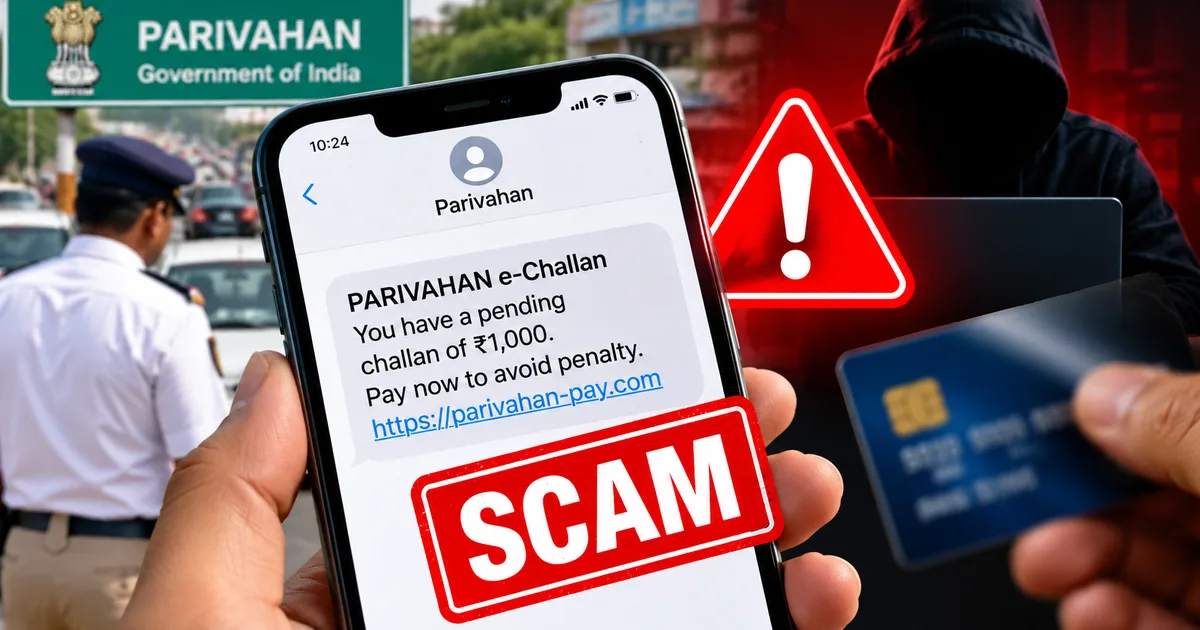
You are sitting at your desk on a busy weekday, and your phone buzzes. The text claims your car jumped a red light and warns that you have a pending fine of ₹1,000. It says you must clear the balance within 24 hours or police will seize your vehicle. If you drive a car or ride a two-wheeler in India, you need to watch out for the fake Parivahan e-challan payment SMS scam that has exploded across the country in 2026.
It's an ugly trap.
Look, nobody likes traffic fines. But when an official-looking text arrives on your phone with a link to pay immediately, fear takes over. You worry about police visits, court summons, or a blocked registration certificate. Scammers bank on that exact panic. Over the past few months, cyber cells across Delhi, Mumbai, Bengaluru, and Chandigarh have logged thousands of complaints from ordinary vehicle owners who lost their hard-earned money. I saw one of these messages on my uncle's phone just last week in Pune, and his heart skipped a beat because he thought his scooter had an active warrant. We regularly track these new digital traps in our scam alerts and safety guides, and this particular campaign is spreading faster than most.
Here's the deal: the text message you received is almost certainly fake, and clicking that link could empty your bank account before you finish your evening chai.
What the fake Parivahan e-challan scam looks like in 2026
The scam starts with a simple SMS or WhatsApp message sent to your mobile number. Fraudsters buy bulk databases of vehicle owners leaked from local garages, insurance aggregators, or unauthorized loan brokers. Sometimes they don't even bother with leaked lists. They just fire millions of automated messages to random Indian phone numbers across major telecom circles like Airtel and Jio.
The message usually reads something like: "Challan No: DL87654321 is pending against your vehicle. Pay ₹1,000 immediately to avoid court proceedings. Visit: echallan-parivahan-gov.in to clear dues."
Notice that domain name? At a quick glance on a five-inch phone screen, it looks totally convincing. It has the words "echallan", "parivahan", and "gov" jammed together. But it isn't a government website. In fact, a Mumbai-based comedian recently flagged this exact ruse after nearly losing his savings. He received a text claiming an unpaid fine of ₹500, clicked the link, and landed on a portal that copied the Ministry of Road Transport and Highways design down to the national emblem and footer links. He hesitated only because the web address looked slightly off (which, for the record, saved him from losing his entire savings).
Panchkula Police issued an advisory pointing out that fraudsters often send these messages late in the evening or early on weekends. During those hours, you can't easily walk into an RTO office or call a local traffic branch to verify anything. Panic sets in, and people pay without thinking.
How the fake traffic challan SMS scam drains bank accounts
Understanding how fraudsters pull this off helps you spot the trap before any damage happens.
The mechanics depend on two different methods that scammers run in parallel:
- First, you get an SMS claiming a traffic violation. The message warns about compounding penalties or impending legal action under the Motor Vehicles Act to make you panic.
- Second, tapping the link sends you to one of two destinations: a phishing website that clones the Parivahan payment portal, or a direct download prompt for a malicious Android package file.
- Third, if you land on the phishing website, it asks for your vehicle registration number and immediately shows a fake pending challan. When you click pay, it prompts for your debit card details, credit card CVV, or net banking user ID and password.
- Fourth, if the link pushes an app download, it installs a background Trojan disguised as a government tool. That app requests SMS permissions the moment you open it.
- Finally, the fraudsters initiate a high-value debit from your bank. The malware intercepts the one-time password sent by your bank and forwards it straight to the fraudster's server, leaving you with zero warning until the debit SMS arrives.
The app variant is particularly dangerous. Greater Kashmir recently reported an alert from the Jammu and Kashmir Crime Branch about rogue APK files circulating on WhatsApp. Fraudsters tell victims that they need to install an app named "Parivahan_Seva.apk" to view camera violation evidence or download their challan receipt. Once you grant permission, the software reads every incoming message.
And that's how people lose ₹50,000 to ₹1,50,000 in minutes. You think you are paying a minor ₹500 parking fine, but you just gave a criminal full access to your banking OTPs. We have documented similar credential-stealing tactics in our report on fake traffic police challan alerts, where cloned payment gateways quietly harvest card numbers.
"Fraudulent text messages impersonating government departments are deploying malicious Android applications to intercept multi-factor authentication codes. Citizens must avoid installing unknown application files received through messaging channels." (CERT-In Advisory)
Warning signs of a fake e-challan payment link
Spotting these fake notices isn't hard once you know what real government traffic alerts look like. Real departments follow strict communication guidelines, while scammers cut corners.
- The message comes from a normal ten-digit mobile number or an international country code instead of an official sender header like TD-VAHAN or VM-ECHALN.
- The web address does not end with gov.in or nic.in, and instead uses commercial extensions like dot-top, dot-in, or dot-xyz.
- The link prompts you to download a file ending in dot-apk onto your Android phone, which genuine government portals never do.
- The notice fails to list your exact vehicle engine number, chassis number, or the specific traffic junction where the camera captured the violation.
- The text uses aggressive threats about immediate vehicle impoundment or police warrants within a few hours to force a rushed payment.
Thing is, fraudsters rely on the fact that most people glance at text messages while commuting or working. They copy the layout of official messages and tweak just one or two letters in the link (I know, it sounds obvious, but panic makes people miss small typos). It's the same trick we warned about regarding India Post delivery SMS fraud, where a single misspelled letter in a web address cost victims thousands of rupees.
Don't fall for the artificial hurry. Traffic police departments in India issue challans under formal procedures. They don't send goons to your house if you don't pay within three hours. You have ample time to verify the record on genuine government portals.
How to safely check and pay genuine traffic challans
If you suspect you might have an unpaid challan, never use the link sent in an SMS or WhatsApp message. Ever.
Instead, verify everything directly through official channels. The Ministry of Road Transport and Highways maintains a centralized database, and checking your status takes less than two minutes.
- Open your mobile or desktop web browser and manually type echallan.parivahan.gov.in into the address bar.
- Click on the Check Challan Status option visible on the main homepage navigation bar.
- Enter your vehicle registration number along with the last five digits of your chassis number or engine number, then submit the captcha code.
- Review the details displayed on screen, including the photographic proof of the violation, the exact date, and the assigned fine amount.
- If a genuine fine exists, proceed to payment through the integrated government payment gateway using your preferred UPI app or debit card.
You can also use the official mParivahan mobile app or DigiLocker, both developed by the National Informatics Centre. When you link your registration certificate inside DigiLocker, any pending challan shows up automatically. No third-party links. No sketchy downloads.
Honestly, bookmarking the official Parivahan website on your phone browser takes ten seconds. It saves you from guessing every time an alert pings your inbox. We cover safe digital verification methods in our step-by-step tech guides, and taking control of where you enter your data is the most reliable habit you can build.
Where to report traffic fine fraud and get help
What if you already tapped the link, entered your bank details, or installed an app?
Act fast. Minutes matter.
First, if an APK file started downloading or installing on your Android phone, turn on airplane mode right away. That cuts off the malware from transmitting your data to remote servers. Go to your phone settings, open the apps menu, look for recently installed apps with generic names like "Challan Service" or "Parivahan Pay", and uninstall them immediately. If the app won't uninstall, restart your phone in safe mode or perform a complete factory reset.
Second, call your bank helpline to freeze your bank account and block your debit card or net banking access. Tell the customer care representative that you shared credentials on a phishing portal. They can disable online transactions to prevent further unauthorized debits.
Third, dial the national cyber financial fraud helpline at 1930 immediately. The Ministry of Home Affairs set up this toll-free helpline to connect state cyber police units with banking nodal officers. When you report fraudulent debits during the first golden hour, authorities can freeze the funds before scammers siphon them through cash-out rings.
Fourth, file a formal complaint online at cybercrime.gov.in. Prepare your evidence before submitting: take clear screenshots of the SMS or WhatsApp message, copy the sender's phone number, record the exact phishing link, and download your bank transaction statement showing the disputed debit.
Finally, you should report the rogue website URL and malicious APK file to CERT-In (https://www.cert-in.org.in/). CERT-In coordinates incident response across India and works with domain registrars to pull fraudulent domains offline. That simple report protects thousands of other vehicle owners from falling into the exact same trap.