I got a message forwarded to me by my uncle yesterday, and honestly, it looked incredibly convincing. It was a warning about a Fake PMJAY Ayushman Bharat 2026 KYC Update WhatsApp Scam. He asked if his health cover was actually suspended. I told him to delete the message immediately. But the fact that he even had to ask shows exactly why this specific scam is spreading so fast across India right now.
Scammers know exactly what they're doing. They're targeting something people desperately rely on, the ₹5 lakh free health insurance cover under the Pradhan Mantri Jan Arogya Yojana. When people think they might lose access to medical care for their family, they panic. And when you panic, you click things you shouldn't. You share OTPs you shouldn't.
The National Health Authority doesn't send random WhatsApp messages threatening to cancel your card. But these scammers are banking on the fact that you don't know that. I think the best way to handle this is to understand their exact process. Let me break down how this scam operates and how you can lock down your bank accounts before it's too late. You can read more about similar issues in our latest tech news section.
What exactly is this Ayushman Bharat KYC scam?
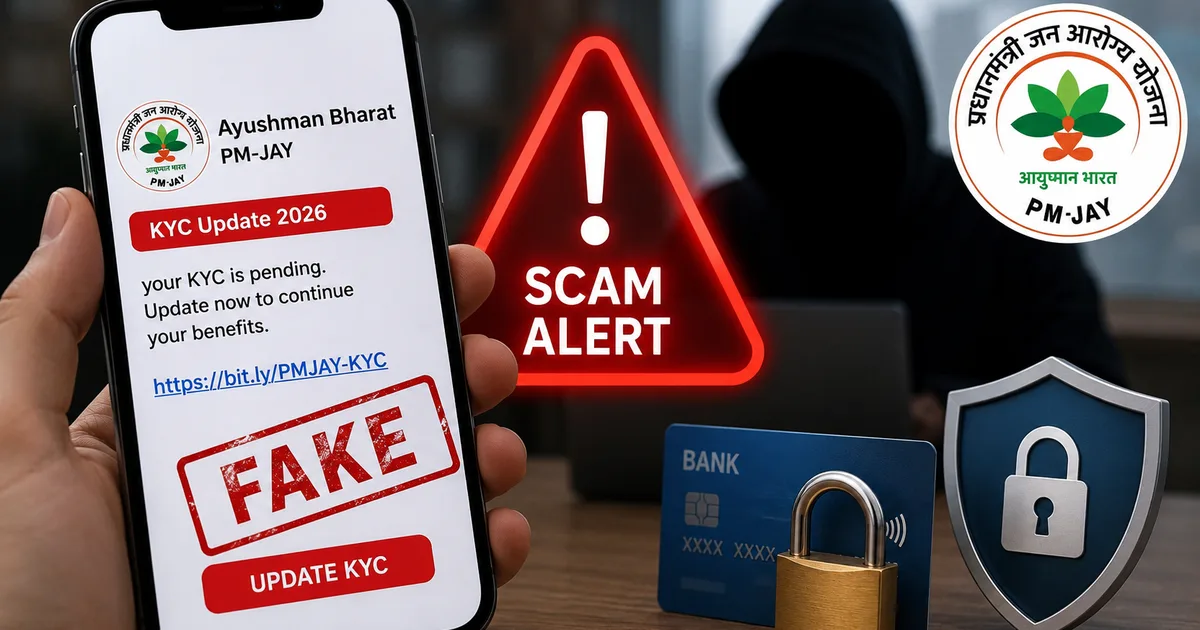
Basically, this is a classic phishing operation wrapped up in a government scheme's branding. Fraudsters are sending out mass WhatsApp blasts claiming that your Ayushman Bharat card is out of date for 2026. They tell you that a mandatory "KYC update" is required immediately. If you don't do it, your family's ₹5 lakh medical coverage will be permanently deactivated.
It usually starts with a message that includes official-looking logos. Sometimes they even include a PDF attachment that looks like a notice from the Ministry of Health and Family Welfare. The message is designed to create absolute panic. Look, if you have an elderly parent who relies on this scheme for their dialysis or heart medication, getting a message saying the cover is gone is terrifying. It's a complete mess.
The goal is simple. They want your money. They don't care about your health insurance. They're using the PMJAY scheme purely as bait to get you to hand over your banking credentials or your UPI PIN.
We saw this same tactic used last year with electricity bill updates. Now they've moved on to healthcare. This is arguably much more sinister (which makes sense, actually, given how people react to medical emergencies). They play on that exact fear.
How the fraud works step by step
Understanding the sequence of events is your best defense here. Scammers follow a very specific playbook. Honestly, once you recognize the steps, you can stop the attack before it causes any damage.
Step 1: the panic-inducing WhatsApp message
You receive a WhatsApp message from an unknown number. The profile picture is usually the Ayushman Bharat logo or the national emblem. The text is written in a mix of Hindi and English. It says your PMJAY eCard is blocked because of incomplete Aadhaar linking or pending 2026 KYC verification. Simple as that.
The message always includes a strict deadline, often saying you have 24 hours to complete the process. This fake urgency is a massive red flag. Real government processes are slow and give you months to update things, while scammers give you hours. They want you acting on adrenaline, not logic.
Step 2: the malicious link or fake APK
This is where things get dangerous. The message will contain a link, and if you tap it, one of two things happens. Sometimes it takes you to a fake website that looks exactly like the official PMJAY portal. They even copy the exact color scheme and fonts.
Other times, and this is becoming much more common, it prompts you to download an Android app package file. They'll call it something like "PMJAY_KYC_Update_2026.apk". Never install apps from random links. If you install that APK, you're giving the scammer full access to your phone.
The app will quietly ask for permissions to read your SMS messages. Bad news. Once they can read your SMS, they can read your bank OTPs. It runs silently in the background, waiting for you to make a financial transaction.
Step 3: the "processing fee" trap
Once you're on the fake site or in the fake app, they ask for your details. They want your Aadhaar number and your phone number. Then comes the final trap. They tell you there is a nominal processing fee for the KYC update. Usually, it's a tiny amount like ₹10 or ₹50.
They ask you to pay this fee using UPI or net banking. When you enter your UPI PIN on their fake payment gateway, the transaction fails. But they just recorded your PIN. And because they have that malicious app reading your SMS, they can now initiate large transfers from your bank account and empty your savings before you even realize what happened.
You think you're paying ₹10 to save your health insurance. You end up losing ₹50,000 to a guy sitting in a scam call center in another state.
Warning signs you should never ignore
- WhatsApp as the first point of contact: Government departments don't initiate official KYC processes through random WhatsApp numbers. If there's a real issue, you'll get an SMS from a verified sender ID (like AD-NHAIND), not a standard 10-digit mobile number.
- Requests to install APK files: Official apps are on the Google Play Store and the Apple App Store. The government will never ask you to download an app directly from a WhatsApp link. If you have to bypass your phone's security settings to install it, it's malware.
- Any request for payment: Ayushman Bharat cards are completely free for eligible beneficiaries. There is no ₹10 KYC fee. There is no processing charge. If anyone asks for money about PMJAY, they are scamming you. You can read more about recognizing these payment patterns in our fraud prevention section.
- Spelling and grammar mistakes: Official government communication goes through multiple checks. Scam messages are often full of typos and weird formatting. They might capitalize random words or use strange phrasing.
- Threats of immediate cancellation: The government doesn't cancel health insurance with 24 hours notice over WhatsApp. That is a pure pressure tactic designed to make you panic.
The real situation with Ayushman Bharat fraud
This isn't just a small problem. The scale of fraud surrounding this scheme is massive, and it goes far beyond WhatsApp messages. We've seen reports of fake hospitals claiming ₹562.4 crore in fraudulent health insurance payouts. The system is under constant attack from bad actors trying to exploit it.
Recently, an investigation uncovered a major fake Ayushman Bharat card scam in Uttar Pradesh and Punjab. Authorities found over 300 fake IDs linked to official State Agency for Comprehensive Health Insurance (SACHIS) accounts. Fraudsters were generating real cards for fake beneficiaries. When the internal systems are being compromised like this, it's easy to see how scammers outside the system can convince everyday people that a random KYC update is suddenly required. The numbers here are a bit fuzzy, but the impact is real.
There was even an absurd case recently in Madhya Pradesh where a man claimed he could open a hospital anywhere and get it empanelled under the Ayushman Bharat scheme for a bribe of ₹1 crore. He claimed to run 17 hospitals himself. The audacity of these criminals is sketchy, honestly.
The government is actually pushing for more digitization to combat some of this. Medical colleges are being asked to link patients' digital health records to their Ayushman Bharat Health Accounts (ABHA). New facilities, like the 81 Ayushman Arogya Mandirs recently launched by the Delhi government, are providing accessible healthcare on the ground. But this rapid push for digital records makes it easier for scammers to confuse people about what is a real digital update and what is a fake one. In my experience, any major tech rollout always brings a wave of new scams with it.
How to protect your family and your bank details
You aren't helpless here. There are concrete steps you can take today to lock down your information and ensure you don't fall for this.
First, verify your eligibility and card status only through official channels. The official website is beneficiaries.nha.gov.in. You can also use the official Ayushman App from the Google Play Store. Don't trust any other website or app. If you're confused, visit a real, physical government hospital or an empanelled private hospital. They have designated Ayushman Mitras who can check your status securely on their verified systems.
Second, secure your phone. Go into your Android settings right now. Search for "Install unknown apps" and make sure no app is allowed to install APKs without your permission. This one setting can save your bank account. Keep your DigiLocker updated with your real documents, so you always know where your authentic records are stored. If you need help with this, check our step-by-step tech guides.
Third, talk to your older relatives. They're the primary targets for this. My uncle almost clicked that link because he was worried about my aunt's upcoming surgery. Sit down with them and show them this article. Explain that no government official will ever ask for their UPI PIN on WhatsApp.
And finally, be very careful about where you share your Aadhaar number. Don't send photos of it to random WhatsApp numbers. If a hospital needs it, provide a masked copy if possible, or only hand it over at the official registration desk.
Where to report this fraud immediately
If you or someone you know has clicked the link or transferred money, you need to act in minutes, not hours. Don't wait to see if the money comes back. It won't.
Call the National Cyber Crime Reporting Portal helpline immediately at 1930. This number works across India. Tell them exactly what happened. They have the ability to freeze bank accounts and stop transactions if you report it quickly enough. Speed is the only thing that matters here.
You must also file a detailed complaint on the official portal at cybercrime.gov.in. Provide screenshots of the WhatsApp messages and any transaction IDs. Don't delete the WhatsApp chat before taking screenshots. You need that evidence to prove the fraud occurred.
If your phone was compromised by an APK, put it in airplane mode immediately to cut off the scammer's access to the internet. Then, use another phone to call your bank and block your UPI and net banking access. Finally, factory reset your compromised phone to wipe the malware completely. It's a hassle, but it's the only way to be sure the app is gone.
The Indian Computer Emergency Response Team (CERT-In) regularly tracks these malicious domains and apps. But they can only take down what they know about. Reporting these scammers doesn't just help you, it helps get their infrastructure taken down before they can steal from someone else. Trust nothing on WhatsApp by default.