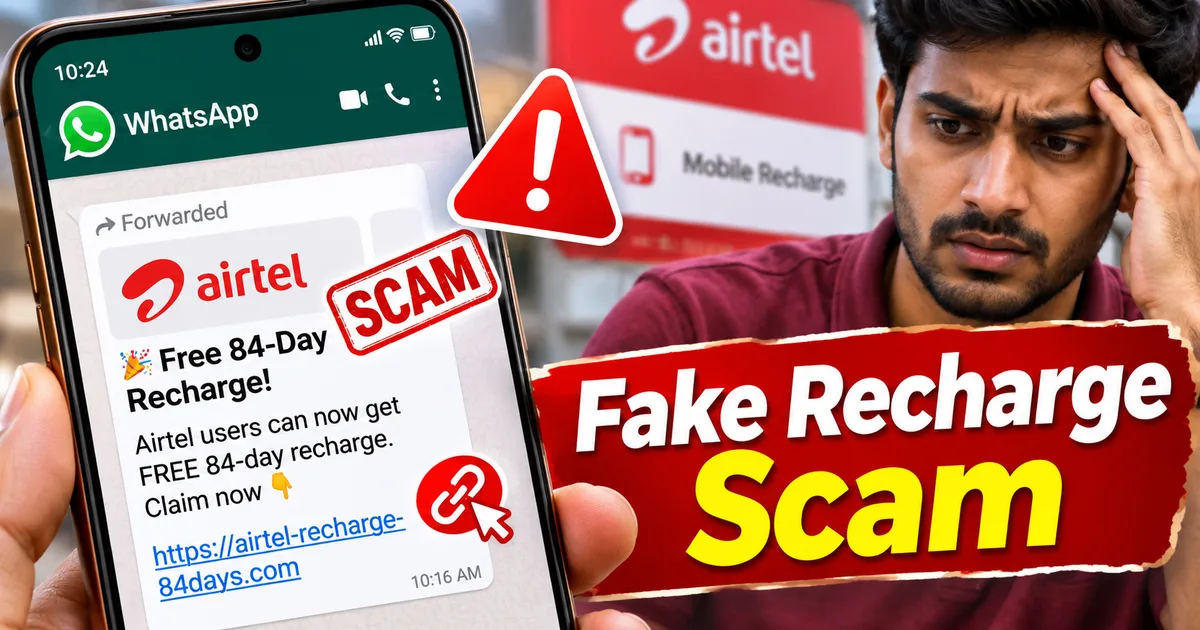
If your family WhatsApp group buzzed this morning with an exciting forward offering three months of unlimited calls and high-speed data for zero rupees, hold your finger. The fake Airtel free 84-day recharge WhatsApp link scam 2026 is spreading aggressively across India right now, targeting people who want relief from recent telecom price hikes. It looks convincing at first glance. But it's an outright trap.
Don't click it.
Just this morning, I saw this message hit two neighborhood chat groups within an hour. Both claimed Bharti Airtel and the central government are giving away 84 days of free recharge with 2GB daily data. It comes with a blue link and a fake countdown timer urging you to claim it before midnight (annoying, but it's complete nonsense). It sounds tempting. After all, Airtel's standard 84-day plan with 1.5GB daily data costs ₹859 in stores, so free data feels like a huge win. If you ask me, that steep price is why folks fall for it. But here's the reality: Airtel never distributes free recharges through WhatsApp forwards or third-party web portals.
Look, everything in that forward is built to trick you. Telecom companies run their promotions through official apps like the Airtel Thanks app or verified SMS sender IDs, never through sketchy shortened links. We track these scams all the time in our scam alerts hub. And this latest wave uses psychological tricks refined over years of festive and political spam campaigns.
What the fake Airtel free recharge message actually claims
The text usually reads like this: 'Central Government and Airtel are offering 84 days of free recharge with unlimited 5G data to all Indian users on the occasion of New Year 2026. Click the link below to activate your free plan before the offer expires today.' Sometimes scammers swap the government angle for an anniversary celebration or a festival bonus. The story shifts constantly.
While the exact words change every few months, the main bait is always identical. Scammers know recharge bills sting. When prices jumped during the last tariff revisions, an 84-day recharge turned into a heavy expense for students, gig workers, delivery drivers, and daily wage earners. Scammers exploit that exact pocketbook pain.
The links in these forwards never point to airtel.in. Instead, they use weird domain extensions like .xyz or .site, or hide behind shorteners like TinyURL and Bitly. When you tap, you don't land on an Airtel server. You land on an ad-heavy phishing page built on cheap hosting. In my experience, almost nobody checks the URL before tapping (and honestly, who can blame them?).
How the fake Airtel 84-day recharge scam traps users step by step
Knowing how this trick works is the easiest way to protect yourself before making a costly mistake. Honestly, the crooks follow a predictable playbook based on social pressure and manufactured panic. It's simple, but it works.
The deceptive landing page
The moment you tap that link, your mobile browser opens a webpage mimicking Airtel's classic red-and-white theme. You'll see copied brand logos alongside fake customer testimonials. Right below them sits an input form asking for your 10-digit mobile number, your telecom circle, your state, and whether your SIM is prepaid or postpaid.
A lot of these sites show a fake progress bar. First, you type your number and tap submit. An animated wheel spins for five seconds while claiming to verify your eligibility on the mobile network. Then boom. A pop-up announces that your number qualifies for the free 84-day pack.
It looks real enough to fool an unsuspecting relative (annoying, I know). Thing is, the page never actually checks whether your number belongs to Airtel. You can enter ten random zeros or a dead landline, and the site still celebrates you as an instant winner. The entire thing is pure theater.
The forced WhatsApp distribution trick
Here's where the scam spreads across India. Right after claiming your recharge is ready, the site locks the button behind a fake rule: you have to share the link with ten friends or five WhatsApp groups to unlock it. It won't let you proceed otherwise.
A green bar sits beneath the button, creeping forward with every forward you send. Once you tap the share button, WhatsApp opens up. You send the link to your family group, and that green bar jumps up twenty percent. It feels like genuine progress.
This viral loop explains why these scams explode across Indian networks. People don't think they're tricking anyone. They genuinely believe they're sharing a great deal with family (which makes sense, actually). By turning regular users into distributors, cybercriminals bypass spam filters and borrow family trust. If your uncle sends a link, you assume he checked it. He didn't. In my experience, that blind trust is the real engine behind WhatsApp fraud.
The dangerous payload and data theft
So what happens once someone finishes sharing the link with ten contacts? Nothing. That promised ₹859 recharge never shows up. Not a single rupee of talktime or megabyte of data ever hits your SIM.
Instead, the webpage dumps you straight onto one of three sketchy paths:
- Downloading rogue APK packages that contain spyware capable of intercepting incoming SMS messages, banking OTPs, and Aadhaar authentication codes.
- Redirecting your browser through shady advertising networks that bombard your phone with intrusive popups, adult content, and deceptive gaming subscriptions.
- Stealing personal identity details like full names, dates of birth, and home addresses to package and sell to illegal call centers and dark web brokers.
This setup is identical to the similar Jio free recharge scam that hit millions of subscribers during earlier tariff adjustments. Scammers just swap the logo and change the colors from red to blue before launching the exact same script on a fresh domain. It's an old trick on a new URL.
Clear warning signs of a WhatsApp recharge fraud
Spotting these fake offers is pretty simple once you know what to look for. Honestly, these scammers are sloppy, and their templates always carry obvious errors that real telecom operators never make. If you ask me, those flaws are easy to spot if you don't rush.
Here are the glaring red flags you should watch out for:
- The website URL does not end in airtel.in: Airtel hosts all legitimate offers and customer promotions strictly on its official domain or within the Airtel Thanks application. If the URL contains strange subdomains, hyphens, or endings like .club or .live, it is fake.
- The page demands social media sharing to claim a benefit: No legitimate telecom company or government department conditions a service on forwarding messages to your contacts. never forward the message to your contacts if a page demands shares to unlock a reward.
- Artificial countdown timers and manufactured pressure: Fake pages feature ticking clocks warning you that the offer ends in four minutes or that only a few recharge slots remain. Real corporate plans don't vanish in five minutes.
- Broken interface elements and stolen images: You will often notice fuzzy logos, typos in Hindi or English, and dummy footer links for terms or privacy policies that lead nowhere when tapped.
- Requests to download unknown APK files: Telecom recharges happen on network servers, not by installing untrusted software packages from unknown browser prompts onto your Android device.
Take a look at this warning from national cybersecurity authorities:
CERT-In regularly cautions mobile users against clicking unverified links circulating on messaging platforms. Fraudulent campaigns promising free recharges, lottery winnings, or government subsidies are common vectors for harvesting personal data and spreading malicious mobile software across Indian networks.
What to do immediately if you clicked the link
If you already tapped that link or typed in your mobile number before realizing something was sketchy, don't panic. Mistakes happen. What matters now is how quickly you act to protect your accounts.
Your next steps depend on how far you went down the rabbit hole:
If you only opened the page and backed out right away, your risk is low. Just head into your mobile browser settings and clear out both your history and website cookies. Also, double-check that you didn't accidentally grant notification permissions to the scam site (which spammers love to abuse).
If you entered your phone number, prepare for a flood of spam calls and phishing texts. Scammers bundle submitted numbers into active lists and sell them on dark web forums or rogue Telegram channels. I'm not sure exactly why those channels stay up so long, but they do. Watch out for messages claiming your bank account or electricity will be suspended.
If you actually downloaded and installed an APK file from that site, your phone is compromised. Act immediately.
- Disconnect your phone from the internet immediately by enabling airplane mode and turning off Wi-Fi to stop background data transfer.
- Open your phone Settings, go to Apps, find the downloaded application, and uninstall it completely. If the app hides its icon, boot your phone into safe mode to remove it.
- Open Google Play Store, tap your profile picture, select Play Protect, and run a thorough security scan of your installed apps.
- Log into your net banking or UPI apps from a separate secure device and change your passwords and transaction PINs immediately.
We cover deeper protection steps in our practical consumer security guides to help you secure banking apps. If you ask me, taking twenty minutes to clean your device now saves weeks of misery later.
Where to report cyber fraud in India
Filing a quick report protects your accounts and helps law enforcement shut down scam networks before other people lose money. Basically, it takes five minutes, and every report adds pressure.
The Indian government has official digital channels set up specifically for reporting telecom fraud and online cybercrime:
- National Cyber Crime Reporting Portal: Visit cybercrime.gov.in to submit a formal complaint detailing the URL, sender phone number, and any financial loss.
- Cybercrime Helpline: If you lost money through an unauthorized UPI transfer or banking transaction, call the national helpline 1930 immediately. Reporting within the golden hour allows authorities to freeze stolen funds before fraudsters route them through mule accounts.
- Department of Telecommunications Chakshu portal: Use the Chakshu facility on the Sanchar Saathi platform to report suspected fraudulent communications received over SMS or WhatsApp.
- In-app WhatsApp reporting: Long-press the fraudulent forward inside WhatsApp, tap the three-dot menu in the upper corner, and select Report. This flags the account to WhatsApp trust and safety systems.
We saw this exact kind of mass reporting knock out networks behind fraudulent government bonus schemes during the last festive season. The numbers here are a bit fuzzy, but when enough people flag a domain on the same day, registrars pull the plug and telecom operators block the link at the gateway level (usually within a few hours). Reporting works.
How Airtel actually announces recharge discounts and plans
Bharti Airtel is a regulated telecom operator running under rules set by the Telecom Regulatory Authority of India (TRAI). Every single change in tariffs, validity periods, data quotas, or plan structures has to be filed with TRAI and published openly on Airtel's official site. Basically, nothing happens in secret.
Whenever Airtel rolls out real promotional data packs or festival validity extensions, you'll always find them in three official places:
- The official Airtel Thanks app downloaded directly from the Google Play Store or Apple App Store.
- The official web portal at airtel.in under the prepaid recharge catalog.
- Authorized local retail counters and payment aggregators like Google Pay, Paytm, and PhonePe with verified merchant integration.
Airtel never uses unsolicited WhatsApp messages from unknown numbers to give out secret discounts. If an offer promises free recharges with zero official confirmation, delete it. And please, tell whoever sent it to stop forwarding it.