If your phone buzzed this morning with a text claiming your package can't reach your doorstep, you're not alone. Not by a long shot. Millions of people across the country are getting messages about a parcel stuck at a regional sorting hub because of missing address details. The Press Information Bureau has issued an urgent warning against this fake India Post parcel delivery SMS scam, confirming that the postal department never sends texts asking people to verify delivery addresses through external websites. It's an outright fraud designed to clean out your bank balance.
Look, I got one of these messages myself on Tuesday. The SMS popped up from a random ten-digit mobile number, claiming my parcel was held at the regional delivery facility because my street name was missing. It gave me a strict twelve-hour window to update my details or have the item sent back. For a split second, I wondered if it was that phone charger I bought on Flipkart over the weekend. That momentary doubt is what scammers bank on.
Here's the deal: India Post is trusted everywhere. They deliver everything from driving licences and passport renewals to court notices and Speed Post parcels across every corner of the country. Most people trust that familiar red and yellow logo without a second thought (which makes sense, honestly). Scammers know that trust runs deep. You can check our latest online scam alerts to see how often phishing gangs impersonate Indian government departments.
"Have you received an SMS stating your package has arrived at the warehouse, asking you to update address details? Beware! This message is fake. India Post never sends such messages asking to update your address for delivering articles. Never click on such fraudulent links." (PIB Fact Check official advisory)
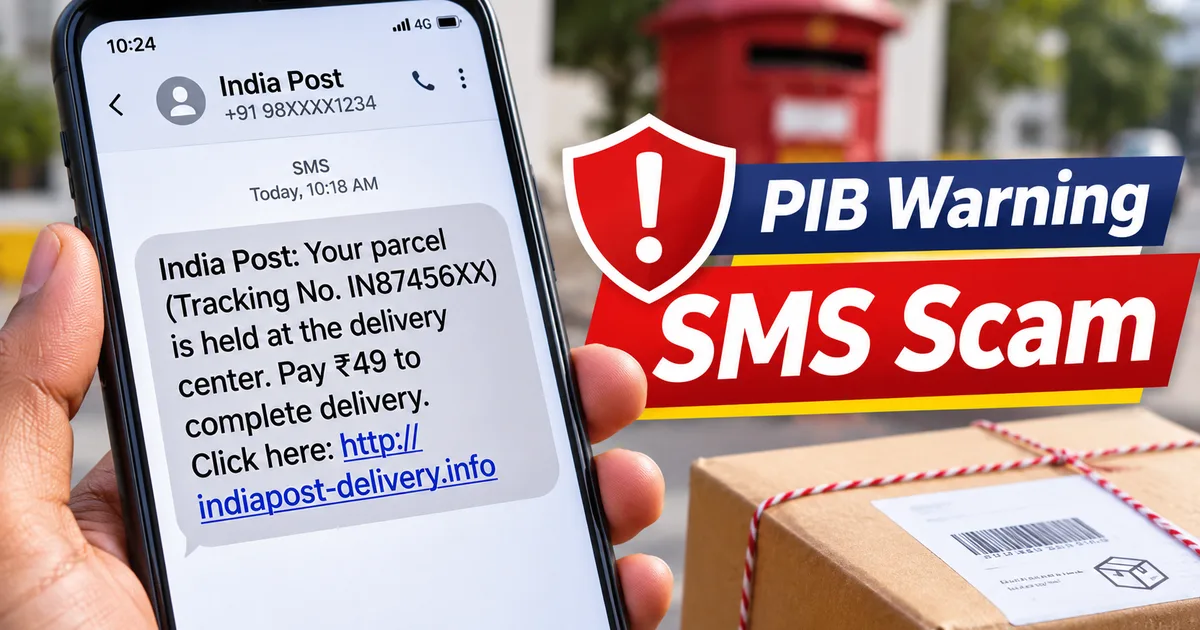
What the fake India Post parcel delivery SMS looks like
These messages follow a very tight script. Scammers rent bulk messaging gateways to blast tens of thousands of automated texts across Indian telecom circles every single hour. The wording changes slightly depending on who runs the operation, but the core setup is always identical.
Here are two common message formats currently circulating:
- "Your package has arrived at the warehouse and we attempted delivery twice but were unable due to incomplete address information. Please update your address details within 48 hours otherwise your package will be returned: https://indiapost-gov-in.one/index"
- "India Post: Your package could not be delivered due to incomplete address information. Please confirm your delivery location within 12 hours at http://iydc.in/u/5c0c5939f"
Look at those web addresses. Neither of them belongs to the Department of Posts. The real India Post website is only at indiapost.gov.in. Scammers buy throwaway domain names that look official at first glance, stuffing words like "indiapost", "gov", "help", and "track" into the link to trick people viewing the text on a phone screen. In my experience, most people tap without checking because the screen is small and the message looks urgent.
And this setup isn't new. It looks almost identical to the fake Blue Dart delivery scam that swept across Indian cities earlier this year. In both cases, criminals rely on the panic of a missed delivery so you forget basic caution.
How the India Post parcel tracking scam actually works
Once you see how this racket works, it's a lot easier to protect your money. Scammers don't care about your actual street address. What they really want is direct access to your bank account and UPI apps. Here's how the entire trap unfolds.
The bait text and fake urgency
The whole operation starts with an automated SMS blast. Scammers don't know who you are. Nor do they know whether you actually ordered anything online. It's just a pure numbers game.
If a criminal syndicate blasts 100,000 text messages across Mumbai, Delhi, Bengaluru, or Kolkata, several thousand recipients are bound to be waiting for an actual delivery. Some are expecting a replacement debit card from SBI or HDFC. Others are tracking a Speed Post document from a government office. Slapping an aggressive twelve-hour or forty-eight-hour countdown on the message forces a quick emotional reaction. And when people rush, they don't stop to examine the sender address or inspect the link.
The clone website and data theft
Thing is, clicking that link opens a clone website that looks shockingly real. If you ask me, the clone design is what fools most people. The scammers copy the official India Post layout, with the postal emblem, official government banners, familiar color schemes, and even a mock consignment tracking bar showing your package marked as "delivery failed".
The page instructs you to re-enter your delivery information. You're asked for your full name, father's name, residential address, pin code, and registered mobile phone number. (Sounds harmless on the surface, but it's a huge privacy trap). Once you submit that form, the scammers get a complete personal profile to store for future identity fraud.
We saw this exact data-harvesting playbook in the India Post recruitment scam. Phony job portals there collected applicant credentials under the very same pretext.
The small fee trap that drains your account
Once you submit your updated address, the spoofed site hits you with a fee request. It claims you must pay a token redelivery charge of ₹25 or ₹48 to reschedule dispatch. Honestly, this is where most victims get caught.
If the fraudsters demanded ₹10,000 upfront, anyone would spot the scam and close the tab immediately. But ₹25 feels harmless. It sounds like a routine postal convenience fee. So people willingly pull out their debit card or open their payment screen.
That payment page is completely fake. The moment you type your 16-digit debit card number, expiry date, cardholder name, and CVV, the attackers intercept those credentials instantly. Behind the scenes, their automated script initiates an unauthorized payment for ₹25,000 or ₹50,000 on an e-commerce platform, a crypto exchange, an online gaming wallet, or a gift card portal.
A bank OTP arrives on your phone. Because you're expecting to authorize a ₹25 charge, you might glance at the six-digit code and punch it in without reading the actual rupee amount written in the SMS text. You hit submit. And in seconds, your savings vanish.
And there's another nasty twist. Security researchers at CyberPeace Foundation discovered that some versions of this site push a background APK download on Android phones. That hidden malware asks for SMS reading permissions, letting the scammers steal your banking OTPs silently without alerting you at all.
Clear warning signs in the fake India Post message
Spotting these fake parcel alerts is straightforward once you know what to look for. In my experience, scammers always slip up on the technical details because genuine communication from the postal department follows strict government rules.
- The SMS comes from an ordinary 10-digit mobile number or an international country code like +1 or +44, never from registered government headers such as "GV-IPOST" or "AD-DOP".
- The link points to domains ending in .one, .top, .xyz, or generic URL shorteners, rather than the authentic government domain indiapost.gov.in.
- The message demands a fee or card payment to correct an address. Real postal staff never charge online fees to fix an address for an article already in transit.
- The text threatens that your parcel will be returned, returned to sender, or destroyed within a short 12 or 24-hour window.
- The message doesn't include a genuine 13-character tracking number (like EM123456789IN) that you can look up on the official website.
How to protect your bank account and UPI apps
Protecting your money from these phishing attacks comes down to a few basic habits. You don't need to be a cybersecurity specialist to keep your hard-earned cash safe.
First of all, India Post never asks you to update address details by clicking external links. Never. If you get a text claiming your parcel is stuck, simply delete it. Don't click the link out of curiosity. And don't reply with "STOP" or call the sender number back, because answering only tells scammers your phone number is active.
If you're actually expecting a Speed Post parcel or official document, verify it the safe way. Open your phone browser, go to indiapost.gov.in directly, and manually type the consignment number you received from the sender when the parcel was dispatched. If the tracking status shows a delivery issue, walk over to your local post office with your ID card and ask the counter staff directly. They can verify it on the spot.
Whenever you're asked to make an online payment, never enter your debit card details or UPI PIN on any unverified webpage. If you ask me, this is where caution matters most. Entering a UPI PIN always deducts money from your account; it's never used to receive funds or reschedule deliveries. Read our practical digital security guides for step-by-step walkthroughs on locking your UPI transactions and setting daily debit limits.
Where to report parcel delivery fraud in India
If you already clicked a link and shared your card numbers or OTP, every second counts. Don't panic. Acting quickly can stop stolen funds from being moved through mule accounts or withdrawn at ATMs.
Take these emergency actions right away:
- Open your mobile banking app or net banking portal and immediately block your debit or credit card. Major banks like SBI, HDFC, ICICI, and Axis allow instantaneous card freezing through their apps.
- If you entered your UPI PIN on a suspicious portal, reset your UPI PIN immediately inside Google Pay, PhonePe, or Paytm, or turn off UPI transactions in your bank settings.
- Dial the national cybercrime helpline and call 1930 immediately. The 1930 helpline connects you directly to the citizen financial cyber fraud reporting system. If you report the incident during the golden hour (the first two hours after money is debited), nodal bank officers can freeze the money before the criminals siphon it away.
- Lodge a detailed complaint on the National Cyber Crime Reporting Portal at cybercrime.gov.in. Attach screenshots of the SMS, the phishing website link, and your bank debit alert.
- Report the fraudulent web domain to the Indian Computer Emergency Response Team (CERT-In) at incident@cert-in.org.in. CERT-In coordinates with domain registrars and internet providers to pull down phishing servers.
You can also forward spam SMS messages to the Department of Telecommunications reporting facility Chakshu on the Sanchar Saathi portal, or report them to your telecom provider by texting 1909. Honestly, the numbers here are a bit fuzzy because so many victims never report small attempted thefts. But I think sharing this alert with your family group on WhatsApp can save someone's hard-earned savings from walking out the door.