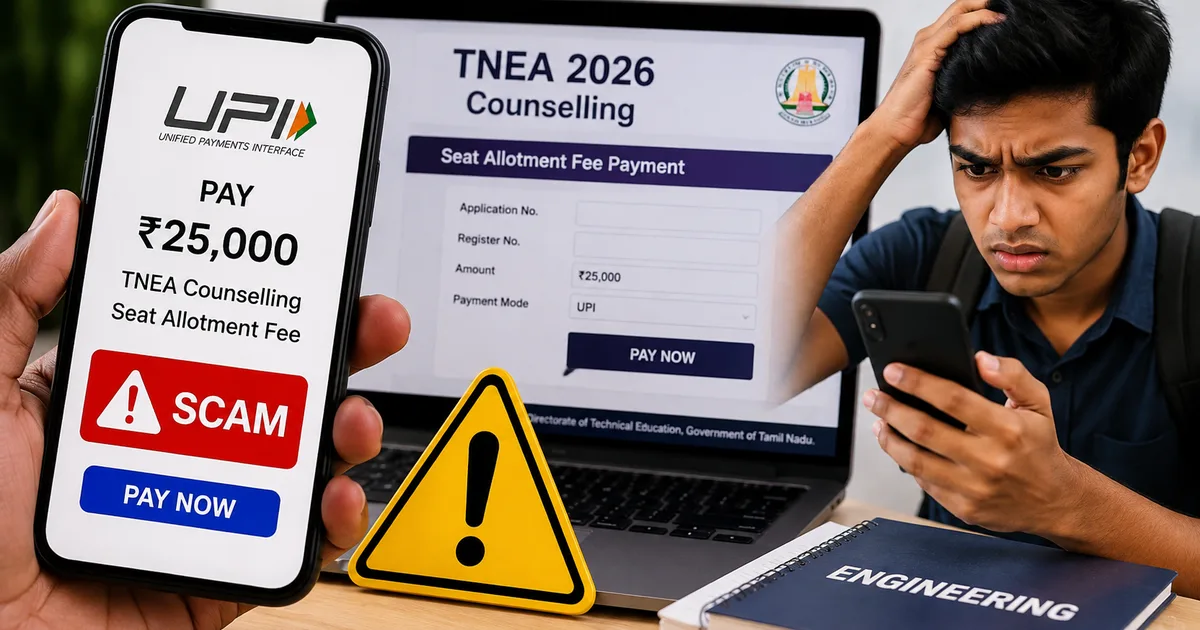
Listen, the pressure of getting into a good engineering college is bad enough without scammers trying to rob you blind. Right now, there is a nasty fake TNEA counselling 2026 seat allotment fee UPI scam running wild across Tamil Nadu, and it's catching a lot of anxious parents and students off guard. I get it. You've been waiting for weeks to see if you got that Anna University affiliated college, and suddenly you get a message saying your seat is confirmed but you need to pay a fee immediately to lock it in. Panic sets in, you click the link, and just like that, your bank account is empty.
Honestly, this is one of the more cruel frauds out there. Over 35,000 students received their tentative allotments in the first round of TNEA 2026 counselling recently. Scammers know this. They know the dates and the anxiety. And they are exploiting it perfectly. They prey on the fear of missing out, the terror that if you don't act in the next ten minutes, you'll lose your spot at a top college and end up nowhere. It's a psychological game. Sadly, they are winning too often.
What exactly is the TNEA seat allotment fee scam
Basically, criminals are sending targeted SMS and WhatsApp messages to students who registered for the Tamil Nadu Engineering Admissions (TNEA). The message usually looks incredibly official. It claims that a seat has been allotted to you in a top-tier college, perhaps even one of the highly sought-after government colleges. Then it says you must pay a "seat confirmation fee" or "counselling processing fee" within the next few hours.
Thing is, the Directorate of Technical Education (DoTE) doesn't ask for random UPI payments via SMS to confirm seats. The entire process is through the official tneaonline.org portal. But when a stressed student sees a message threatening that they'll lose their hard-earned seat if they don't pay INR 5,000 right now, they often don't stop to double-check. They just want the nightmare of admissions to be over.
This isn't just a random phishing attempt. It's highly targeted. The scammers somehow have access to phone numbers of students who actually applied for engineering colleges. (I know, sounds complicated, but it's not. Data gets leaked or sold all the time. Sometimes it's from a shady coaching center, or a compromised database.) Armed with your name and phone number, the message feels legitimate. I think this level of detail is what makes it so convincing.
How the fraud actually works
The mechanics of this scam are sketchy but simple. Scammers don't need to hack your phone, because they just need to hack your judgment. Here is the step-by-step breakdown of how these criminals steal your money:
- The hook: You receive an SMS or WhatsApp message with an urgent tone. It might say something like: "TNEA 2026: Seat tentatively allotted at [College Name]. Pay INR 10,000 confirmation fee via this link before 5 PM today or your allotment will be cancelled."
- The fake portal: You click the link out of sheer panic. It takes you to a website that looks exactly like the official TNEA portal. They rip the logos, the colors, the fonts, everything. It looks like the real deal.
- The payment gateway: The site prompts you to pay using UPI, credit card, or net banking. Most students choose UPI because it's fast and everyone in India uses it daily.
- The theft: You enter your UPI PIN. The money leaves your account. Sometimes, they even ask you to enter an OTP they sent to your phone, which actually authorizes a much larger deduction from your linked bank account, or sets up a recurring mandate.
- The silence: You get a fake PDF receipt. It might even have a barcode on it to look authentic. When you log into the real TNEA portal later to check your status, you realize no fee was ever recorded and your seat is still pending confirmation. The money is gone.
And worst of all, trying to get that money back from a fraudulent UPI transfer is a massive headache. The funds move through five different mule accounts before you even finish dialing your bank's customer care number. It's a complete mess.
Clear warning signs you shouldn't ignore
You can spot this scam from a mile away if you know what to look for. The problem is, anxiety makes us blind to the red flags. If you see any of these, stop immediately. Take a breath.
- Urgent deadlines via text: The official authorities give you days to confirm your tentative allotment, and they communicate the exact dates well in advance on their website and in the newspapers. They don't send you a text at 2 PM giving you a 5 PM deadline on the same day.
- Suspicious links: Look closely at the URL. Is it exactly tneaonline.org? Or is it something like tnea-seat-confirm2026.com, tnea-gov.in.net, or a random bit.ly link? Never click shortened URLs for official government business.
- Asking for UPI directly: The official portal uses a secure payment gateway integrated directly into your login dashboard. You have to log in with your application number and password first. If a link takes you straight to a payment page without requiring a proper login, it's a scam.
- Grammar mistakes: Often, the SMS will have weird capitalization, spelling errors, or poor English. Official government communications are usually proofread. If the message says "kindly pay fee to confirm ur seat," it's fake.
CERT-In has repeatedly warned Indian internet users about these seasonal exam and admission scams. When a major national or state exam happens, scammers set up fake websites within hours to trap confused students.
How to protect yourself and your money
Look, I've seen too many families lose their hard-earned savings to these digital thugs. The money you saved for tuition shouldn't go to some criminal's crypto wallet. So here is what you need to do to keep your money safe during the counselling process.
First and foremost, only use the official website. Bookmark tneaonline.org on your laptop and your phone. If you need to check your random number or your tentative allotment, open your browser, click your bookmark, log in, and check it there. Never rely on a link sent via WhatsApp. I don't care if the sender name says "TNEA Admin" or has the official logo as their display picture. Sender IDs and WhatsApp profiles can be spoofed easily.
Second, talk to your parents. Scammers often target parents directly because they are the ones holding the purse strings. They might not be as tech-savvy. Warn them that no fee should be paid unless you are sitting together, logged into the official desktop site. Tell them to ignore any calls from people claiming to be "counselling agents" offering to guarantee a seat for a small bribe or fee.
Third, verify the communication. If you are ever in doubt, you can find the official helpline numbers on the real TNEA website. Call them. Yes, the lines might be busy. But waiting 20 minutes on hold is infinitely better than losing INR 50,000 and still not having a college seat.
If you're looking for more general advice on staying safe online, check out our other scam alerts. You might also want to read our guides on digital hygiene and our latest explainers on how UPI frauds are evolving. We update them constantly.
What to do if you already paid the scammers
If you fell for it, take a deep breath. It happens to smart people every single day because these scams are designed by professionals. But you need to act fast. Don't feel embarrassed and hide it from your family. Every minute counts when dealing with UPI fraud. The longer you wait, the further your money travels across the banking system.
Call 1930 immediately. This is the National Cyber Crime Reporting Portal helpline. Tell them exactly what happened. Give them the transaction ID and the phone number that sent you the link.
Next, file a formal complaint online at cybercrime.gov.in. This is absolutely required. Your bank will need the acknowledgement number from this portal to even begin investigating your claim and trying to reverse the transaction. (Which makes sense, actually.)
Finally, contact your bank. Call their fraud department and tell them you've been a victim of a UPI scam. Sometimes, if you report it quickly enough, they can put a freeze on the recipient's account before the criminals withdraw the cash or transfer it to another bank.
And secure your documents. If you uploaded your Aadhaar card or 10th mark sheet to the fake website while trying to "confirm" your seat, you need to be careful about identity theft. Scammers use these documents to open fake bank accounts. Consider locking your Aadhaar biometrics via the official UIDAI app or website just to be safe. And always fetch your official documents directly from DigiLocker instead of trusting random third-party apps.
Why engineering admissions are a prime target
You might be wondering why scammers focus so heavily on engineering admissions in Tamil Nadu specifically. The answer is simple. Scale and desperation. Tamil Nadu has one of the largest numbers of engineering colleges in India. Every year, lakhs of students apply. The competition for the top-tier government and government-aided colleges is fierce. When the stakes are this high, people get desperate.
In my experience, scammers know that parents are willing to drain their life savings to secure a good future for their children. They exploit this emotional blind spot. They know that a parent who might usually scrutinize a random text message will suddenly throw caution to the wind if they think it means their kid gets into Anna University. They use the confusing nature of the multi-round counselling process against you.
With round after round of tentative allotments and confirmation deadlines, the process can get overwhelming. Students are constantly refreshing their browsers. They are waiting for updates. When a message arrives that sounds like an official update, it bypasses our normal critical thinking filters. We just want to get it over with and celebrate. That tiny window of relief is exactly when the scammers strike. The numbers here are a bit fuzzy, but the success rate for these criminals is definitely high.
The bigger picture on admission frauds
It's honestly infuriating how these scammers operate. They prey on the dreams of young students. The authorities have cracked down on fake engineering colleges in the past. (Recently it came out that half of TN engineering colleges used fake faculty for affiliation.) But the digital scammers are much harder to catch because they hide behind fake SIM cards and rented bank accounts.
The transition to online counselling was supposed to make things easier and more transparent for everyone. And for the most part, it has. You don't have to travel to Chennai and stand in line for days anymore. But it has also opened the door to digital fraud that targets people in their most vulnerable moments.
Just remember, no legitimate educational institution operates through high-pressure WhatsApp messages or random SMS links demanding instant payment. Stay calm. Verify everything on the official portal. And keep your UPI PIN to yourself. Your college seat is waiting for you. Just make sure you pay the real authorities when the time actually comes.
Be smart and stay alert. Double check every URL. And don't let these criminals ruin what should be a proud moment for you and your family.