You've been checking the official website every morning. I get it. The wait for the UGC NET June 2026 response sheet has been nerve-wracking since the exam wrapped up on June 30. But scammers know you're anxious. And they're using that against you.
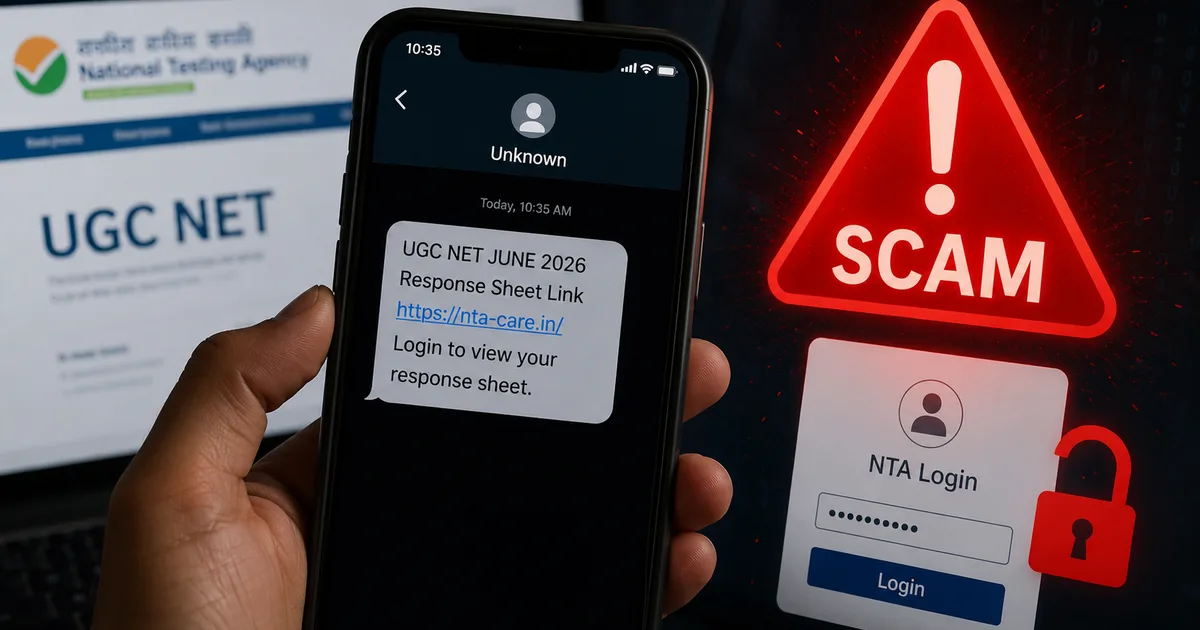
Thousands of candidates across India are getting fake SMS messages right now. WhatsApp texts too, all claiming their answer keys are ready. These messages look incredibly real. They even slap the National Testing Agency (NTA) logo on the websites they link to. Basically, if you click that link and enter your details, you hand your NTA login right to cybercriminals. And maybe your bank details.
The anxiety is high for everyone. NDTV and Times of India are reporting the provisional answer key is expected tomorrow or the day after. But until you see the link live on the actual NTA domain, you need to be very careful.
Let's break down exactly what this scam is. And I'll show you how to keep your money safe.
What exactly is the UGC NET June 2026 SMS scam?
It's a classic phishing attack. It's timed perfectly to hit you when you're stressed. Recent news reports say the provisional answer key is expected soon. Fraudsters read the exact same news we do. They know 87 subjects were tested. Hundreds of thousands of students are hitting refresh on their browsers every single hour.
So they cast a massive net. They buy leaked databases of student numbers and send out bulk texts. The messages usually say something like: "Dear Candidate, your UGC NET June 2026 provisional answer key and response sheet are now live. Click here to download and raise objections: [fake link]."
The link might look real at first glance. Maybe it says "ugcnet-nta-nic.in". Or maybe "nta-results-2026.com" instead of the actual official URL with dots. Look, if you're checking your phone half-asleep, you probably won't notice the difference. I know I wouldn't.
You tap that link and it takes you to a landing page. It's a carbon copy of the real NTA login screen. It asks for your application number and password. Sometimes it wants your Aadhaar number or DigiLocker PIN. The moment you hit submit, the scammers capture your information.
How the fake response sheet fraud works: step by step
I want to walk you through how they drain your bank account. Stealing your exam login is usually just step one. Fraudsters have turned this whole thing into a very sophisticated operation (which is terrifying, honestly). Here's how it happens.
Step 1: The initial phishing link
You get the text message. It might come from a sender ID that says "NTA-UGC" or "GOV-SMS". SMS spoofing is cheap. It's easy for scammers to set up. They use bulk messaging to blast these texts to millions of numbers. They're just hoping some of them belong to actual UGC NET candidates.
Step 2: Harvesting your details
You log into the fake portal. The scammers now have your application number and password. Sometimes the fake site asks for more details to verify your identity. They might ask for your PAN card or Aadhaar details. This is pure identity theft. With your Aadhaar and PAN, they try to open fake bank accounts in your name. Or they apply for loans.
Step 3: The fake objection fee
This is where they actually make their money right away. The NTA charges a fee for every question you want to challenge in the provisional answer key. It's usually around INR 200. The fake website shows you a bogus response sheet. It'll definitely have wrong answers just to make you want to raise an objection.
You go to pay the objection fee. The site redirects you to a sketchy payment gateway. They'll ask you to pay via UPI or enter your debit card details. If you use UPI, they might send a payment request for INR 20,000 instead of INR 200. They hope you just enter your UPI PIN without reading the amount. If you type in your card details, they steal the card info and grab the OTP.
Step 4: Secondary extortion
Sometimes they skip the fake payment gateway entirely. They have your phone number and application details now. So they call you directly. They pretend to be NTA officials. They claim there's a discrepancy in your application. They say your results will be withheld unless you pay a fine. It sounds absolutely absurd. But logic often takes a back seat when you're panicked about your career.
"Fraudsters often use high-stress situations, like exam result days, to bypass your logical thinking. Always verify links through the official homepage."
Why the 2026 UGC NET delay is fueling scams
It's been almost a month since the exam ended on June 30. Students are getting very restless. Candidates have even taken to social media. They're begging the NTA to release the answer keys quickly. When there's no information, scammers rush in. They love an information vacuum.
They know you've been waiting for weeks. You're way more likely to click a link that promises immediate answers. You might be worried about missing the short window to challenge incorrect questions. I'm not sure exactly why the NTA takes so long, but fraudsters use this exact psychological pressure. They want you to think, "If I don't click this now, I might lose my chance to object."
But the NTA will give clear official notice when the real keys are out. They won't just silently drop a link in a random text message. They publish public notices on their site. And they alert major news outlets.
Warning signs of a fake NTA SMS
You need to know how to spot these fakes. The official NTA communications are pretty standard. They rarely deviate from their set format. Here are the red flags to watch out for.
- Check the URL carefully. The only official website for this exam is ugcnet.nta.nic.in. If the link in the SMS has typos, uses a .com extension, or has hyphens instead of dots, it's a scam.
- Watch out for fake urgency in the text. Scammers want you to act fast. If the message says "Link expires in 2 hours" or "Download immediately to avoid cancellation," be highly suspicious. The NTA gives candidates a window of two to three days to raise objections.
- Never give out weird information. The official portal will never ask for your UPI PIN or your debit card CVV just to log in. They only need your application number and password or date of birth.
- Read the message for grammar mistakes. Poor spelling or weird formatting is a dead giveaway. Government messages are usually formal and proofread.
- Ignore direct WhatsApp messages. The NTA doesn't send official response sheets or answer keys via WhatsApp. If you get a PDF on WhatsApp claiming to be the official answer key with a link to pay objection fees, block the sender immediately. You can read more about common messaging frauds in our scam alerts section.
How to protect your NTA login and personal details
Look, the internet is full of traps. But you don't have to be a victim. Taking a few simple precautions will keep your data and your money safe.
First, never click on links in unexpected text messages. Just don't do it. If you get an SMS saying the response sheet is out, open your browser and manually type in ugcnet.nta.nic.in. Better yet, bookmark the official page right now. Then you don't have to search for it later.
Second, don't share your application number on public forums. Scammers hang out in Telegram groups looking for targets. I see students posting screenshots of their admit cards all the time (annoying, I know). They completely forget to blur out their details. Don't do that. Your application number is private.
Third, turn on SMS alerts for your bank account. If someone tries to start a transaction, you want to know instantly. If you're raising a legitimate objection on the real website, double-check the amount on the UPI mandate screen before entering your PIN. Scammers often slip in an extra zero.
For more advice on securing your digital life, check out our latest digital safety guides. Or read our detailed explainers on cybersecurity.
Where to report this fraud in India
If you clicked the link and entered your details, you need to act fast. Don't panic. But definitely don't wait around either.
If you only gave them your NTA login details, go to the official website immediately. Change your password. Do it from a different device if possible. This helps just in case you downloaded a malicious APK file by accident on your phone.
If you lost money or shared your bank details, here's exactly what you need to do:
- Call 1930 immediately. This is the national cybercrime helpline in India. It's run by the Ministry of Home Affairs. If you call them fast enough (usually within an hour or two), they can sometimes freeze the scammers' bank accounts and stop the transaction.
- File a complaint online. Go to the National Cyber Crime Reporting Portal at cybercrime.gov.in. You'll need a mobile number to register and file a detailed report. Keep screenshots of the fake SMS and the fake website as evidence.
- Contact your bank. Call your bank's customer care and block your debit card or disable your UPI ID. Tell them it was a fraudulent transaction. Ask them to reverse the charge if it was done via a credit card.
- Update your passwords. If you use the same password for your NTA login and your email or banking apps, change all of them right away. Use a password manager if you can't remember them all.
The Indian Computer Emergency Response Team (CERT-In) has repeatedly warned about phishing attacks targeting Indian internet users. They track these mass SMS campaigns. Reporting the scam helps them take down the fake websites faster. That protects other students from falling for the exact same trick.
The bottom line
The wait for the UGC NET June 2026 results is tough. The NTA has 87 subjects to process. The delay is making everyone a mess. But don't let that anxiety cost you your savings.
Trust only the official website. Ignore the noise on Telegram and the random texts on your phone. The real response sheet will be announced properly. You'll have plenty of time to check your answers and raise objections.