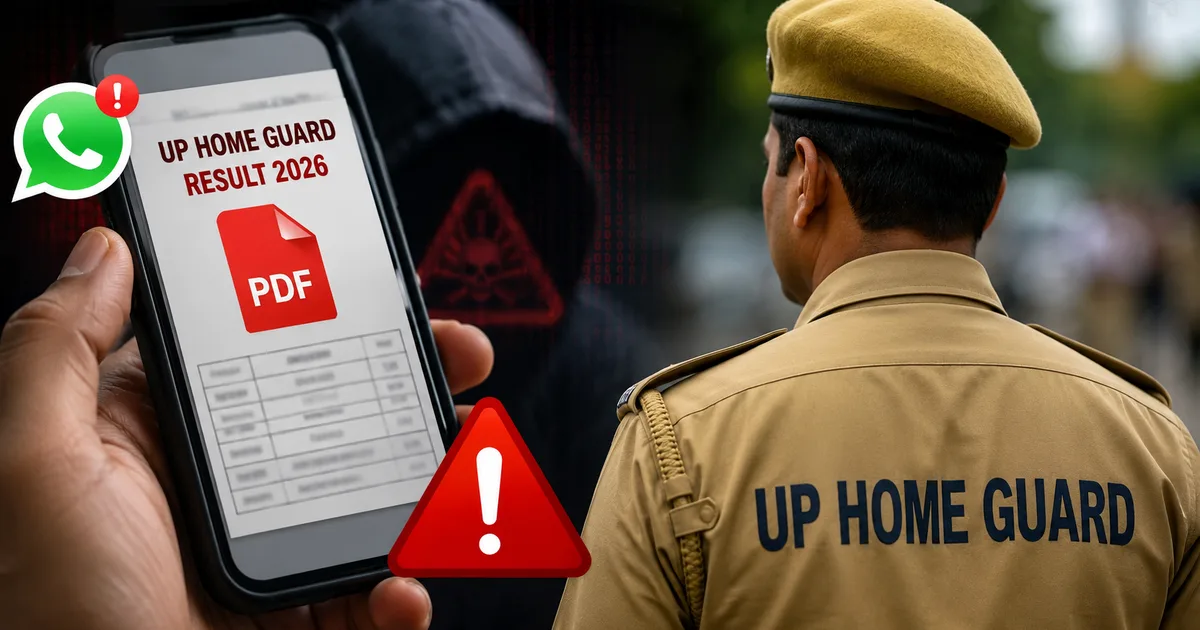
Look, I know how stressful it is waiting for exam results. You've prepared for months. You gave the UP Home Guard exam back in April, and now you're just refreshing pages hoping for an update. Scammers know this exactly. And right now, there's a highly dangerous fake UP Home Guard Result 2026 PDF circulating on WhatsApp groups that isn't a result sheet at all. It's malware. Complete malware designed to hijack your phone.
Honestly, this is one of the more convincing traps I've seen this year. The timing is a mess. The Uttar Pradesh Police Recruitment and Promotion Board (UPPRPB) is reviewing objections right now, and they're preparing to release the real results soon on uppbpb.gov.in. People are obviously expecting a PDF. So when someone drops a file named something like UP-HomeGuard-Result-MeritList-2026.apk into a Telegram or WhatsApp group, thousands of anxious candidates tap it without thinking twice.
I've spoken to people who fell for similar tricks recently. The panic is identical. Reason vanishes. That's exactly the blind spot these scammers target.
The trap: what the UP home guard result scam actually is
Basically, these scammers are taking advantage of the massive anticipation around the UP Home Guard recruitment. The offline exams happened on April 25, 26, and 27. Local news outlets are correctly reporting that the results are expected any day now. It's intense. Just recently, police in Kanpur arrested three people for posing as fake invigilators for this very exam (wild, I know). When there is this much real news and tension surrounding an exam, people panic easily.
The scammers create fake WhatsApp messages that look official. They claim they have an insider leak of the merit list before it goes live on the UPPRPB website. They might even use stolen logos. But the file they attach isn't a standard document. It's not a PDF.
It's an APK file disguised as a PDF. Or it's a malicious link that forces a background download. Once you install it, you aren't looking at your scores. You're giving these scammers complete access to your SMS and contacts. And your banking OTPs. They want to steal your data. They want to drain your bank account via UPI fraud while you're distracted looking for your roll number.
They aren't just creating a basic phishing site to ask for your password. This is active malware. It's a tiny application that installs itself on your Android phone. It runs silently in the background and monitors everything you do. It preys entirely on your hope of seeing your name on that merit list.
How this scam works (step-by-step)
I want to break down exactly how these scammers operate. Knowing their exact playbook is the only way you can beat them before they gain access to your phone. I'm not sure exactly why they keep using the same steps, but they do. I'll explain the entire process from the moment you receive that sketchy message.
First, the bait. You get a message on a student WhatsApp group. Or maybe a Telegram channel you joined for study materials. The message is urgent. It says something like "UPPRPB Server Down! Download Home Guard Result PDF directly here before it gets deleted." They might add fake testimonials below it to trick you.
Second, the click. You see a link or a file. If it's a link, clicking it takes you to a fake website that looks exactly like a government portal. It might even have the UP Police logo and a fake moving ticker tape. But if you look at the URL at the top of your browser, it's something sketchy like up-police-results-2026.net instead of the official uppbpb.gov.in. I've seen this happen so many times.
Third, the download. The site tells you to download a Result Viewer App. Or it simply downloads an APK file directly. Real government websites don't force you to download special apps just to view a PDF. They let you download the file directly.
Fourth, the takeover. You tap the file to open it. Your Android phone probably throws up a warning saying "Install unknown apps?" Because you're desperate to see your result, you go to settings and allow it. The app installs. It asks for permissions like SMS and phone calls. You hit allow because you think it needs it to verify your identity. Sometimes they name the app "PDF Reader Pro" to make it seem real.
Finally, the theft. The app hides its icon. You still don't see your result. But in the background, the malware is reading your incoming SMS messages. The scammers trigger a password reset on your bank account or initiate a UPI transfer using your registered mobile number. The malware intercepts the OTP and deletes the message. Then it forwards the code to the scammers. Within minutes, your account is emptied. You only realize what happened when you check your bank balance.
The official way to check your UP home guard result
To avoid all this mess, you just need to stick to the actual process. The UPPRPB makes it very clear how they release information. They don't leak it on WhatsApp. And they definitely don't send you random APK files.
If an exam result file asks for permission to read your text messages, you are dealing with financial malware. Delete it immediately.
When the results are officially out, you'll see it on major news channels first. Then, open your browser and type in uppbpb.gov.in. Look for the latest announcements section on the homepage. There is a clear link saying "UP Home Guard Result 2026". Clicking that link will either download a real PDF file or take you to a secure login page. It's that simple.
If you're ever in doubt, just wait. If you ask me, a few hours of delay won't change your marks. But a hasty click can completely wipe out your savings.
The red flags you can't ignore
You have to be paranoid about this stuff when dealing with unofficial exam links. In my experience, there are specific warning signs that indicate the link or file you received is a total scam. It's designed to steal your money. Never ignore these signs.
- Check if the file ends in .apk instead of .pdf. A real merit list is a document format, usually a PDF. An APK is an Android application package. If someone sends you a result file and it's an app, you need to delete it immediately.
- Look closely at the website URL. The only official website for these results is
uppbpb.gov.in. If the link you get is a short link, or something ending in .com, .in, or .net that isn't the exact official domain, it's completely fake. Always double-check the spelling. - Watch out for strange permissions. A document viewer doesn't need to read your text messages or access your microphone. If a downloaded file asks for these, it's malware. Deny the permissions and uninstall it right away.
- Be skeptical of high-pressure language. Messages that say you have to forward the link to 10 people to unlock the PDF, or that the link expires in 5 minutes, are classic scam tactics. The government doesn't put time limits on checking your exam results, and they certainly don't ask you to spam your contacts.
- Never trust prompts for Aadhaar or KYC updates on these sites. Sometimes the fake site will ask for your Aadhaar number or banking details to verify your identity before showing the result. The UPPRPB will never ask for your bank details to show a merit list.
How to protect yourself from malicious PDFs
I know the anxiety is real when you're waiting for results, but you need to take a breath and protect your device. If you've been following the news, you know that the UPPRPB has actually set up specific email and WhatsApp numbers for people to report paper leaks and fraud. They take this seriously. And so should you.
Always wait for the official announcement. The UPPRPB is going to issue a press release when the UP Home Guard Result 2026 is actually declared. Major news outlets will cover it. You don't need to rely on a shady WhatsApp forward from a number you don't recognize. I think the wait is worth it.
Never bypass your phone's security settings. When your Android phone warns you about installing apps from unknown sources, listen to it. Keep that setting turned off in your security preferences. Only download apps from the Google Play Store. And even then, check the reviews (which makes sense, actually).
If you're unsure if a link is safe, don't click it. Instead, open your browser, type in uppbpb.gov.in yourself, and navigate to the results section. This is the only way to be 100% sure you are on the right site. You can also check advisories from CERT-In (cert-in.org.in), the government's nodal agency for cybersecurity. They frequently warn about these specific malware campaigns.
Where to report this scam
If you made a mistake and downloaded the file, don't panic. But you need to act fast. First, turn on Airplane mode immediately to cut off the internet connection. This stops the malware from sending your OTPs to the scammers. Then, go to your phone settings and uninstall the sketchy app. Change all your banking and UPI PINs from a different, safe device like a laptop or a family member's phone.
You absolutely must report this. It helps authorities track down the scammers creating these fake sites. We've written extensive scam alerts on this, but the process is straightforward.
Call 1930 immediately if you have lost money. This number is the National Cyber Crime Reporting Portal helpline. The faster you call, the higher the chance they can freeze the fake transaction before the money is moved to untraceable accounts.
I think you should also file a formal complaint online at cybercrime.gov.in. Take screenshots of the WhatsApp message and the phone number that sent it. Grab a picture of the fake website too, assuming you can do so safely. Just include all this evidence in your report. It helps the police build a case. And it helps them block the bad domains.
Waiting for exam results is stressful enough. Don't let scammers turn that anxiety into a financial disaster. Stick to official channels. Warn your friends. Be careful.