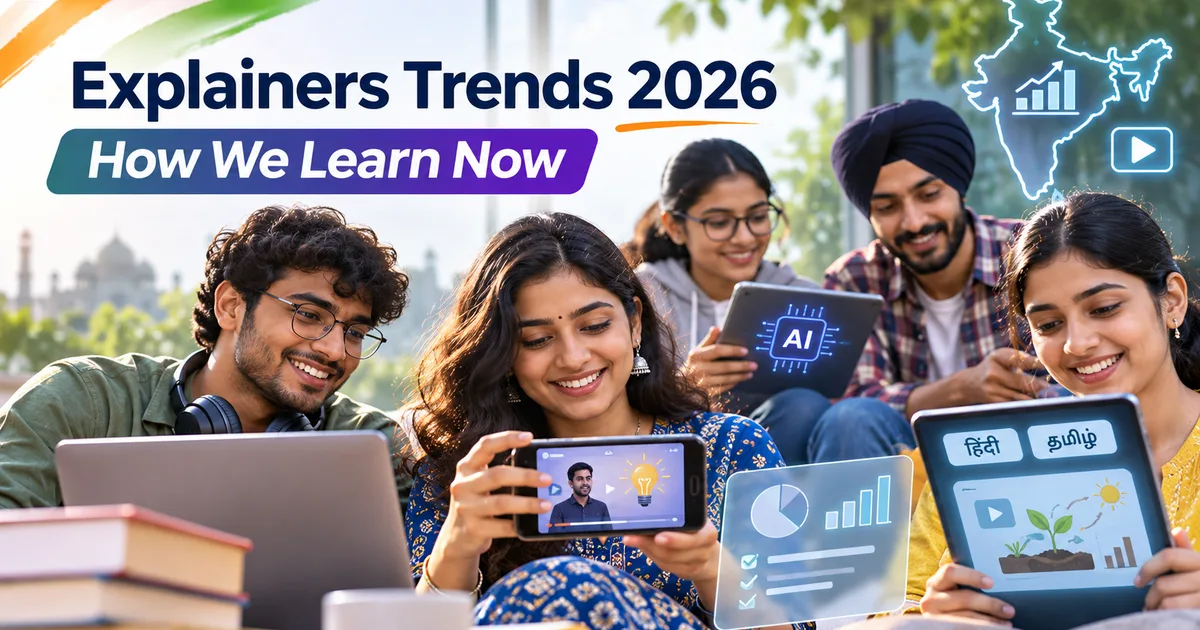
Last Tuesday night, my uncle in Pune forwarded a 42-page Reserve Bank of India PDF to our family WhatsApp group and asked one terrified question: "Will my pension account freeze if I don't submit this form by Friday?" Nobody in the family opened that PDF. Not one person. Instead, my twenty-two-year-old cousin pasted the circular's link into an AI search app and asked for a Hinglish summary. He dropped a four-line answer back into the chat within thirty seconds. If you want to understand the latest explainers trends in India 2026, that thirty-second interaction tells you almost everything. Across tier-1 metros and small towns alike, the way Indians figure out complicated rules, tax changes, new technology, and global news has completely flipped.
We don't sit through screaming 9 PM television panels hoping for a straight answer anymore. Honestly, who has the blood pressure for that?
People just want to know how a new rule or a piece of tech affects their wallet and their phone, or what it means for their job and daily commute. Look, everything from your scooter's petrol to your Aadhaar authentication now runs on messy policy and code. So the humble "explainer" is now the default format of the Indian internet, if you ask me. Let's look at what modern digital explainers actually are and how the tech behind them works in 2026, because Indian readers are suddenly obsessed with topics they used to ignore.
What is a digital explainer and how does the tech behind it work?
Think of a digital explainer like the pressure cooker in an Indian kitchen. Raw toor dal is hard and dry. You can't eat it straight out of the packet. A 60-page government gazette notification from the Telecom Regulatory Authority of India (TRAI) or a dense research paper on artificial intelligence is the exact same thing, basically. An explainer takes that tough document and puts it under pressure. It strips away the legal jargon and gives you something you can actually swallow in three whistles.
Five years ago, an explainer was just a long newspaper column written by a senior editor. In 2026, it's a mix of sharp human journalism and real-time software engineering.
When big news breaks today, two different systems kick in at the same time. On one side, human writers at specialized publications (including our tech explainers hub) test the actual apps and read the fine print of official circulars, then write plain-English breakdowns with real rupee calculations. On the other side, software systems using Retrieval-Augmented Generation (RAG) scan those verified articles and government databases to answer your specific voice or text queries on the fly. (I know, "Retrieval-Augmented Generation" sounds like a textbook term from an IIT lecture, so let's put it into normal words.)
How AI search and voice explainers process your questions
Say you open Google, Perplexity, ChatGPT, or a WhatsApp bot on your phone and ask, "Why is my bank OTP coming late today?" The app doesn't guess an answer based on old training data from two years ago. If it did that, the advice would be a mess. Instead, modern explainer tools use a four-step pipeline that runs in around two seconds:
- First, a language model translates your casual question, whether you typed it in English, Hindi, Tamil, or broken Hinglish, into a structured search query that a computer database can understand.
- Second, the retrieval engine searches a live index of trusted sources, such as recent TRAI orders on SMS traceability, RBI press releases, and verified tech portals, pulling out only the exact paragraphs that mention OTP delays.
- Third, the language model reads those pulled paragraphs and rewrites them at an eighth-grade reading level, stripping out stiff phrases like "pursuant to sub-clause 4(b)" and replacing them with clear cause-and-effect sentences.
- Fourth, the interface attaches clickable source links to the summary so you can tap through and check if the machine actually read the right circular.
I think this shift toward instant, chat-style answers is also why we're seeing huge growth in AI tools and subscriptions in India right now. College students and chartered accountants alike are using document-reading bots to chew through hundreds of pages of syllabus updates or tax rules in minutes.
Why India turned into a Q&A capsule nation in 2026
Tech only explains half the story. The other half is in our heads. Have you noticed how your cab driver, your barber, your neighbourhood kirana shop owner, and your college-going niece are all suddenly talking about semiconductor supply chains, ethanol blending, chip shortages, and West Asian oil routes?
A sharp July 2026 column in The New Indian Express pointed out that political and current-affairs curiosity among the "Twenty20s", the generation in their twenties during this decade, is higher right now than at any point in recent memory. I'm not sure exactly why it spiked so fast this year, but you can see it everywhere. An Uber driver in Agra wants to understand the historical context of Punjab in the 1980s. Meanwhile, second-year college students are prompting ChatGPT to explain pre-Partition Bengal politicians like Huseyn Shaheed Suhrawardy, and regular middle-class commuters on the metro are searching for quick breakdowns on why global tariffs are hitting their monthly mutual fund SIPs.
"You can't blame young people for wanting to know why things are so messed up. That has turned us into a textbook nation! Not an ideal one, just one where even adults are now consuming knowledge in easy-to-digest Q&A capsules. In any case, we are a society of exam-takers, leak or no leak. So we in the media too turn into a Kota coaching centre." - The New Indian Express (July 2026)
That comparison to a Kota coaching centre made me laugh out loud over my morning chai because it's dead accurate. We grew up on guidebooks, Kunji notes, exam digests, and question banks. So when life in 2026 feels overwhelming, we naturally reach for Q&A capsules to make sense of the mess.
And look at the smartphone math. With 5G data plans on Jio and Airtel costing around Rs 300 to Rs 350 a month, bandwidth is practically free, but our attention span is completely fried. Nobody wants to sit through a 25-minute YouTube video where a creator spends the first six minutes begging you to smash the subscribe button (annoying, I know). Readers just want the background and the numbers, plus what it means for them, laid out in five minutes flat. That demand is what shapes our own approach to decoding complex tech simply for everyday readers.
The biggest explainer topics Indians are searching for in 2026
So what are people actually typing into their search bars and AI apps this year? If you look at search traffic and newsroom data across India in late 2026 (the numbers here are a bit fuzzy across regional languages, to be fair), three big themes top the explainer charts.
1. Everyday tech, Digital India at 11, and E-20 fuel rules
With the Digital India programme crossing its 11-year mark in 2026, the baseline questions have grown up. Five years ago, people searched "How to create a UPI PIN". Today, UPI processes billions of transactions like clockwork. So the questions are much more specific now. Parents want to know how UPI Circle lets them give Rs 5,000 a month to a college kid or an elderly parent without handing over their main bank password, while small business owners are asking how DigiLocker API verification works for instant GST or loan onboarding.
At the same time, citizens are asking tougher questions about how government algorithms handle their personal data. Recently, the Internet Freedom Foundation (IFF) published a widely read analysis and explainer on how the Special Intensive Revision (SIR) process excluded voters at scale. Readers didn't want political slogans. They wanted the exact database mechanics of how voter rolls are cleaned and why legitimate names get flagged by automated deduplication software. And of course, they needed to know how to check their own status online before polling day.
Even what goes into your vehicle's fuel tank now needs a technical explainer. One of the most forwarded explainers of 2026, which The Wire pointed out, asked a simple question about E-20 petrol: "What are India's vehicles drinking?"
Thing is, if you ride a motorcycle or drive a car bought before April 2023, filling up with E-20 (which blends 20% ethanol with 80% petrol) has real mechanical consequences for your engine. Good explainers became viral hits in WhatsApp housing society groups because they broke the chemistry down in plain words. Higher ethanol content can corrode older rubber fuel lines, and it also pulls moisture from the air into your fuel tank during the monsoon. Plus, people wanted to know why their mileage might drop by 4% to 6% when they're already paying Rs 95 to Rs 105 per litre at the pump.
2. Defence technology and Exercise Tarang Shakti 2026
There was a time when military exercises were only followed by retired colonels and UPSC aspirants. Not in 2026. When drones, missile systems, stealth radar, and indigenous fighter jets dominate daily news feeds, regular people want to know how the hardware actually works.
Take the huge spike in searches around Exercise Tarang Shakti 2026. The Indian Air Force hosted this second edition of the multinational exercise at the Jodhpur air base from September 26 to October 11, 2026. It brought together nearly 40 countries, including the United States and France, alongside Germany and dozens of other air forces. A popular video explainer by The Times of India broke down why this event was much more than an air show for the cameras.
In my experience, Indian readers mostly wanted to see how India's home-grown platforms, like the HAL Tejas fighter jet or our Dhruv utility and Prachand light combat helicopters, stack up next to foreign aircraft like the American F-35 stealth fighter. Instead of throwing around raw military acronyms, the best explainers this year focused on three practical concepts:
- How Dissimilar Air Combat Training works, which is basically like a left-handed batsman practising in the nets against a mystery spinner they have never faced before, allowing Indian pilots to test their tactics against unfamiliar foreign jets.
- What fifth-generation "sensor fusion" actually means inside an F-35 cockpit, where radar, infrared cameras, and ground data merge onto a single helmet visor display, and how observing this helps Indian engineers designing our own Advanced Medium Combat Aircraft (AMCA).
- How operational lessons from recent missions like Operation Sindoor and joint army drills like PRAGATI 2026 (launched at the Umroi Military Station in Meghalaya with 12 partner nations) change the way Indian forces share live battlefield data across different military branches.
3. Geopolitics, critical minerals, and tech trade corridors
Why does a 28-year-old software developer in Whitefield, Bengaluru care about diplomatic visits in 2026? Well, foreign policy now directly decides where global capability centres (GCCs) open and which countries offer smooth tech work visas. It also determines where India gets the lithium and silicon needed for our electronics boom.
We saw a clear example of this during Polish Prime Minister Donald Tusk's visit to India from October 21 to 23, 2026. Traditional diplomatic wire reports on the trip were super dry. Your eyes would glaze over by paragraph two. But the foreign-policy portal India's World published a sharp explainer that connected the diplomatic handshakes directly to business and tech deals.
Here are the specific numbers that made tech and business readers pay attention. After meeting Prime Minister Narendra Modi in New Delhi, Tusk took around 100 business leaders and flew straight to Bengaluru for technology and industry meetings (which makes sense, actually). This trip built on Modi's August 2024 visit to Warsaw, which was the first by an Indian PM in 45 years, and a September 2026 mid-term review between External Affairs Minister S. Jaishankar and Polish Deputy Prime Minister Radoslaw Sikorski. Both governments set a hard target to double bilateral trade by 2030. According to Indian Embassy data in Warsaw, bilateral trade was at US$6.36 billion in 2025. Indian exports made up US$4.83 billion of that, while imports from Poland stood at US$1.53 billion.
"The focus was on consolidating the progress made since 2024 and translating our growing convergence into practical cooperation and tangible outcomes." - Sibi George, Secretary (West), Ministry of External Affairs, Government of India (October 2026)
What made the Poland-India explainer click with young readers was how it tied old history to future tech. It reminded Indians how the Jam Saheb of Nawanagar and the Kolhapur royal family sheltered Polish women and children during the Second World War, and how Poland helped evacuate Indian medical students from Ukraine during Operation Ganga in 2022. Then it linked that history to 2026 priorities, like a new Defence Industry Dialogue for co-producing military tech and fresh cooperation in space, plus securing critical minerals for electric vehicles and expanding cross-border IT corridors.
When explainers go wrong: AI hallucinations and fake advisory scams
Here's the deal: I love a crisp two-minute summary as much as anyone else, but our national habit of reading bite-sized explainers has a nasty side effect in 2026. When people stop reading original documents and trust whatever bulleted graphic lands on their screen, two things go wrong very fast.
First, lazy AI bots hallucinate Indian numbers. I tested three free AI browser extensions last month by asking them to explain the latest income tax rebate slabs and SEBI's new F&O lot size rules. Two of them mixed up old 2024 budget proposals with current 2026 rules. One even invented an RBI circular number that doesn't exist. Because the answer was in neat bullet points, it looked 100% official. If you act on an AI-generated financial explainer without checking the source link, your tax filing or compliance can turn into a mess.
Second, scammers have turned the explainer format itself into a scam.
These scammers now design slick "Explainer Infographics" with fake PIB, RBI, CERT-In, or SBI logos and push them on WhatsApp and Telegram. Basically, they take a real news topic like Mera Ration 2.0 Aadhaar eKYC or Jeevan Pramaan digital life certificates for pensioners, or popular schemes like PM Surya Ghar solar subsidies and FASTag rules. Then they add a sketchy step at the bottom telling you to download an `.apk` file or click a short link to "complete verification instantly."
We track these scams daily in our coverage of staying safe from online scams, and I think the rule of thumb is pretty simple. No real government explainer from the RBI or TRAI, or from bodies like the Ministry of Electronics and Information Technology (MeitY) and the Income Tax Department, will ever ask you to install an app outside the official Google Play Store or Apple App Store. Before you forward a helpful-looking summary to your family group, run through this quick verification checklist:
- Check if the explainer links to an actual `.gov.in` or `.nic.in` press release, or cites a verifiable circular date, rather than just saying "As per new government rules issued today."
- Be extra skeptical of Instagram Reels and YouTube Shorts using cloned AI voices of famous Indian news anchors to explain stock market tips or government subsidy schemes.
- Never enter your UPI PIN, Aadhaar OTP, or netbanking password on a web page linked inside a WhatsApp PDF guide; official portals like DigiLocker, UMANG, and Jeevan Pramaan only authenticate inside their verified apps or official government domains.
- If a family member falls for a fake advisory guide and loses money, don't waste time searching for bank customer care numbers on Google; call the national cybercrime helpline at 1930 immediately or file a report at cybercrime.gov.in so the banking freeze system can block the transfer.
If you want to check how a new digital service actually works before touching your settings, bookmark reliable step-by-step tech guides that walk you through the official app screens without sketchy third-party links. Millions of Indians are now reading up on defence aviation, tax rules, fuel chemistry, and data privacy in 2026, which is great to see. Just make sure the pressure cooker you use to digest the news isn't serving you half-baked facts.