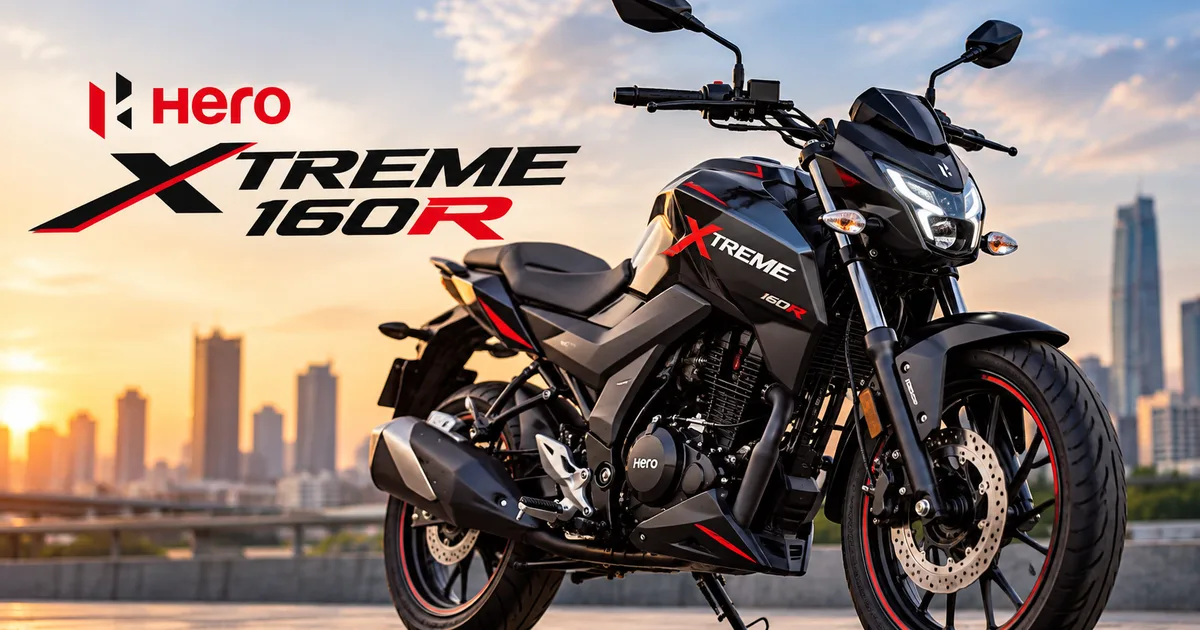
Picture this. You're stuck at a red light on a sweltering evening in Pune. Traffic crawls. The Hero Xtreme 160R 2026 is built for that daily grind. It packs punchy low-end torque so you can zip past auto-rickshaws without breaking a sweat. If you spend an hour every morning dodging potholes and crawling through narrow market streets, wrestling an overweight bike is exhausting. You want something agile and light that doesn't drain your wallet every time you visit the petrol pump.
Hero MotoCorp spent years refining its premium commuter formula. The original two-valve Xtreme was capable, but it struggled at highway speeds. Then the four-valve update gave it much-needed lung capacity. For the 2026 model, Hero focuses on compliance updates and safety equipment that riders asked for. In my experience, these adjustments fix several niggles from earlier batches.
Look, the 160cc segment in India is crowded.
Bajaj and TVS fight hard for college riders and young office workers. Hero knows that to keep the Xtreme relevant, it has to deliver agility alongside sensible ownership costs.
What is new on the Hero Xtreme 160R 2026
The biggest mechanical shift is about onboard emission compliance. Under current environmental rules across India, two-wheelers must meet updated OBD-2B diagnostics. If that sounds like bureaucratic jargon, think of it this way. Older diagnostic systems were like an annual clinic visit. They only alerted you after a component broke down completely. The OBD-2B system works like a fitness band on your wrist. It tracks catalytic converter health and oxygen levels continuously. When an engine misfires or runs too rich, the system flags it immediately.
And alongside updated sensors, the fuel map has been recalibrated for E20 petrol blends. Ethanol burns differently than pure petrol, and older rubber fuel lines rot when exposed to alcohol over time (a mess if left unchecked). So Hero swapped out fuel hoses and tweaked electronic injection parameters so the bike starts cleanly on chilly winter mornings without hesitating.
You also get minor cosmetic refreshes. The front LED headlamp cowl has sharper edges, while the tank shrouds look slightly more angular. If you ask me, these changes don't add top speed, but they give the bike a clean, muscular stance.
Expected Hero Xtreme 160R price in India and variant breakdown
Pricing is the main decider for Indian buyers shopping in the 160cc bracket. Always has been. Hero knows that crossing psychological price limits pushes buyers toward rival showrooms. Honestly, the numbers here are a bit fuzzy until official launch day, but dealer channel estimates point to a clear breakdown:
- The standard single-channel ABS variant will likely carry an ex-showroom price starting around Rs 1.32 lakh.
- The mid-spec variant with dual-channel ABS and updated graphics is expected around Rs 1.36 lakh ex-showroom.
- The top-tier edition with gold-finished inverted front forks and connected telematics should land near Rs 1.39 lakh ex-showroom.
Ex-showroom numbers never tell the full story. You still have to pay state registration taxes, road safety cess, mandatory five-year insurance, and dealer handling fees. In Delhi, the top variant will cost roughly Rs 1.56 lakh on the road. In Bengaluru or Mumbai, where state RTO taxes are higher, that same motorcycle easily reaches Rs 1.63 lakh before you add a crash guard or seat cover.
Most young buyers opt for monthly financing. With a down payment of Rs 30,000 and a three-year loan at 10.5 percent interest, your monthly EMI settles around Rs 4,200. If you want to estimate your total monthly transport budget, checking out comprehensive commuter tech buying guides helps you plan insurance renewals and fuel expenses together.
Engine specifications, OBD-2B compliance, and real-world mileage
Under the fuel tank sits a 163.2cc single-cylinder, four-stroke engine with an oil cooler. It produces 16.9 PS of power at 8,500 rpm and 14.6 Nm of peak torque at 6,500 rpm. Those numbers place it right alongside the Apache RTR 160 4V and Pulsar N160.
Why does four-valve technology matter in city traffic? Think of breathing during a run. If you try breathing through one pinched nostril, you manage fine while walking, but you choke when you sprint. A two-valve engine has one intake valve and one exhaust valve. That restricts airflow at higher revs. Four valves let the engine breathe freely. You get clean acceleration when overtaking slow trucks on state highways.
Power delivery is tuned for urban commuting. Maximum torque arrives at 6,500 rpm, so you don't need to wring the throttle to find usable momentum. You can keep the gearbox in third gear at 30 km/h and pull away smoothly without engine shudder.
Now let's talk about real-world mileage. Official laboratory figures rarely match chaotic Indian traffic (which makes sense, actually). In daily city riding across stoplights and speed breakers, you can realistically expect between 42 kmpl and 45 kmpl. Out on open highways with steady cruising at 75 km/h, the motorcycle delivers up to 48 kmpl.
With a 12-litre fuel tank, you get a dependable riding range of around 500 kilometres. If your daily office commute spans 25 kilometres, you only need to visit a petrol pump once every two weeks. At current fuel prices, your monthly petrol bill stays around Rs 1,400 to Rs 1,600. In my experience, that kind of efficiency keeps daily running costs painless.
Safety upgrades and suspension handling on Indian roads
Indian city streets test suspension setups brutally. Between unmarked speed humps and monsoon potholes, your front fork takes continuous punishment. Hero fixes this by fitting 37mm KYB inverted USD front forks on higher trims.
Inverted forks flip traditional suspension upside down. The heavy outer slider tubes mount directly to the chassis steering clamp, while the lighter chrome tubes attach to the wheel axle. This cuts unsprung weight. Think of running in heavy work boots versus light sneakers. With less weight bouncing at the wheel, the tire tracks uneven pavement faster. That keeps your front wheel planted over mid-corner bumps (and trust me, you'll encounter plenty).
The rear suspension relies on a 7-step preload-adjustable monoshock. Hero tunes it slightly plush out of the factory. That absorbs sharp road joints nicely. If you ask me, carrying a pillion passenger regularly requires stiffening the preload by two notches to avoid scraping over tall speed breakers.
Braking safety improves with standard dual-channel ABS on upper variants. Single-channel systems only prevent the front wheel from locking. That leaves the rear wheel vulnerable during panic stops. On dusty or rain-slicked asphalt, a skidding rear wheel gets sketchy fast.
ARAI testing guidelines for two-wheelers emphasize that dual-channel anti-lock braking systems drastically cut skidding incidents on wet asphalt and loose gravel during sudden panic stops.
The braking hardware pairs a 276mm front disc with a 220mm rear disc. The petal disc contours dissipate heat quickly during repeated stops. Lever feel is progressive and predictable. It doesn't have the sudden grab that frightens newer riders.
Digital console features and smartphone connectivity
Riders now expect digital instrument clusters to show clear trip data and phone alerts. The 2026 model has an inverted LCD digital console with crisp contrast. It remains legible under direct Indian afternoon sun.
The console pairs with your smartphone using Bluetooth through the Hero Connect app. Once connected, it displays turn-by-turn navigation prompts and incoming call alerts directly on the dash. That eliminates mounting an expensive phone onto handlebar brackets where vibrations can damage camera optics (annoying, I know). If you ride with helmet audio like CMF Buds Neo audio gear, you can glance at the dash before answering. For a broader look at connected vehicle hardware, browse our automobile tech explainers.
The mobile app also tracks trip analytics, parking location, and service schedules. Having automated maintenance prompts helps you stay on top of chain lubrication and oil changes. In my experience, that routine care keeps the engine healthy over years of daily riding.
How the Xtreme 160R stacks up against rivals
Nobody buys a 160cc motorcycle without checking the alternatives. The Hero Xtreme 160R 2026 faces direct competition from the TVS Apache RTR 160 4V and Bajaj Pulsar N160.
The Apache RTR 160 4V delivers 17.55 PS and includes selectable ride modes for rain and sport. If you frequently ride on open highways, the Apache offers slightly stronger top-end punch. However, it feels broader between your legs and slightly heavier when you crawl through dense evening traffic.
The Bajaj Pulsar N160 focuses on smooth tractability and solid straight-line stability. Its projector headlamp provides outstanding illumination on unlit roads. But at 152 kg, the Pulsar is noticeably heavier to push around in parking spots.
This is where the Xtreme holds an advantage, if you ask me. At roughly 145 kg, it is one of the lightest motorcycles in its segment. You feel that difference every time you filter through narrow lanes or dodge a sudden crater. Manufacturers continually update chassis components to balance agility and rigidity, much like the engineering tweaks seen in Skoda Slavia facelift upgrades in the passenger car space.
Who should buy this bike and who should look elsewhere
If your daily routine involves 15 to 30 kilometres of city commuting and quick market errands, the Xtreme 160R makes good sense. It delivers agile handling, brisk pickup away from red lights, dependable mileage, and affordable maintenance backed by Hero's nationwide service network.
Spare parts are easy to find, and local mechanics understand the platform. A standard routine service costs around Rs 800 to Rs 1,200 for engine oil and filter replacements.
Still, this bike is not for everyone. If you travel with a pillion passenger regularly over long distances, the stepped rear seat is narrow and firm. I'm not sure exactly why Hero made the rear cushion so stiff, but it feels awkward for family members. And if you plan 400-kilometre weekend highway tours, the upright ergonomics and lack of wind protection will tire you out.
For solo riders who want a sharp, lightweight city commuter with reasonable running costs, the Hero Xtreme 160R 2026 delivers a sensible package. Take it on a test ride through a broken road section to see how the suspension feels before making your final decision.