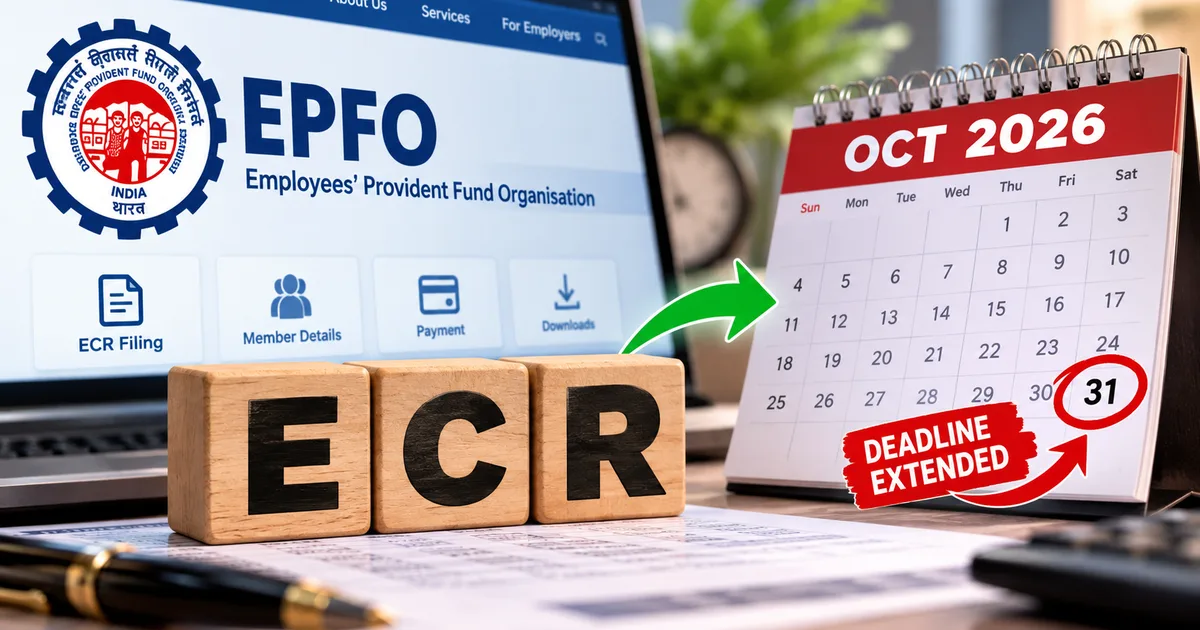
Picture this: it's 11:30 PM on October 15, and your accounts manager is frantically refreshing the screen because the portal keeps throwing a gateway timeout error. If your firm hasn't cleared the monthly provident fund dues yet, take a breath. The central provident fund commissioner just announced an official EPFO ECR deadline extension October 2026, shifting the final cut-off date to October 21, 2026. That gives thousands of Indian businesses extra days to compile payroll files and clear bank debits before penalties hit.
Every month, around seven million registered establishments across India go through this exact mess. The numbers here are a bit fuzzy depending on who you ask, but the scale is massive.
Thing is, when server traffic spikes right before the festival season, the portal just chokes. In my experience, payroll teams routinely sit up past midnight just waiting for a single challan receipt to generate. It's ridiculous. So this extra window is a genuine lifesaver.
What is an ECR and why does it matter?
If you're new to payroll or running a startup here, government acronyms will give you an instant headache. ECR stands for Electronic Challan cum Return. Basically, it's a monthly statement and invoice an employer sends to the Employees' Provident Fund Organisation.
Back in the day, offices filed physical paper slips and manual bank challans. Not anymore. Now it's completely digital (which makes sense, actually). You build an encrypted text file listing each employee along with four specific pieces of data: their 12-digit Universal Account Number, gross pay, Aadhaar identity, and exact PF deductions. Then you upload it straight to the EPFO Unified Employer Portal. The portal validates those entries against central Aadhaar databases. If the records match up, it spits out a unique Temporary Return Reference Number.
Look, you can't just transfer a lump sum into a government account and call it a day. The cash has to link to real people. If you ask me, that's where most first-time founders get confused. Say a staff member making ₹15,000 basic pay sees ₹1,800 deducted from their paycheck. The ECR tells the EPFO servers exactly which member ledger gets that ₹1,800, right beside the company's matching share. And without an approved ECR on file, the department can't credit your staff's monthly interest or update their pension records.
Why the October 2026 deadline moved
The standard cutoff for uploading an ECR and clearing PF dues is the 15th of every month. Simple enough. For September 2026 payroll, that meant October 15. But this week, the portal ground to a dead halt.
Why did it happen? Two big reasons.
First, tons of businesses run festival advances and Diwali bonuses during early October. That caused huge wage adjustments and bulkier payroll files across sectors like manufacturing and logistics. When thousands of accountants tried pushing these heavy text files at the exact same hour, the servers started crashing. You'd get a 504 gateway timeout, or your session would just die midway.
Second, the portal's digital signature applet turned into a total mess. (Dealing with government Java applets in 2026 feels like using a typewriter, annoying, I know). Plenty of CAs and finance leads noted that even with valid USB crypto tokens, the system refused to sign off on uploads. I'm not sure exactly why the signer bridge kept failing this time, but after thousands of angry complaints landed on the Ministry of Labour's desk, officials finally stepped in.
"In view of technical bottlenecks encountered by establishments on the Unified Portal and festival bank holidays, the competent authority has approved extension of ECR filing and wage payment up to October 21, 2026 without levying Section 14B damages."
Honestly, this relief was long overdue. Slapping late fines on small businesses because a government site crashed isn't right. I think giving teams this breathing room saves everyone from senseless legal fights down the road.
How the penalty waiver works under Section 14B
The circular protects your wallet as well as your calendar. Under the Employees' Provident Funds and Miscellaneous Provisions Act of 1952, falling behind on payments triggers two separate charges: Section 14B damages and Section 7Q penal interest.
Knowing how these two penalties work can save your company serious cash:
- Damages under Section 14B represent a punitive fine levied for delayed compliance, where rates start at 5% per annum for delays up to two months and climb all the way to 25% per annum for chronic defaults.
- Penal interest under Section 7Q is a statutory simple interest charged at 12% per annum on the outstanding amount from the due date until the day the funds actually clear.
- Administrative account charges face surcharge scrutiny if remittances get delayed into subsequent reporting quarters.
Under this order, the department waived Section 14B damages for every filing and remittance completed on or before October 21, 2026. So if your money shows up in the EPFO account by that date, you won't get hit with penalty slabs or late notices. In my experience, this setup works a lot like the tax amnesties under the Vivad Se Vishwas 2026 penalty relief rules, where paying during a grace period wipes out punitive fines clean.
Now, what happens with Section 7Q interest? That's the catch. Even though officials waived Section 14B damages, Section 7Q simple interest is written straight into the parent act as mandatory. Field officers have occasionally ignored 7Q interest during short extensions, but don't bet your payroll budget on their generosity. Clear your challan a couple of days early so the bank stamp proves you paid well before the final buzzer.
Step-by-step employer guidelines to file without errors
Look, getting five extra days doesn't mean you should procrastinate until the night of October 20. Don't do that. The server will almost certainly crawl as everyone rushes in at the eleventh hour. If you ask me, sticking to a disciplined checklist is the only way to get this done without losing your sanity.
- Double-check your payroll text file formatting in a plain text editor before attempting an upload, because missing a single separator character will instantly reject the entire batch.
- Ensure every newly joined employee has an active Universal Account Number seeded with their verified Aadhaar card to avoid validator errors.
- Log into the Unified Employer Portal during off-peak hours and navigate to the ECR upload section under the Payment tab to select September 2026.
- Wait for the system to validate the record count, then download the draft error log and summary sheet to inspect total wages and deductions.
- Approve the challan using your registered Digital Signature Certificate or e-Sign Aadhaar OTP mechanism to lock the reference number.
- Initiate payment through your designated corporate net banking account right away instead of scheduling an offline NEFT transfer.
We've mapped out plenty of similar statutory workflows in our detailed tech explainers so Indian founders can manage portal filings without burning money on outside consultants.
Troubleshooting common portal errors and payment traps
Even with extra time on hand, you'll probably run into a few annoying glitches. Here's what actually helps when things go sideways.
Getting hit with a "Session Expired" error right after uploading your file? Don't just hammer reload. That messes up your session cookies in Chrome. Instead, fire up an incognito window and wipe your local browser cache. That usually clears the blockage right away.
USB token signers are another headache. Browsers push security updates all the time, and that can break the local signing bridge out of nowhere. In my experience, making sure your e-Pass or mToken software runs on the latest 2026 driver solves half the trouble. Restart the crypto service before plugging the key back in for another try.
Also, stay alert about sketchy security threats over the next few days. Every time a big government deadline gets moved, fraudsters start fishing for easy targets. They'll blast out messages claiming your PF account is frozen, or push sketchy links asking for immediate settlement. Taxpayers deal with this all the time via fake ITR deadline extension penalty SMS alerts during tax season, and payroll staff now get hit with the exact same scam. The scam messages pretend to come from the regional PF commissioner. Don't fall for it. The EPFO never asks for money over third-party UPI handles or random phone calls. Every single rupee belongs on the official Unified Portal tied to a legitimate challan reference.
If you're also juggling corporate income tax filings this month, take a look at our breakdown of ITR filing deadline rules for AY 2026-27 so your finance calendar stays well ahead of government cutoffs.
Practical checklist before logging out
Once your corporate net banking debits the money, don't just shut your laptop and walk off. Log back into the Unified Portal after 45 minutes to check the status. You want to see that status switch from "Payment Initiated" to "Transaction Successful".
Grab the final Payment Confirmation Receipt and the electronic CRN slip. Save both PDFs right next to your September salary register. In my view, having those timestamped files stored safely is the only proof that saves you if an auditor ever comes knocking.
Your team put in the hours all month. Getting this return through means their retirement money actually reaches their accounts on time, without surprise penalties hanging over your head.