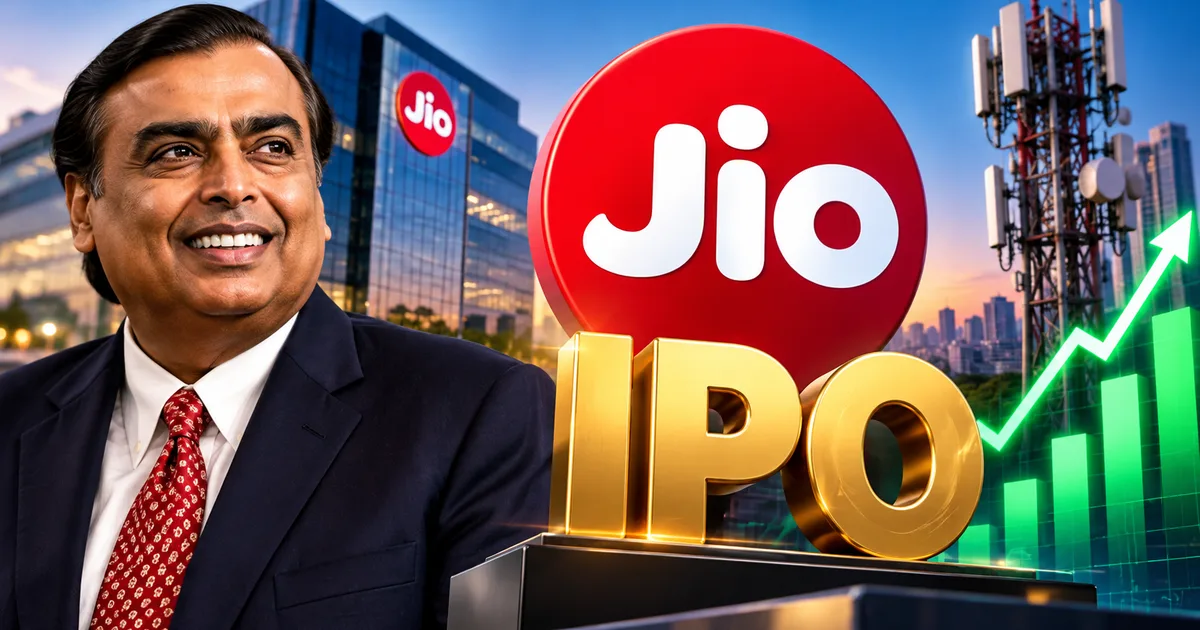
If you've recharged a phone through Google Pay or streamed a cricket match on your smartphone recently, you've interacted with Reliance Jio. Over 490 million Indians rely on its telecom network every single day. Now, after years of endless market rumours and speculative WhatsApp forwards, the Reliance Jio IPO 2026 is officially moving toward Dalal Street with a formal public issue. Retail investors and household savers across India are wondering whether this is the moment to open their trading apps and place a bid.
I get the buzz. Honestly, in my experience, a public listing from India's biggest telecom player doesn't come around often.
To understand what's happening, you have to look at the company behind your SIM card. It's Jio Platforms. That's the digital and tech arm of Reliance Industries Limited. Back in 2020, tech giants like Google and Meta bought minority stakes in it, and now parent firm Reliance Industries is finally listing the business on the National Stock Exchange and the Bombay Stock Exchange. It gives everyday Indian retail investors a real chance to own a direct slice.
Expected valuation and how big this issue really is
Numbers in stock market filings get dizzying fast. So let's break this down into plain rupee terms that make sense over a cup of morning tea.
Draft offer documents show Jio Platforms is issuing up to 27 crore equity shares through a fresh issue structure. Basically, the company will create brand-new shares to bring fresh cash straight onto its balance sheet (which makes sense, actually, given how much cash they want to pump into infrastructure), rather than just letting existing promoters cash out. The numbers here are still a bit fuzzy, but market estimates peg the total issue size around $4 billion. In Indian rupees, that's roughly ₹33,000 crore to ₹40,000 crore. If it crosses ₹28,000 crore, it officially beats Hyundai Motor India's 2024 public issue as the largest stock offering in Indian history.
Think about that for a second.
The overall business valuation is expected to sit between ₹8.5 lakh crore and ₹11 lakh crore, or roughly $100 billion to $130 billion. That puts Jio right in the league of India's most valuable corporations from day one. If you ask me, that's an eye-watering valuation. Much like we saw during the Shiprocket IPO valuation debate, investors are asking whether growth projections can truly justify such a massive price tag.
Elixir Equities founder Dipan Mehta pointed out that even a 10% to 12% listing gain above the price band would elevate Jio Platforms to India's second-largest company by market capitalization, moving ahead of Bharti Airtel and HDFC Bank.
That's massive. But whether that valuation leaves enough money on the table for retail listing gains depends entirely on the price band merchant bankers end up picking.
Listing timeline and dates you should mark on your calendar
Timing in the market matters just as much as valuation. The company cleared its first big hurdle when SEBI gave observation approval on August 28, 2026, as detailed in our earlier breakdown of how Jio filed draft papers for the issue.
Here's how the calendar shapes up for bidders:
- The public subscription window opens on October 21, 2026, and closes on October 23, 2026.
- Anchor investors bid one day prior to the public opening and set the initial institutional tone.
- Share allotment finalization happens roughly two working days after the issue closes.
- Refunds and release of bank funds begin shortly after allotment confirmation.
- Shares credit to successful bidders' Demat accounts before the official listing ceremony on NSE and BSE.
The formal bidding window runs strictly from October 21 to October 23, 2026. That gives you three working days to get your bids in through your broker. Don't wait until 4:30 PM on the final day. In my experience, UPI payment gateways turn into a complete mess when millions of applicants try to approve mandates all at once.
How the RIL shareholder quota works for regular retail investors
Here's where things get interesting for everyday Indian families. If someone in your house already holds shares of Reliance Industries Limited in their Demat account, you've got an edge.
The issue includes a dedicated RIL shareholder quota. Think of it like a special reservation counter at a busy railway station. While millions of applicants pile into the regular retail line, existing shareholders get a separate pool of shares reserved just for them.
How many RIL shares do you need to qualify? Just one. As long as you held at least one equity share of Reliance Industries in your Demat account on the record date, you're eligible to apply under this reserved quota. (I know, corporate stock rules usually feel restrictive, but this one is surprisingly fair for small retail savers).
And it gets better. SEBI guidelines let you apply in two categories at the same time using the exact same PAN card:
- You can apply under the general retail category for up to ₹2,00,000.
- You can place a separate application under the RIL shareholder category for up to ₹2,00,000.
- Both applications remain fully valid because SEBI treats the shareholder quota as an independent reservation category.
This double-bid setup essentially bumps your bidding limit to ₹4 lakh across two separate buckets. I think it's a huge advantage. If the retail bucket ends up heavily oversubscribed, your shareholder application sits in a much calmer allotment pool with noticeably better odds.
How to apply for shares through UPI and your Demat account
You don't need to visit a bank branch or deal with messy paper forms anymore. Everything happens right on your phone in under five minutes.
Here's the exact step-by-step process:
- Open your preferred investment app, such as Zerodha or Groww.
- Navigate to the IPO section and locate the Jio Platforms listing during the open dates.
- Select your category, choosing either retail or shareholder, or submit two separate applications if you qualify for both.
- Enter the number of lots you want to buy at the cutoff price to ensure your bid stays competitive.
- Enter your UPI ID linked to your bank account, such as yourhandle@okhdfcbank or yourhandle@ybl.
- Open your UPI app, like PhonePe or Google Pay, and approve the UPI mandate request before the deadline.
Once you approve the mandate, your bank doesn't take the cash out right away. Instead, it just places a temporary hold on that balance. If you get an allotment, the blocked funds are debited automatically, and the shares land in your Demat account through CDSL or NSDL. If you don't get any shares, the bank lifts the lien within a few days, and your money is free again. If you ask me, the UPI route is far smoother than the old banking paperwork ever was. For more detailed walkthroughs on demat management, check our practical investing guides.
Risks and realistic expectations before you put your money down
Look, it's easy to get swept up in the noise when headlines shout about the biggest public issue in Indian history. But smart investing is about looking at both sides of the coin.
Earlier in 2026, market data from Prime Database showed that mainboard IPO proceeds dropped around 39% compared to the previous year, while retail oversubscription rates dipped below 40%. Many listings struggled to hold their debut gains (which happens often when liquidity dries up). Besides, a giant issue size of ₹30,000 crore to ₹40,000 crore absorbs huge amounts of cash from the market. That alone can put a lid on wild listing-day pops.
Grey market premium trackers report unofficial premiums hovering around ₹220, or around 20% over estimated issue prices. But don't forget that GMP is completely unregulated and flips daily on pure speculation. Honestly, Jio's real long-term value will depend on whether it can keep raising its average revenue per user through 5G plans and home broadband, not on first-day hype.
If you like understanding how major technology shifts touch your daily routine, browse our tech explainers hub for more straightforward breakdowns. Base your investment choices on your own financial goals and risk tolerance. And whatever you do, don't borrow money on credit just to chase an IPO allotment.