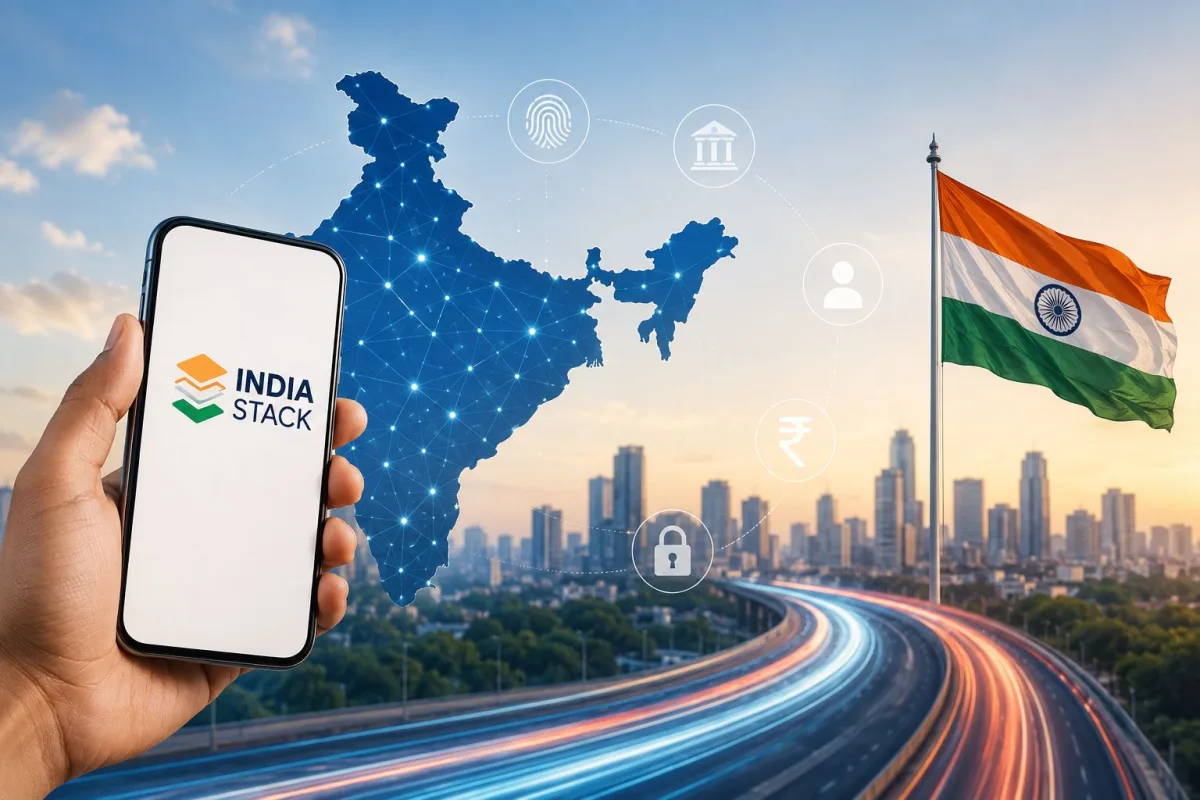
India signed MoUs with 23 countries to share its Digital Public Infrastructure model, and in 2026, that's no longer just a line in a press release. UPI is live in over eight nations. Kenya is actively building a digital identity stack using India's DPI playbook. The India Stack Global initiative, which formally facilitates this export of Indian digital systems to partner countries, has moved from concept to actual deployment across multiple continents. Most Indian users haven't fully registered the scale of what's happened in the past two years.
What India Stack Global actually is
India Stack is the collective name for the open APIs and digital systems that power everyday Indian life: Aadhaar for identity, UPI for payments, DigiLocker for document storage, and the Account Aggregator framework for financial data sharing. You've used at least one of these today, probably without thinking about it. In my experience, most people who use UPI daily have no idea it's become an export product.
India Stack Global is the initiative that takes this model and helps other countries build something similar. It runs under MeitY (Ministry of Electronics and Information Technology) and works through bilateral agreements and technical assistance, along with knowledge sharing. The idea is straightforward: countries don't have to reinvent the wheel. India spent roughly a decade and enormous public resources getting UPI and Aadhaar to work at scale. Why shouldn't a smaller country skip straight to the good part?
The initiative picked up steam at the G20 under India's presidency in 2023. But 2025-26 is when the actual work accelerated. Agreements are being signed. Teams are being deployed. And some of these systems are already live.
The 23-country MoU push: who signed and what they're getting
India signed digital cooperation agreements with 23 countries covering DPI adoption across identity and payments, along with data sharing frameworks. The list spans Africa, Southeast Asia, Latin America, and the Middle East. Honestly, the complete list of all 23 hasn't been published in one official document as of this writing, but confirmed partners include nations from the African Union bloc, ASEAN members, Caribbean nations, and a few others. The numbers here are a bit fuzzy when it comes to exact country names.
Basically, these MoUs aren't just friendship handshakes. They typically cover:
- Technical assistance from Indian government and private sector teams
- Sharing of source code and documentation for India Stack components
- Training for local government and tech staff
- UPI interoperability and payment corridor setup
- Aadhaar-equivalent identity system architecture guidance
Some of this is done through NPCI International (the global arm of the National Payments Corporation of India) and through iSPIRT, the nonprofit that helped build much of India Stack's architecture. It's a mix of government diplomacy and tech-sector involvement. That's why it tends to move faster than pure government-to-government programs.
UPI abroad: more than just convenience for NRIs
UPI is now accepted in Singapore, UAE, France, Mauritius, Nepal, Bhutan, Sri Lanka, and several others. As of 2026, it's live in over eight countries. For most Indians, this registers as "good for travel" and not much more.
But the more interesting story is at the infrastructure level. Countries aren't just plugging into UPI as a payment method. Some are using the UPI architecture as a template for building their own interoperable payment systems. Several African and Southeast Asian nations are explicitly studying India's model through India Stack Global partnerships, with NPCI International providing the technical roadmap.
NPCI International has set up UPI acceptance networks in partner countries and is working on bilateral payment corridors where a merchant in Mauritius accepts UPI from an Indian tourist and settlement happens in real time. If you've been to Mauritius or Dubai recently, you may have already done this without thinking about the infrastructure behind it. (I tried it in Dubai last year. It works. Still mildly surprised every time.)
For India, the benefit isn't just diplomatic goodwill. Every country that adopts UPI rails or an interoperable system based on India's model creates a larger network effect. The diaspora gets more utility. Indian businesses get more cross-border trade settlement options. And India gains more say over how global payment infrastructure gets built.
Kenya and what the identity infrastructure story actually looks like
Kenya is the case study everyone in this space is watching. The country is working on a national digital ID system and has explicitly drawn on Aadhaar's architecture, with India Stack Global providing technical guidance. Kenya's digital ID journey has had its own rocky history, including court challenges around privacy. That should sound familiar to anyone who followed Aadhaar's legal battles in India's Supreme Court.
This is where it gets complicated. India's digital infrastructure is being exported partly because it works at scale and partly because India is actively marketing it. But the domestic track record is genuinely mixed. Aadhaar has enabled welfare delivery at a scale that was previously impossible, helped distribute COVID vaccines, and is now the backbone of everything from ITR filing to DigiLocker. It's also been linked to exclusions and outages that locked people out of ration systems, along with privacy concerns that haven't been fully resolved even after the Puttaswamy judgment.
Tech Policy Press described this as the "Aadhaar Paradox": a system with serious domestic failures that has simultaneously become a globally admired model. If you ask me, that framing is one of the more honest things written about this whole push. The countries adopting India's DPI model are getting the architecture, but they're also getting the risk profile. Whether they've thought that through is a separate question.
What India actually exports through this model
The actual exports are more specific than "digital infrastructure" suggests. There's open-source code for Aadhaar-equivalent identity systems, maintained through MOSIP (the Modular Open Source Identity Platform). There's UPI's payment protocol specifications, which NPCI International licences or adapts for partner country systems. There's DigiLocker-equivalent document wallet architecture, and Account Aggregator framework guidance for countries building open banking systems.
MOSIP deserves specific mention. It's a Bangalore-based initiative, supported partly by the Bill and Melinda Gates Foundation, and has become the go-to open-source platform for countries building national identity systems. Philippines, Morocco, Ethiopia, Guinea, and Sierra Leone are among the countries where MOSIP-based systems are either live or in development. India Stack Global and MOSIP are technically different programs, but they're deeply connected in the diplomatic and implementation story.
Policy and regulatory templates also get shared, including lessons from India's experience managing TRAI, RBI, MeitY, and related regulators. I think this is arguably as valuable as the code itself, because most developing countries struggle less with the technology and more with the governance side. Our India DPI explainers cover the regulatory framework in more detail if you want the background.
The geopolitics behind the generosity
India isn't doing this purely out of goodwill. There's real strategic interest in becoming the country whose infrastructure standards the Global South adopts.
The alternative in many of these countries is Chinese-built infrastructure: Huawei-built networks and payment systems from Alibaba or Ant Financial. Both the US and European governments have been pushing back against Chinese tech infrastructure in developing countries for years. India's DPI model gives these countries a third option, one without the political conditions that often come attached to Chinese infrastructure deals and without the cost barriers of Western enterprise solutions.
Sam Altman called India a "full stack AI leader" at the AI Impact Summit in early 2026. That framing was partly flattery before a business visit, but there's something real underneath it. India has built infrastructure at a scale that few countries have managed, for a population more diverse and economically varied than most comparable democracies. Other governments find that credible. (Whether it stays credible is another matter entirely.)
Whether India can sustain this positioning depends on things that aren't settled yet. How well the DPDP Act gets implemented matters. Whether India's AI regulatory approach stays coherent matters. Whether domestic digital infrastructure keeps improving rather than stagnating matters. Our digital policy guides track DPDP and related developments for anyone following this closely.
What this means for you as an Indian user
Honestly, most of this doesn't change your daily life directly. But a few things are worth knowing.
UPI abroad is genuinely expanding. If you travel internationally, check whether your destination has a UPI acceptance network before you go. The list is growing fast, and it saves you the exchange rate hit on card transactions. Our tech news section tracks the latest country additions as they happen.
Second, India's global DPI push creates indirect pressure on Indian systems to stay well-maintained and secure. When your payment infrastructure is being used as a model by 23 countries, there's real reputational risk in letting it degrade. That's not a small thing.
Third, if you work in tech, particularly fintech or govtech, India Stack Global is creating genuine work abroad. NPCI, iSPIRT, MeitY, and others are all involved in deployments across Africa and Southeast Asia, and they pull in Indian private sector expertise. It's a career path that didn't exist five years ago.
India built something real. It works, mostly. Other countries want it. There are legitimate questions about privacy and exclusion that haven't been fully resolved at home. But the global adoption is happening regardless, and understanding it gives you a clearer picture of where India's tech sector is actually heading.