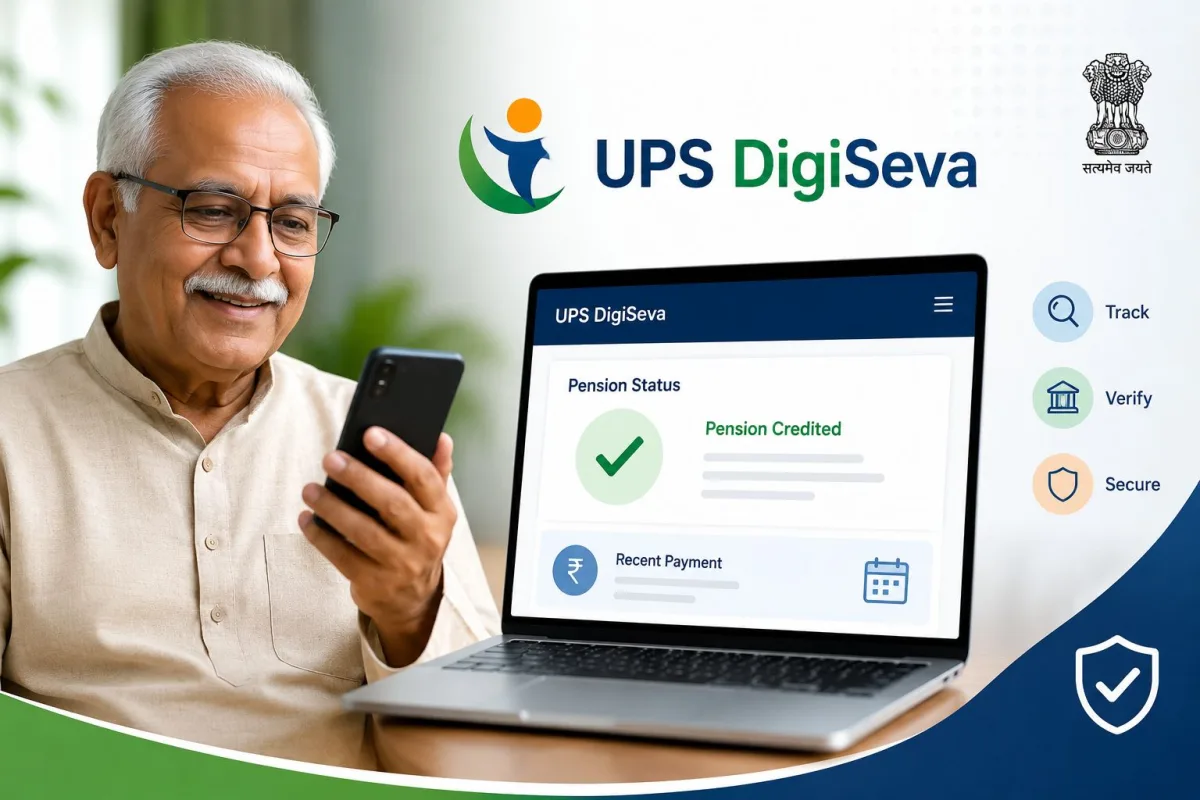
If you're a central government employee, the last couple of years have thrown a lot at you: the Unified Pension Scheme notification, NPS switch windows, equity allocation changes, life certificate deadlines. And now, in 2026, pension tracking through the UPS DigiSeva integration means you can check your account details, contribution history, and projected retirement income without making a single trip to your department's admin office. This post breaks down what genuinely works online right now, what the 2026 rule changes mean for your corpus, and what still needs attention before the next round of hard deadlines.
What UPS actually is (and why it's not the same as OPS)
The Unified Pension Scheme was notified for central government employees and became operational from April 1, 2025. The headline feature: UPS guarantees a pension. Specifically, 50% of the average basic pay drawn in the last 12 months before retirement, provided you've completed 25 years of service. There's also a proportionate pension for those with 10 to 25 years of service, and a minimum pension of Rs 10,000 per month for anyone who's completed at least 10 years.
NPS, by contrast, gives you whatever the market gives you. That's fine when equity markets cooperate, but nobody wants to retire in a down year and find their corpus is 30% smaller than they projected. The push for UPS came after years of state government employees and unions demanding a return to the Old Pension Scheme. UPS is the central government's compromise (not a clean one, but a compromise). The Tamil Nadu Assured Pension Scheme, which The Hindu covered recently, is a state-level variation doing something similar, though the specifics differ.
For All India Services officers (IAS, IPS, IFS), the central government notified the All India Services (Implementation of National Pension System) Rules, 2026, which SCC Online covered in detail earlier this year. Those rules clarify how NPS provisions apply to these cadres and what options are available to them.
What the DigiSeva pension portal actually lets you do
DigiSeva is the government's integrated service delivery interface, and its pension-related features have expanded quite a bit through 2025-26. Here's what central government employees can genuinely do online right now, without visiting any office:
- View your PRAN statement and month-by-month contribution history on the PFRDA's CRA portal
- Check employer contributions (14% of basic pay plus DA) and your own contributions (10% of basic pay plus DA) separately and verify they're correct
- Update nominee details without a physical form
- Submit your annual life certificate digitally via Jeevan Pramaan, now integrated with DigiLocker
- Access UPS pension projection calculators that estimate your guaranteed monthly amount at retirement
- Download pension passbooks and annual statements directly to DigiLocker for use in loan applications and tax filings
Honestly, the DigiLocker integration is the most useful part for day-to-day purposes. If you've already set up DigiLocker (and if you haven't, our guide to DigiLocker for government documents walks you through it), pension statements stored there are accepted as verified documents by most banks and the income tax department without printing or re-uploading anything.
Step-by-step: checking your pension balance and UPS projection
You'll need your PRAN first. If you don't have it handy, your DDO (Drawing and Disbursing Officer) can provide it. Or you can get it by logging into the eNPS portal with your registered mobile number.
Once you have the PRAN:
- Go to cra-nsdl.com (for NSDL CRA users) or the PFRDA portal at npstrust.org.in
- Click "Subscriber Login" and enter your PRAN and password
- For first-time login, authenticate via the OTP sent to your registered mobile number
- Under "Transaction Statement," you'll see full contribution breakdowns and total pension wealth accumulated
- The UPS tab, added in 2025, shows your projected guaranteed pension based on current service length and pay grade
The projection calculator under the UPS tab isn't perfect. It doesn't account for pay commission revisions or future DA hikes. But it gives a reasonable baseline number and it's useful for rough retirement planning. I'd treat it as a floor, not a ceiling.
The equity allocation change NPS subscribers should actually know about
This one didn't get as much attention as it deserved. The Economic Times reported that central government employees can now opt for equity allocation up to 75% of their NPS corpus via the LC75 lifecycle fund option. Previously, the options for central government NPS subscribers were more restricted, with lower default equity ceilings.
"If I could invest in only one asset class for life it would be equity," said Sriram Iyer, MD and CEO of HDFC Pension, in a recent Economic Times interview.
Look, that's a reasonable view for long-horizon investors. If you're 32 years old and have 26 years until retirement, the LC75 option makes mathematical sense. The lifecycle fund structure automatically reduces equity exposure as you approach retirement age, so it's not like you're holding 75% in equities at age 58.
To change your investment option, log in to the CRA portal and navigate to "Investment Option Change." You can do this twice a year for free. The change applies to future contributions, but existing corpus allocation can also be switched in the same session.
Deadlines you need to put in your calendar right now
Government pension administration has hard annual deadlines that cause real problems when missed. Upstox flagged a "triple deadline" around November 30 that caught a significant number of employees off guard in 2025:
- Life certificate (Jeevan Pramaan): Due by November 30 every year. Submit via the Jeevan Pramaan smartphone app using face or fingerprint biometrics, at any Aadhaar-enabled Common Service Centre, or at your bank branch. Missing this can freeze pension disbursement for pensioners already retired.
- KYC update: Also flagged around November 30. Outdated KYC records trigger account restrictions. The CRA portal now lets you update documents entirely online.
- Pension scheme switch window: The window for existing NPS subscribers to switch to UPS had a hard deadline in late 2025. If you missed it, check with your department's admin section for any extended windows announced in 2026.
Set a calendar reminder for October 15 every year. Six weeks of buffer is enough to sort out KYC issues and get the life certificate submitted without any last-minute scrambling.
NPS vs UPS in 2026: an honest read
If you're still on NPS in 2026, that's not automatically the wrong position. It depends entirely on your situation.
For employees with 20 or more years left to retirement, the LC75 equity option under NPS could build a substantially larger corpus than what UPS would guarantee, assuming reasonable long-term market returns. NPS also allows a 60% lumpsum withdrawal at retirement, which can be useful for large one-time expenses. UPS structures the payout primarily as a monthly annuity, which is a meaningfully different thing.
Thing is, if you're within 10 to 15 years of retirement and want income certainty, UPS's 50% guarantee is genuinely valuable. Market volatility matters more when the horizon is short. And there's real psychological value in knowing exactly what you'll get every month. The NPS corpus-to-annuity conversion path can't give you that same precision.
The 8th Pay Commission is expected to revise pay scales for central government employees, and the impact flows directly into UPS calculations. Since UPS pegs pension to basic pay at retirement, any upward revision from the commission raises the guaranteed pension floor. The exact fitment factor isn't announced yet, and the numbers there are a bit fuzzy until the commission submits its report. Track the updates through our government policy news section as recommendations come in.
What about state government employees?
The UPS and DigiSeva integration described here applies to central government employees and All India Services officers. State government employees are on different schemes depending on their state. Several states reinstated the Old Pension Scheme after employee agitation, and others remain on NPS variants. Tamil Nadu has its own Assured Pension Scheme with different guarantee structures.
If your state uses NPS, the PFRDA portal and CRA login will still work for tracking your NPS account. But UPS specifically, and the DigiSeva-based pension projection tools, are currently a central government feature. The rollout timeline for state employees varies considerably and hasn't been uniformly announced.
Check your state government's service portal for state-specific pension tracking. Many states have their own pension portals now, though none are as well integrated into DigiLocker and Aadhaar authentication as the central system is.
For a broader picture of how India's digital service delivery infrastructure connects, our explainers on India's digital governance stack cover how DigiLocker, DigiSeva, ABHA, and other platforms are converging into a single identity-linked service layer that'll eventually cover most citizen-government interactions.