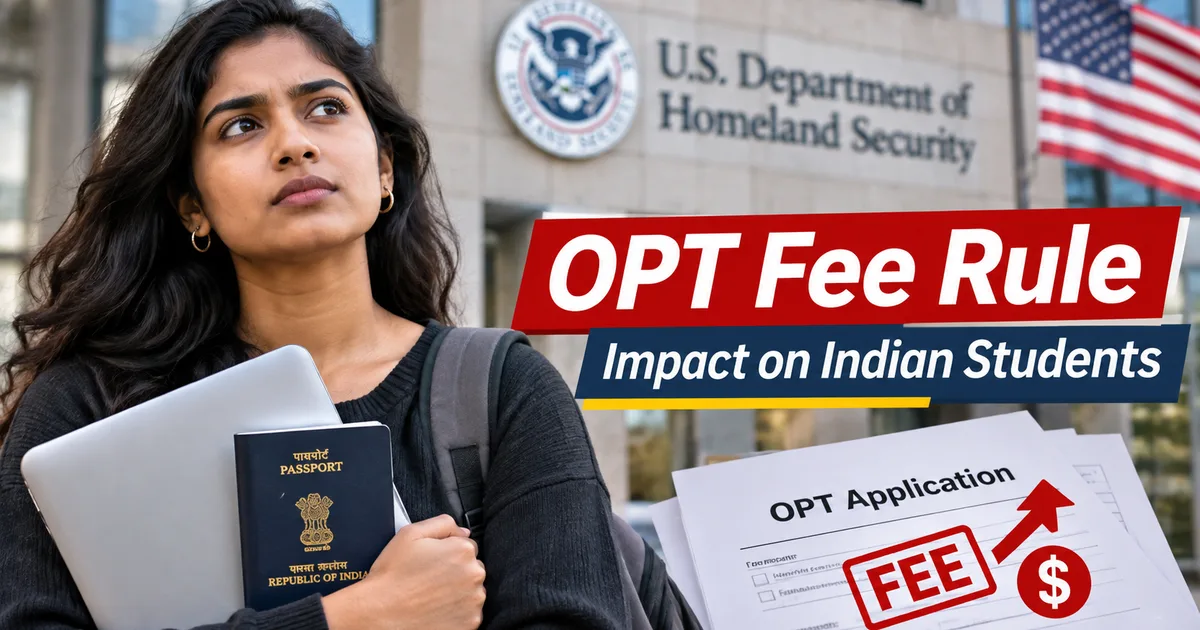
If you have a cousin or classmate packing bags for a master's degree in America, you probably know the usual math. It's intense. Families pledge fixed deposits and put ancestral property on the line for an SBI education loan of ₹50 lakh, counting on three years of US work authorization to clear the debt. That calculated risk just hit a massive speedbump with the US DHS proposed OPT fee rule, a regulatory shocker that would slap a $70,000 fee on international graduates seeking practical training.
Yes, seventy thousand US dollars.
Converted to Indian currency at current exchange rates, that comes out to roughly ₹58 lakh to ₹67 lakh upfront just for permission to work after finishing college. (The numbers here are a bit fuzzy depending on the day's exchange rate, but the scale is terrifying.) And if a student applies for the additional two-year science and technology extension, the proposal asks for another $30,000, which is around ₹29 lakh. In total, you're looking at an eye-watering bill touching ₹96 lakh before earning a single dollar in full-time salary.
Honestly, I know it sounds completely surreal. When the draft first circulated through US university circles, people genuinely thought it was a typo or a bad joke. But it's not. The Department of Homeland Security submitted the rule to the Federal Register, and it already cleared White House review. If you ask me, the shockwaves are very real, hitting middle-class households across Hyderabad, Bengaluru, Pune, and Chennai.
What is the US DHS proposed OPT fee rule?
To understand why everyone is panicking, you have to look at how Optional Practical Training (OPT) actually works today. Under current US immigration rules, any international student on an F-1 visa who finishes a degree gets 12 months of temporary work authorization. If the degree is in a STEM subject (science, technology, engineering, or mathematics), graduates can apply for a 24-month STEM OPT extension. That gives them three full years to work and try their luck in the H-1B visa lottery.
It's the main draw. Without it, the math doesn't work.
Right now, getting an Employment Authorization Document card from USCIS means filing Form I-765, which costs around $470 to $520. That's an annoying expense (I know), but manageable on a student budget. Under the new Department of Homeland Security plan, that basic paperwork cost turns into an absolute nightmare. The proposal establishes a $70,000 fee for the initial OPT recommendation, alongside another $30,000 fee for the STEM extension.
According to the American Council on Education, an association representing more than 1,600 colleges and universities, these proposed fees would shut out thousands of talented international graduates and inflict lasting damage on higher education research programs.
DHS officials claim the giant fee helps offset federal overhead and protects American workers from wage competition. But university leaders don't buy that for a second. In my view, it's pretty obvious what this really is: a backdoor attempt to kill off the OPT program without passing new laws through Congress.
How the $70,000 OPT fee breaks down in Indian rupees
Look, when US policy papers talk about $70,000, it sounds like some distant bureaucratic figure. Turn that into Indian rupees, though, and it gets terrifying for normal families.
At typical exchange rates, $70,000 comes out to roughly ₹58 lakh to ₹67 lakh, depending on currency swings and bank transfer fees. Add the $30,000 extension fee (around ₹25 lakh to ₹29 lakh), and the full government bill tops ₹96 lakh.
That is an insane amount of money.
Think about how Indian families actually pay for an American degree. Most students don't come from family wealth. Parents borrow against residential flats or take out non-collateral education loans from private lenders like HDFC Credila or Avanse at 10.5% to 12.5% interest. Just covering tuition and living costs at an ordinary public university runs between ₹40 lakh and ₹65 lakh. Now stack an extra ₹67 lakh on top of that mountain of debt before a graduate can even accept a job offer.
It's completely unrealistic.
Even if an employer wanted to sponsor someone, asking any company to cough up $70,000 for an entry-level software engineer or data analyst is just absurd. Startups won't do it. In my experience, small tech firms will simply refuse to hire F-1 visa holders rather than deal with that kind of fee. And if students have to pay it directly, going to America is over for the middle class.
Impact on Indian STEM students and education loan repayment
Indian students are the foundation of graduate STEM programs across America. According to Open Doors data, India accounts for more than 330,000 students in the country, and over three-quarters of them study engineering, computer science, mathematics, or data analytics.
Why do so many Indians pick STEM? Simple. It's the 36-month work window.
That three-year runway gives graduates time to earn in US dollars and send money back home through wire transfers or UPI-linked NRE accounts to clear their Indian bank loans. Without those dollar paychecks, repaying a ₹50 lakh loan on an Indian fresher salary of ₹6 lakh to ₹10 lakh takes decades. It crushes family finances.
Thing is, the tech job market is already rough. With recent tech visa layoffs hitting major software firms, landing an entry-level role takes months of endless interviewing. Slapping a massive government fee on top of an already tight market will lock out thousands of promising engineers.
And this rule doesn't sit alone. Pair it with permanent US visa bond rules that ask for thousands of dollars in travel security deposits, and the pattern is obvious. If you ask me, the message from Washington is pretty clear: international talent isn't welcome anymore.
Why US universities and state attorneys general oppose the fee
The pushback across the US has been furious. Nearly 600 American universities and academic associations submitted formal objections asking DHS to scrap the rule right away.
I think people often forget how much American universities depend on these students. Major research institutions, including Cornell University, the University of Michigan, the University of Southern California, and the University of Washington, warned that charging $70,000 per head will empty out graduate engineering labs. It's not an exaggeration. International students work as teaching assistants and run laboratory experiments, all while paying full out-of-state tuition that keeps these departments afloat.
State attorneys general jumped in too. They filed formal comments arguing that the proposed fee violates federal rulemaking standards. They made the point that chasing foreign talent away damages state economies that rely on student spending and tech partnerships.
On the other side, restrictionist groups like the Center for Immigration Studies backed the plan. Their argument is that OPT gives foreign grads an unfair tax edge over US citizens, since OPT workers and their employers skip Medicare and Social Security taxes for their first couple of years.
So the lines are drawn. On one side, you have universities and state governments fighting to keep their talent. On the other side sits a hardline federal agency determined to cut foreign workers out of the equation altogether.
The legal battle ahead and whether the rule will survive
Whenever a headline-grabbing visa proposal drops, everyone assumes the border doors are shutting tomorrow morning. That's natural. But in the US regulatory system, putting forward a wild fee proposal is very different from actually making it stick. Honestly, if you ask me, the odds of this $70,000 rule surviving a federal courtroom in its present form are practically zero.
Here's why.
Before any federal rule turns into binding law, the agency has to follow the Administrative Procedure Act. Under this statute, DHS has to review and formally address every single substantive public comment sent in by universities and private employers. That process takes many months (and often over a year).
If DHS ignores the outcry and pushes out a final rule anyway, a coalition of universities and industry groups will sue within hours. They'll ask a federal judge for an emergency preliminary injunction to freeze the policy before anyone pays a dime.
Federal courts have knocked down arbitrary fee spikes before when agencies acted without clear permission from Congress. Judges generally don't let bureaucrats invent massive monetary barriers out of thin air. And while those lawsuits drag through the courts for two or three years, the existing OPT rules stay active.
You can read more about how regulatory changes impact technology careers in our practical tech explainers.
Sensible next steps for students and applicants
Watching this regulatory mess unfold from thousands of miles away is stressful, especially when you've already spent real money on GRE coaching and visa consultants. Panicking and tearing up your plans overnight makes zero sense. But pretending everything is fine is just as bad. Here are sensible steps to protect yourself:
- Keep in close touch with your university international student office to get verified updates rather than relying on viral social media clips.
- Calculate your education loan budget strictly around tuition costs and avoid borrowing beyond what your family can comfortably guarantee.
- Explore accredited master's programs in countries like Germany, Canada, or the United Kingdom where post-graduation work routes are more transparent.
- Build strong technical skills in machine learning, systems engineering, and open source development that make employers willing to navigate visa paperwork.
- Keep personal savings in liquid funds so unexpected administrative delays do not leave you stranded without living expenses.
Look, America still has world-class research labs and massive tech employers. That hasn't vanished. What has changed, though, is the idea that an American degree is a guaranteed ticket to easy Silicon Valley wealth. If you ask me, going in with eyes open is the only way forward now: keep your loan manageable and don't gamble with your family's security.