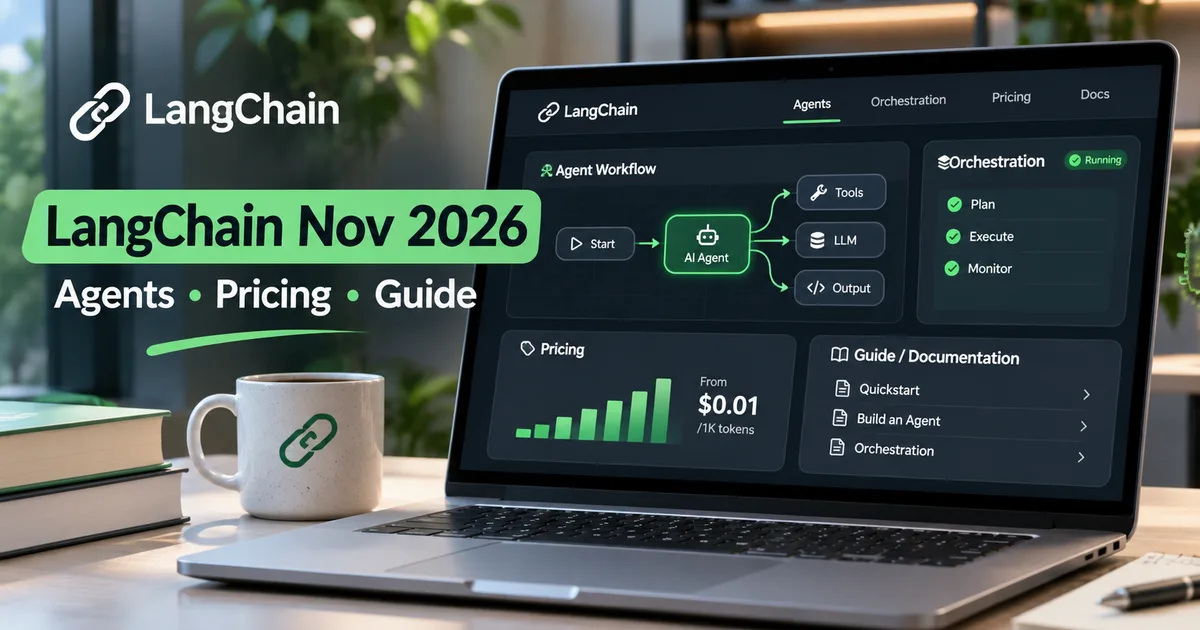
Most people still treat AI like a slightly smarter search engine. You type a question, and it spits out a paragraph. The LangChain November 2026 update is a pretty loud sign that this simple chat phase is wrapping up. Fresh off a massive $300 million Series C round led by CapitalG, which pushed its valuation to $3 billion according to The Wall Street Journal, LangChain has doubled down on software that actually finishes multi-step work on its own.
Sounds great on paper. But if you're a B.Tech student in Pune or a small agency owner trying to automate boring client work, you probably have just one question. Is this stuff actually useful right now, or is it just more Silicon Valley hype?
I spent the last few days digging through the release notes and reading some pretty blunt complaints from senior engineers who've walked away from the framework. Also tested a local Python setup on my own laptop. Honestly, the truth sits somewhere in the middle (which makes sense, actually, given how fast this space moves). Some of the new tooling is genuinely helpful. Other parts are still a mess and feel way heavier than they need to be.
Why everyone is talking about LangChain right now
Look, if you haven't touched code before, LangChain can sound intimidating. It isn't an AI model like ChatGPT or Gemini. It's the plumbing. An AI model on its own is just a brain sitting in a jar with no hands, and LangChain is what connects that brain to your PDFs, your Google Drive, your SQL database, and your Slack channels so it can actually do things.
In its Business Wire funding announcement, the company said the $300 million raise is meant to help every business own its intelligence rather than renting black-box bots. Clever pitch. More interestingly, HackerNoon reported on LangChain's growing argument that traditional prompt engineering is slowly disappearing. Instead of obsessing over magic wording inside a single prompt, developers are spending their time building structured workflows and error checks around models.
And if you ask me, that shift is why our AI tools and software reviews have moved so heavily toward agent platforms this year. A clever prompt gets you a decent email. A solid workflow gets you an invoice-checking bot that doesn't hallucinate GST numbers at 2 AM.
New AI agent features in the November 2026 update
A bunch of stuff shipped across the ecosystem this month, though you don't need to care about all of it. Three additions actually matter if you build or buy AI software in India.
Deep Agents runtime for multi-step tasks
The headline addition, detailed by MarkTechPost, is Deep Agents. Basically, it's a structured runtime built for planning and long-term memory with proper context isolation in multi-step AI agents.
Why does context isolation matter? Suppose you build an agent to read 40 supplier invoices and compare them against an order sheet, then draft payment reminders. Older agent setups stuffed every error message and raw PDF chunk into one giant chat window. Halfway through, the model got confused and burned through thousands of paid tokens. Deep Agents splits that work into isolated sub-tasks with clean scratchpads. It plans first and runs isolated checks so the main memory stays clean. In my experience, this is one of the better upgrades they've shipped all year because it fixes a real headache developers actually hit in production.
Open-source Content Studio for Slack teams
LangChain also open-sourced Content Studio, which is the internal Slack design agent it used to generate over 3,000 visual assets, as covered by explainx.ai. Look, most open-source demo repos from big startups are barebones toys that break the minute you clone them. This one is different. It was built for a real marketing team living inside Slack.
If you run a small D2C brand or digital agency in Mumbai or Gurugram, you won't magically deploy this with one click. You'll still need a developer for a weekend to wire up your brand fonts, Slack permissions, image APIs, and approval rules. Once it's running, though, your social media team can request campaign graphics right inside a Slack thread. And if you don't want to touch code at all? You're still way better off with a consumer tool like the ones in our Canva Dream Lab AI review.
Enterprise push with NVIDIA NemoClaw
On the corporate side, EY announced an industry-first validation of NVIDIA NemoClaw for LangChain. Everyday users can ignore this completely. Still, if you're at an Indian IT services firm like TCS, Infosys, Wipro, or one of the Big Four global delivery centres in Hyderabad or Noida, pay attention. Enterprise clients in banking and healthcare love seeing validated NVIDIA and EY stamps before they sign off on budgets, so LangChain skills are sticking around on Indian job boards for a while longer. I'm not sure exactly why enterprise teams need this much hand-holding, honestly, but that's how big contracts work.
Quick reality check: LangChain's core Python and JavaScript frameworks remain free and open-source. You don't pay LangChain a single rupee just to write and run agent code on your own laptop or server.
LangChain pricing in India and the hidden API bills
Pricing trips up almost every beginner I talk to. People see a $3 billion valuation and assume they need a corporate credit card just to install the library.
Not true. Here's how the money actually works when you build with LangChain from India:
- The open-source libraries (LangChain, LangGraph, and the Deep Agents runtime) cost Rs 0. You install them with pip or npm and run them anywhere.
- Their paid commercial product is LangSmith, which gives you a web dashboard to inspect traces, test prompts, and catch agent bugs. The Developer tier is free with a monthly cap on traces, which is plenty for college projects and solo prototyping.
- The LangSmith Plus tier sits at $39 per user per month. At current exchange rates, that's roughly Rs 3,300 to Rs 3,400 per seat every month before your bank's 3.5% international forex markup and 18% GST on foreign SaaS charges.
- Enterprise pricing is custom and isn't listed publicly, so I couldn't pin down an exact INR figure for large Indian teams.
One annoying friction point for Indian students and freelancers is billing. It's still USD-based via international debit or credit cards, not UPI Autopay (annoying, I know). Make sure international transactions are on in your banking app before upgrading, whether your card is from HDFC or ICICI or you're using SBI.
Thing is, LangSmith isn't even where most of your money goes. Your actual monthly bill is the AI model providers you plug into LangChain. If your Deep Agent loops 15 times while researching a topic using a frontier model, those API tokens add up fast. You might wire it to Google's latest models (we broke down those numbers in our Google Gemini 4.0 pricing and setup post) or pair your workflow with Anthropic tools covered in our Claude AI desktop app guide. Even a modest freelance project can eat Rs 1,500 to Rs 4,000 a month in API calls if you don't set hard spending limits, and the exact bill is a bit fuzzy until you run real traffic.
LangChain compared against native agent tools
I promised to be honest about the downsides, so here we go. A growing chunk of experienced developers really hate LangChain. An article in Towards Data Science recently explained why many AI engineers are dumping wrapper frameworks for native agent setups directly from OpenAI and Anthropic, or Google's own SDKs.
And honestly, I think their complaint makes total sense. LangChain updates fast and sometimes breaks older tutorials from six months ago. On top of that, it wraps simple API calls in extra layers of abstraction that are a pain to debug. If you just need a bot to call two tools and return JSON, importing a huge framework is total overkill. It's like bringing a tractor to trim a tiny balcony plant.
| Approach | Best suited for | Approx. India cost | Pros | Cons |
|---|---|---|---|---|
| LangChain with Deep Agents | Complex multi-step bots, switching between multiple AI models, IT job portfolios | Rs 0 open-source; LangSmith Plus ~Rs 3,350/seat/month plus model APIs | Huge ecosystem, strong memory isolation, model-agnostic, high recruiter demand in India | Steep learning curve, frequent version changes, can feel bloated for simple apps |
| Native model SDKs (OpenAI, Gemini, Claude) | Clean production apps locked to one main AI provider | Rs 0 SDK; pay only for API tokens (starts under Rs 500/month for light use) | Less code to break, faster debugging, instant access to newest model features | Harder to swap providers later, you build your own memory and retry plumbing |
| No-code automation (n8n, Make) | Small business owners, agencies, non-coders automating WhatsApp or sheets | Rs 0 self-hosted n8n or Rs 800 to Rs 2,500/month cloud plans | Visual drag-and-drop canvas, fast setup over a weekend, zero Python needed | Gets messy for complex reasoning loops, higher monthly SaaS bills at scale |
Step-by-step LangChain guide for a free local RAG setup
You don't need a US credit card or a big API budget to try LangChain today. As Dataconomy recently showed in its walkthrough on Python workflows, a local RAG (Retrieval-Augmented Generation) app lets you chat privately with your own documents for Rs 0.
Say you're a UPSC aspirant sitting on a 250-page Economic Survey PDF, or a chartered accountant sorting through dense RBI circulars. Uploading client PDFs to random free websites is sketchy anyway. Running everything locally on a 16GB RAM laptop (even a mid-range Rs 55,000 Windows machine or an M-series MacBook) keeps your files offline. Here's how to set up a clean test project. You can also check our other practical how-to tech guides if you're brand new to Python environments.
- Install Python 3.11 or newer and download Ollama on your PC. Once Ollama installs, open your terminal and run the command to pull a compact open model like Llama or Qwen. On your screen, you'll see a dark terminal window displaying a white text progress bar as the 4GB to 5GB model file downloads, ending with a clean 'success' message at the bottom.
- Create a fresh project folder in VS Code and activate a virtual environment. Run pip install for langchain, langchain-community, langchain-ollama, and chromadb (your local vector database). In your VS Code bottom panel, you'll watch several lines of yellow and white installation logs scroll past before returning to your active (.venv) prompt.
- Drop one sample PDF into that folder, say an RBI notification or your college syllabus. Write a short Python script using LangChain's PyPDFLoader to split the document into 800-character chunks and store their embeddings inside Chroma. When you run the script, there won't be any flashy graphics, just a new chroma_db folder popping up in your left VS Code file explorer sidebar holding the indexed data.
- Connect your local Ollama model to that Chroma retriever using LangChain's current runnable chain syntax, or wrap it in a simple Deep Agents loop if you want it to check two different PDFs and compare clauses. Type a question into the terminal and hit enter. Your laptop fan might spin up for five seconds, and then the answer will stream word-by-word in plain text right beneath your prompt, citing the exact page number it pulled from.
- Optional debugging step: sign up for the free LangSmith Developer tier and paste your free tracing token into your .env file. When you open LangSmith in Chrome, you'll see a clean white dashboard with a left navigation bar and a tree-style timeline in the centre showing every document chunk your agent retrieved, how many milliseconds each step took, and where any answer went off track.
Quick tip from my own testing: if your laptop only has 8GB of RAM, stick to tiny 3B parameter models in Ollama. Otherwise Chrome and VS Code will freeze up faster than an IRCTC tatkal page at 10 AM.
Who should actually learn LangChain in late 2026?
So, should you spend your next three weekends learning this update? Depends on who you are.
If you're a computer science student or a software engineer in India aiming for AI roles in 2027, yes, go learn it. Even if senior architects complain about the abstraction layers on Reddit, hiring managers across Bengaluru and Pune, as well as Chennai, still filter resumes for LangChain and RAG architecture alongside LangGraph. Knowing how Deep Agents handles context isolation will give you real talking points in technical interviews, if you ask me.
Indie hackers or freelancers shipping a tiny micro-SaaS this month should be pickier. Call the native Gemini or Claude API directly first. Move to LangChain only when your app actually needs multi-step planning or visual trace debugging in LangSmith (or when you have to swap models). And if you're a shop owner or a teacher just trying to get daily work done faster? Don't stress over any of this code. Wait a few months and the features built on LangChain will quietly show up inside the everyday apps you already use.