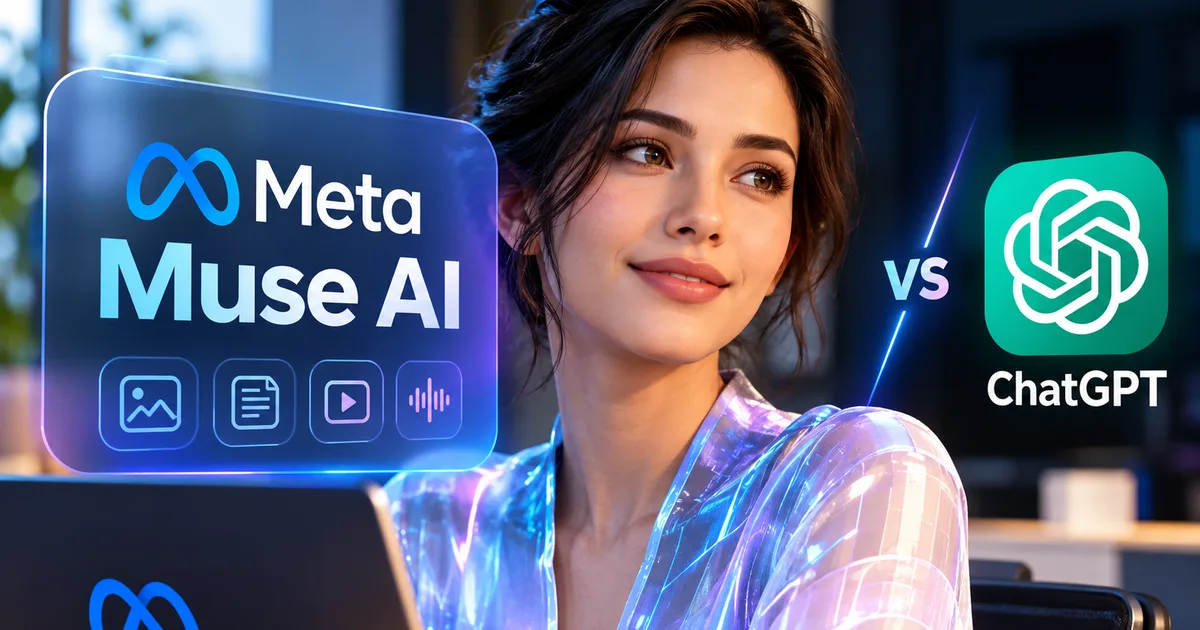
I've been thinking a lot about the difference between talking and doing. For the last couple of years, we've all been talking to AI models. You ask a conversational bot to write an email, it gives you the text, and then you copy it, open Gmail, paste it, and hit send. It's helpful. But it's still limited to conversation. Meta wants to change that. With their Connect announcements, Mark Zuckerberg and his team are pushing the Meta Muse AI 2026 rollout. It's a personal AI agent designed to actually perform tasks for you.
Honestly, this is the first time I've looked at an AI announcement and thought it might actually change how I use my phone. We cover a lot of AI Tools & Software here, and most of them feel like different flavours of the same text generator. Muse feels different. There's a catch for us in India, though. A big one.
The Connect 2026 keynote revealed exactly what Meta Muse AI is, how the new hardware ecosystem works, and the specific reasons you can't use it in India right now.
What exactly is the Meta Muse AI agent?
Basically, Muse is a digital assistant that actually has hands. Meta built Muse to operate across different apps on your device. It actively works in the background to complete multi-step tasks.
CNBC reported that Muse can shop and check out for you. Let that sink in for a moment. You could theoretically tell Muse to buy a specific pair of shoes from Myntra. The agent opens the app. It finds the shoes in your size. Then it adds them to the cart and completes the payment. Meta stated it can autonomously send emails and book travel on your behalf (which makes sense, actually, given their massive resources).
We're moving from AI as an advisor to AI as an executor. And Meta is bringing the Muse AI agent to Windows PCs as a native app, according to iPhone in Canada. This means it integrates right into your desktop workflow. If you ask me, having an AI that automatically manages your calendar and sends out meeting invites is going to save hours for anyone sitting in an office in Bengaluru or Mumbai.
What the Muse AI agent can actually do
To understand why this matters, you have to look at what Muse can actually do. According to Meta's demonstrations, the agent can perform several complex actions.
- It can autonomously draft appropriate responses and hit send without your intervention.
- It navigates ecommerce apps to find products, adds them to your cart, applies relevant coupons, and completes the payment process securely.
- It pulls your personal information from your device to automatically populate tedious online forms and applications.
- It manages travel bookings by finding flights and hotels that match your specific budget and schedule requirements.
Let's look at another example. Say you're planning a trip to Goa. With standard chatbots, you ask for an itinerary, and you get a list of places to visit. You then open MakeMyTrip, search for the flights, enter your details, and pay. But with a fully integrated Muse agent, you just say 'Book me a weekend trip to Goa under 20,000 rupees.' Muse checks your calendar, finds the flights, books the hotel, and handles the checkout. That's the promise. Whether it works flawlessly in reality is another question entirely. We've all seen AI hallucinate. And if it hallucinates while spending your hard-earned money, that's a very expensive mistake.
The hardware side: Muse Charm and smart glasses
Software is only one part of Meta's plan. Thing is, Meta knows that if you have to unlock your phone and open an app to command your AI, you probably won't do it that often. So they're building dedicated hardware to make it easier.
The most interesting piece of tech they announced is the Muse Charm. It's a palm-sized AI device that fits on your keychain. It has a tiny display and a fingerprint sensor. You just touch it and speak your command. Muse does the rest. You never pull out your smartphone. I think this will be incredibly useful when you're carrying groceries or driving.
I'm particularly interested in the Muse Charm because we're all addicted to our smartphone screens. The average person spends hours scrolling aimlessly. By giving you a dedicated device that handles tasks without a massive screen, Meta might actually help reduce screen time. You press the fingerprint sensor, tell it to text your wife that you're running late, and you put it away. No opening WhatsApp and getting distracted by five other chats.
Then there are the Ray-Ban Meta glasses. Meta is heavily expanding their AI glasses portfolio in the Indian market. Ranveer Singh was just named the first India brand ambassador for Ray-Ban and Ray-Ban Meta. They're preparing to add the Muse AI agent directly to these glasses. Imagine walking down a street in Delhi, looking at a restaurant menu, and asking your glasses to book a table and pay the reservation fee via UPI. We aren't fully there yet with the UPI integration, but that's clearly the direction they're heading.
They also announced a new 100-gram VR glasses device. This ditches the bulky headset design. It brings virtual reality into a normal glasses-shaped form factor.
Muse Spark and the open-source push
Meta also launched a secondary project called Muse Spark alongside the consumer products. The numbers on this are genuinely impressive.
Meta claims Muse Spark helped solve 6 major math problems. More importantly for developers, they released it as an open-source project for AI hardware. According to Tech Insider, Muse Spark can run on an ESP32 chip. I'm not sure exactly why they picked that specific chip, but if you know anything about hardware hacking, you know the ESP32 is a dirt-cheap microcontroller you can buy for a few hundred rupees on Amazon India.
College students in engineering colleges across India can now build their own physical AI devices using Meta's open-source models. You could build a smart home controller or a custom robot for less than 500 rupees. I love this approach. While other companies build walled gardens, Meta is throwing the tools out there to see what people build.
How Muse competes with ChatGPT
Everyone is asking how this stacks up against OpenAI and ChatGPT.
ChatGPT is brilliant at processing text and analyzing data. If you need to summarize a 50-page PDF, it's still your best bet. But the whole experience is completely contained within its own app or website.
Muse is designed to break out of that box. The competition is no longer about who has the smartest model. It's about who has the most useful model. Meta has a massive advantage because they own WhatsApp, Instagram, Facebook, and Threads. If Muse can seamlessly read a message from your mom on WhatsApp and order what she asked for on Zepto, OpenAI simply can't compete with that level of integration.
Look, this is very different from what other phone manufacturers are doing. For instance, if you look at the Xiaomi HyperOS 2.0 India Rollout 2026: Eligible Phones List, Release Date, and New AI Features Explained, they're baking AI into the phone's operating system. Meta is trying to build a layer above the operating system, or bypass the phone entirely with their glasses and charms.
If you're curious about how these features might integrate with the apps you already use, you should check out our breakdown of the Meta Muse AI Agent 2026: Features and WhatsApp in India.
Why the India release date is delayed
Now for the frustrating part. Meta launched Muse, but India is excluded from the initial rollout.
Medianama confirmed that the release skips India entirely for now. It comes down to safeguards and regulations.
Livemint recently published a report asking why stronger safeguards matter when AI agents start making decisions without humans. They have a valid point. The Indian digital payments ecosystem is unique. We rely heavily on UPI. If an AI agent has the power to make payments and act on your behalf, the security risks are huge. What happens if Muse gets confused and transfers 10,000 INR to a scammer? Who is liable? The bank? Or you?
Our regulatory bodies like the RBI and CERT-In are exceptionally strict about automated payments and digital security. Meta probably needs more time to build India-specific safeguards and get regulatory approval before they can let an AI run loose in our financial apps. It's annoying to be left behind, but I'd rather they take their time and get the security right.
We're already seeing security issues with AI models globally. According to Tech Insider, a zero-day vulnerability was discovered recently, giving users 4 reasons to avoid Meta Muse AI. Security is hard. And autonomous agents increase the attack surface a lot.
What this means for small businesses
Meta is giving small businesses their own Muse AI agent. This feature caught my eye immediately.
Think about a local boutique or a hardware store that relies on WhatsApp Business to take orders. Right now, a human has to reply to every message, check inventory, calculate shipping, and send payment links. Meta wants to replace that human with a Muse agent. The agent can talk to customers, negotiate prices, check stock levels, and close the sale all on its own.
This is going to change how small commerce works. We'll have to wait for it to arrive here. In the meantime, you can read up on other tech concepts in our Tech Explainers section to stay ahead of the curve.
What to expect next
Muse is a completely different way of interacting with technology. It moves us from talking to doing.
The hardware, especially the Muse Charm and the Ranveer Singh-backed Ray-Ban glasses, shows that Meta wants to bypass the smartphone entirely. They want the AI to be on your face or in your pocket, ready to act.
We might have to wait a while before we can use Muse to automatically pay our electricity bills or order groceries on Blinkit. The regulatory hurdles in India are real. But when it does arrive, it's going to make the current version of ChatGPT look like a glorified calculator.
Things are moving fast. The shift from chatbots to agents is the only trend that actually matters this year, even if we have to wait a little longer for it.