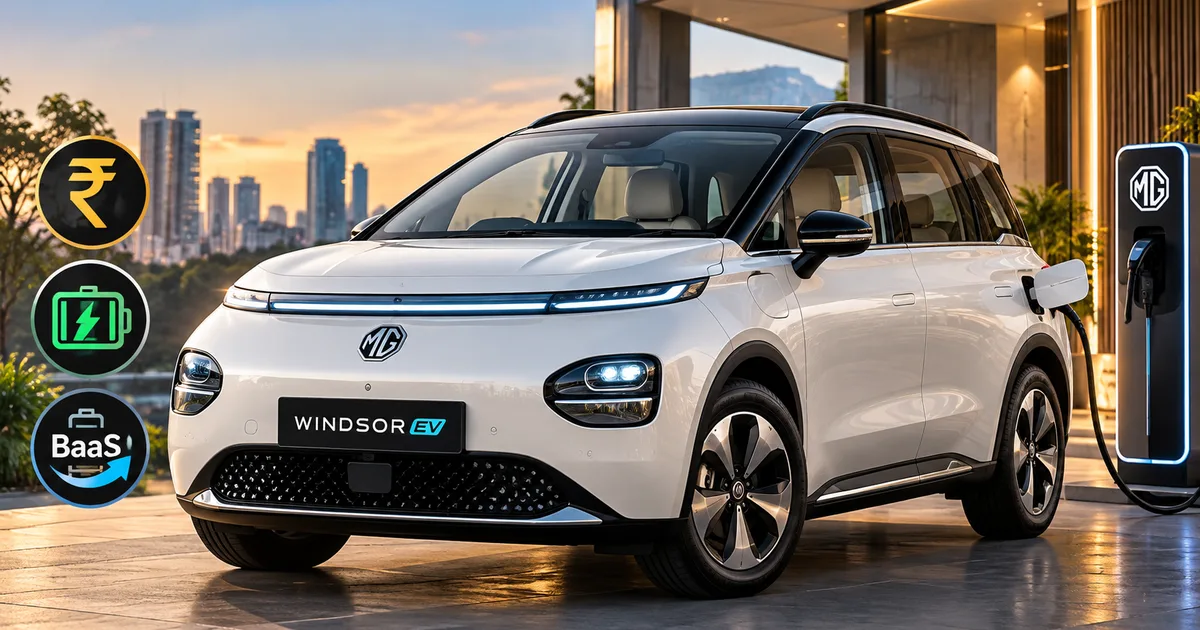
So you're looking at the new electric cars hitting the market and wondering what the MG Windsor EV Indulge Edition 2026 India launch means for your wallet. Honestly, navigating EV prices right now feels like doing advanced math. The car itself costs one amount. But then there's the battery rental. We're going to break down the expected price, range, and exactly how this Battery as a Service (BaaS) model works in plain English.
I've seen the teasers from JSW MG Motor India. They're pushing this new Indulge edition hard. The standard Windsor is already with about 80,000 families in India. That's a massive number for an EV here. In my experience, a number that big means they did something right. But what makes the Indulge edition different? Let's just look at the exact changes.
What the Indulge edition actually changes
JSW MG Motor India started dropping teasers for the Indulge edition recently. From what we know, this is a new top-tier variant. The Windsor itself isn't exactly new to Indian roads. The company says tens of thousands of families are driving one right now.
But the Indulge edition adds some specific extras. We'll probably see exclusive cosmetic changes (which makes sense, actually). Think new exterior colours and factory-fitted accessories that usually cost extra. They want to make it look premium. I think the core mechanical parts will stay exactly the same. You're basically paying for the badge and the styling.
This happens constantly in the Indian car market. A manufacturer launches a car, it sells well, and two years later they release a special edition. They just add a black roof and new seat covers. It keeps the car in the news. Sometimes the extra features are worth it. Often they're just cosmetic fluff. We'll have to wait for the final spec sheet to see if the Indulge edition has any real hardware upgrades. I'd love to see ventilated seats become standard. Indian summers are a mess without them. We can hope.
I expect upgraded alloy wheels too. The standard wheels are a bit basic. A nicer set of machined alloys would completely change the stance of the car. Inside, MG might upgrade the upholstery. The current models have decent seats. But an Indulge badge demands something better. Maybe they'll go with premium artificial leather in a new shade. I also hope they upgrade the audio system. The standard setup is fine for podcasts. But it lacks punch for music. A branded audio system is a solid addition for a top-tier variant.
And then there's the tech. The Windsor already has a massive central screen that controls almost everything. It can be super annoying to use while driving. I doubt MG will add physical buttons back for the climate control. They might update the software for the Indulge edition to make it smoother, though. I'm not sure exactly why they rely so heavily on touchscreens. We'll see when it launches. If you just want the space and the electric drive, the base Windsor is probably the smarter money. But people buy cars with their hearts too.
The Battery as a Service (BaaS) model explained
This is where things get confusing for most buyers. When you buy a petrol car, you own the engine. When you buy an EV with BaaS, you buy the car body and the interior. But you rent the battery.
Why do this? Because the battery is the most expensive part of an electric car. By removing the battery cost from the showroom price, the upfront cost drops massively. Suddenly, a large electric car is about the same price as a mid-size petrol SUV. This lowers the entry barrier for buyers.
Here's how it actually works in India. You pay the showroom price for the car. Then you sign a separate agreement for the battery. You usually pay a fixed amount per kilometre you drive. You recharge the car at your house or at a public charger. You pay your electricity bill as normal. On top of that, you pay MG or their finance partner a monthly bill based on how far you drove.
It's basically like a mobile postpaid plan. You buy the phone outright. But you pay a monthly fee to use the network. In this case, you're paying for battery usage.
"BaaS shifts the battery from a capital expense to an operational expense, lowering the entry barrier for EV adoption in India."
A lot of people worry about this system. What if you don't drive much? You still have to pay some minimum amount usually. And if you drive a lot, the per-kilometre cost adds up fast. You have to do the math for your specific daily commute. I recommend checking out our other Tech Explainers if you want to understand EV charging standards in India in more detail.
Let's look at the math. Suppose the BaaS rental is 3.5 rupees per kilometre. You drive 1000 kilometres a month. Your monthly battery bill is 3500 rupees. Plus the cost of electricity to charge it, which is maybe another 1000 rupees. Total running cost is 4500 rupees. A petrol car giving 12 kmpl is about 8500 rupees for the same distance. You save money every month. And you paid less upfront. That's the sales pitch.
How BaaS billing and payments work in India
You might be wondering how the company tracks your kilometres. The car has an internet connection built right in. It sends telemetry data back to the company servers. They know exactly how far the car has driven. At the end of the billing cycle, they generate an invoice. It's a bit Big Brother, if you ask me.
Paying this invoice is straightforward. The entire system is built around UPI and auto-debit mandates. When you buy the car, you set up an e-mandate on your bank account or credit card. The monthly battery rent is deducted automatically. It's just like a Netflix subscription or a mutual fund SIP. You get an SMS notification. Then the money leaves your account.
If you're considering the BaaS route, keep these things in mind:
- You need a decent CIBIL score to get the battery rental approved by the finance company.
- The monthly mandate must not bounce, or you risk facing remote vehicle restrictions.
- You have to read the fine print about battery degradation and replacement terms.
- Selling the car requires transferring the agreement, which involves extra paperwork.
If the mandate fails because of low balance, the car won't stop immediately in the middle of the road. But if you ignore the warnings for weeks, the company can remotely restrict the car. They might limit the top speed or stop it from fast charging. Eventually, they can disable it completely. This sounds scary to some buyers. It means you never truly own the entire vehicle free and clear. You're tied to the manufacturer forever.
Some people hate this idea. They want to pay once and never think about it again. For those buyers, MG usually has an option to buy the battery outright. But that pushes the showroom price up by several lakhs. You have to decide if the lower upfront cost is worth the monthly subscription tie-in.
Expected price and real-world range
The official price is still under wraps. Automotive portals predict the launch around October 9, 2026. The base models of the Windsor have aggressive pricing because of BaaS. The Indulge edition is at the very top of the lineup. I'd expect a premium of at least fifty thousand to a lakh rupees over the current top model. That puts it in a very competitive price bracket.
Range is another big question. The standard Windsor claims a very healthy number on paper. But real-world range in Indian traffic is always lower. Especially with the air conditioning blasting during a Delhi summer. Expect somewhere around 300 to 350 kilometres on a full charge in everyday conditions. That's plenty for city driving. You'll only need to charge it once or twice a week.
If you take it on the highway, that range drops faster. Electric cars prefer stop-and-go traffic. They recover energy when braking. On the Mumbai-Pune expressway doing 100 kmph constantly, you'll see the battery percentage drop quicker than you might like. You absolutely have to plan your charging stops.
This brings up the topic of fast chargers. India has a lot of highway chargers now. But during long weekends, there are queues. You might have to wait an hour just to plug in (annoying, I know). That's the reality of EV ownership right now. It requires planning. You can't just pull into a petrol pump and leave two minutes later.
To put this in perspective, look at the Tata Curvv EV 2026. It has different battery sizes for different range needs. MG is sticking to one battery size for the Windsor so far. They focus on cabin space and comfort instead.
Charging infrastructure realities
Let's talk about charging. The BaaS model covers the battery rent. But you still have to pay for the electricity. If you live in an independent house, you can install a 7kW home charger. This will charge the Windsor overnight easily. The cost per unit is just your standard domestic electricity rate.
If you live in an apartment complex, things are complicated. Many resident welfare associations are still hostile to EV chargers. They worry about the load on the building transformer. Honestly, getting a charger installed in your basement parking spot can take months of arguing with the committee. You need to check this before you put down a booking amount for the Windsor.
Public charging is better now. Companies have chargers on most major highways in South and West India. The North is catching up. But public charging is expensive. It can cost 18 to 22 rupees per unit. If you rely entirely on public chargers, your running costs are much closer to a petrol car. The real savings only happen when you charge at home.
I also want to mention government regulations. The government is pushing for universal charging standards. Right now, most cars use the CCS2 connector. The Windsor uses this too. This means you can use almost any public fast charger in India. You don't need a special MG-only charger. This is a huge relief. Imagine if every phone brand had a different charging cable again. We avoided that sketchy mess with electric cars.
Resale value and the second-hand market
This is the biggest unknown with BaaS cars. The Windsor has only been around for a short time. The second-hand market for them is practically non-existent right now. But what happens when you want to sell your Windsor Indulge in 2030? The numbers here are a bit fuzzy.
Selling a traditional car is easy. You agree on a price and transfer the RC. With a BaaS car, you also have to transfer the battery rental agreement to the new owner. The new owner has to pass a credit check and set up their own UPI mandate. If their credit score is terrible, the finance company might reject the transfer. Then you're stuck with the car.
Also, how do you price a used car that doesn't include the battery? A five-year-old battery degrades. But with BaaS, you don't own the battery. The company guarantees its performance. If the battery capacity drops below a certain level, they replace it for free. This should theoretically make the used car more valuable because the buyer doesn't have to worry about a dead battery. But Indian used car buyers are conservative. They don't like complicated paperwork. I suspect BaaS cars will be slightly harder to sell in the second-hand market compared to regular EVs.
How does it compare to other upcoming EVs?
The Indian EV market is getting incredibly crowded. That's a good thing for buyers. MG isn't the only company trying new things with batteries. Mahindra is launching the Mahindra XEV 9e BaaS model soon. They test a similar battery rental idea too. Tata is also pushing hard with their new electric cars. But they mostly stick to the traditional ownership model.
The Windsor has the advantage of space. It's designed almost like a large hatchback or a small MPV. The rear seat space is excellent. That's probably why it sells well. Indian families like space. The flat floor in the back makes a big difference for the middle passenger.
The Indulge edition will likely throw in nicer seat materials and better interior lighting to justify the price bump. If you want a chauffeur-driven electric car for the city, the Windsor is hard to beat for the price. The suspension is soft. It handles bad city roads well.
But if you want driving dynamics and sharp handling, this isn't the car for you. It rolls in corners. The steering is very light. It is built for comfort. Not speed. Keep that in mind before booking.
Final thoughts on the Indulge edition
Look, if you just want a practical electric car, the base or mid variants of the Windsor make more financial sense. You get the same battery and the same interior space. You just miss out on some cosmetic upgrades.
The MG Windsor EV Indulge Edition is for someone who wants their car to stand out a bit in the office parking lot. The new colour options and accessories will make it look different from the thousands of other Windsors already on the road. It's an emotional purchase.
And if you're still confused about BaaS, ask yourself this: do you plan to keep the car for three years or ten years? If you change cars often, BaaS is brilliant. You avoid the heavy depreciation hit on the battery. If you keep cars for a decade, buying the battery upfront is usually cheaper in the long run.
The EV market moves fast. We're already hearing rumours about the Kia Syros EV India launch bringing even more competition. Take test drives. Do the math on your daily commute. Don't just buy an EV because it looks cool on social media. Make sure it actually fits your life.