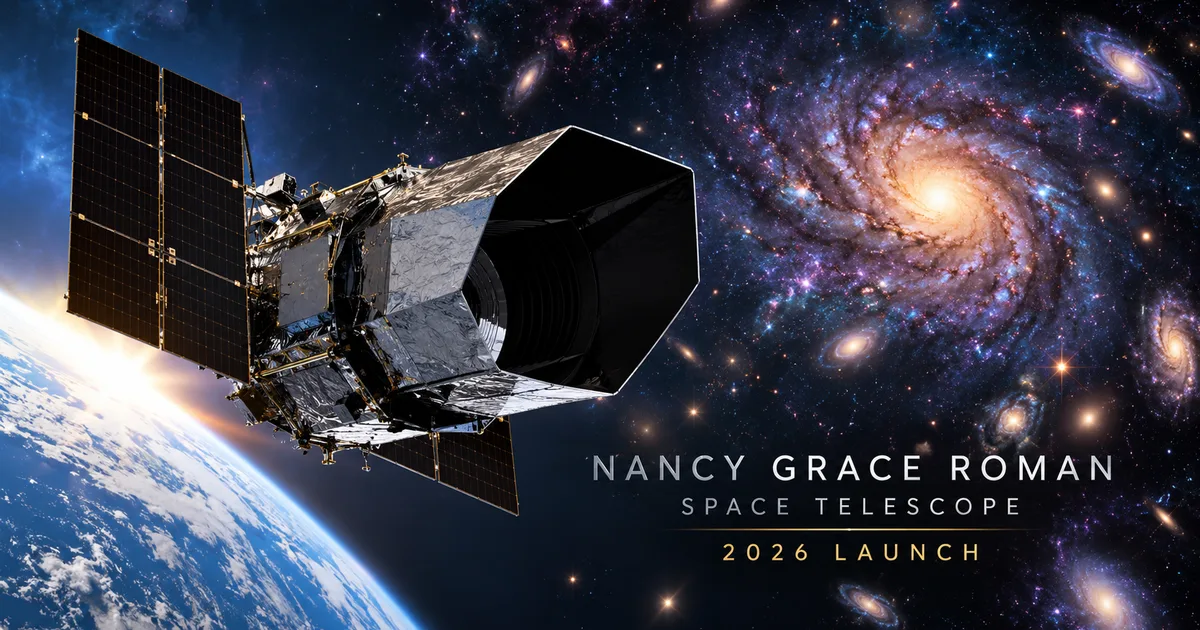
Look, space news usually falls into two categories. It's either billionaires taking a quick suborbital joyride or a massive scientific endeavor that takes decades to build. The Nancy Grace Roman Space Telescope 2026 launch definitely falls into the second bucket.
On August 30, a SpaceX Falcon Heavy rocket lifted off from Launch Complex 39A in Florida. It carried a $4.3 billion piece of hardware straight up into the sky. That's around Rs 36,000 crore for those keeping track at home (a staggering amount, honestly). But the price tag actually starts to make sense when you look at what this machine is built to do.
I caught the launch live early on Sunday morning. It got me thinking. What does this massive investment actually get us? You've probably heard of the Hubble telescope or the James Webb space telescope. They're famous for a reason. And now we have Roman. This mission has a very specific job. The dark matter mission and specs explained by NASA show that this isn't just another camera in space. It's a wide-angle lens. NASA built it to map the universe faster than we ever thought possible.
So let's break down what this telescope actually is. We'll look at how it works. I also want to talk about why astronomers across the globe are losing sleep over the data it will send back.
The strange history of a repurposed spy satellite
I love a good origin story. The Roman Space Telescope didn't start out as a purely scientific project from the ground up. Its beginnings are actually rooted in old military surveillance hardware.
About 15 years ago, NASA was trying to figure out how to build a new space telescope. They wanted to look for exploding stars. These specific stars are called Type 1A supernovas. They're incredibly bright. Scientists use them as a cosmological measuring stick because they explode with a very specific brightness. By seeing how dim they appear from Earth, we can measure how far away they are. This helps us calculate how fast the universe is expanding. The numbers here are a bit fuzzy sometimes, but the concept works.
NASA was scratching its head over the budget and design for a telescope to find these supernovas. Then they got an unexpected phone call.
"The National Reconnaissance Office reached out to NASA, saying, 'We have this amazing satellite sitting in a hangar that we're not using. And what what do you guys think about instead of pointing downwards, we point upwards, and you guys use it?'"
That quote comes from cosmologist Daniel Scolnic at Duke University. The US government agency responsible for spy satellites basically had a spare piece of highly advanced hardware just sitting around in a warehouse. And they gave it to NASA for free.
It wasn't quite ready to fly, obviously. Engineers had to make some serious modifications. They turned a machine meant for looking down at Earth into one meant for looking out at the cosmos (which makes sense, actually). But the core optics were already there. This donated hardware is the heart of the Roman telescope today.
Honestly, I find that fascinating. We're literally using former surveillance technology to search for alien worlds. We're also using it to study the origins of the universe.
Roman Space Telescope specs and capabilities
You have to look at its field of view if you want to understand how Roman fits into the current lineup of space observatories.
Hubble has given us some of the most famous space photos in human history. We all know the Pillars of Creation image. But Hubble looks at the sky through a tiny straw. It sees a very small patch of space in extreme detail.
Thing is, Roman has broadly the same sharpness and sensitivity as Hubble. It sees in the infrared spectrum. This lets it peer through cosmic dust. The massive difference is the width of its vision. It captures an area of the sky at least 100 times larger than Hubble does in a single shot.
Speed is the real upgrade
Julie McEnery is the project scientist for Roman. She put this into perspective recently. She explained that it'd take you about a century of continuous observation if you wanted to survey all the stars in the Milky Way galaxy using Hubble.
Roman can do that exact same survey in one single month.
That speed changes everything about how we do astronomy. You can take wide photos of huge chunks of the sky repeatedly over a short period. Then you start to notice things that move. You notice things that change brightness. You spot planets orbiting other stars. You catch stars exploding in real time. We used to find out about them years later. It's basically like upgrading from a manual film camera to shooting high-definition panoramic video.
If you want more updates on tech hardware, you can check out our Latest Tech News section for daily coverage.
The 15 lakh kilometer journey to L2
Right now, the telescope is coasting through the emptiness of space on a three-month journey.
The launch sequence went perfectly. Ground control at NASA's Goddard Space Flight Center in Maryland started getting telemetry data just seven minutes after liftoff. The telescope separated from the Falcon Heavy rocket about 31 minutes into the flight. It is now flying solo. On August 31, it fired its engines for three and a half minutes. This corrected its trajectory.
Its destination is a spot called the Sun-Earth Lagrange Point 2. People call it L2. This is a location about 1.5 million kilometers away from Earth. Or, as we usually say here in India, 15 lakh kilometers.
That number should sound familiar. When ISRO launched the Aditya-L1 solar mission, it also traveled 15 lakh kilometers from home. The main difference is direction. Aditya went to L1. That spot is located between the Earth and the Sun. Roman is heading to L2. That spot is on the exact opposite side of Earth. It points outward into the deep, dark universe.
L2 is incredibly stable gravitationally. The gravity of the Earth and the Sun balance out the centrifugal force of a spacecraft orbiting there. This means the telescope only needs to fire its thrusters around every 28 days to stay locked in place. It saves a huge amount of fuel. This extends the life of the mission.
Speaking of Indian space efforts, the global space race is definitely heating up right now. We have the ISRO Gaganyaan Mission 2026 coming up soon. It will finally put Indian astronauts into space on indigenous rockets. Watching NASA and ISRO operate on completely different budgets is pretty incredible to witness. They are hitting these massive milestones at the same time.
Exploring dark energy and exoplanets
You're probably wondering what "dark matter" and "dark energy" actually mean in plain English. I'll be honest with you. Even the smartest astrophysicists on the planet don't fully understand what they are. That is exactly why the Roman mission exists.
We know the universe is expanding. We've known that for a long time. But we recently discovered that this expansion is accelerating. Something is pushing everything apart faster and faster. We just can't see it. Scientists call this unseen force dark energy. I'm not sure exactly why it's accelerating, but it's happening.
Then we have dark matter. This is the invisible stuff. It holds galaxies together through gravity. If a galaxy only contained the stars and gas we can see, it would spin apart and dissolve. Something heavy and invisible is holding it all together.
Together, dark energy and dark matter make up around 95 percent of the entire universe. Everything we can actually see makes up just 5 percent. That includes the stars, the planets, your smartphone, and your dog.
Roman is going to measure the expansion of the universe more precisely than ever before. It will track those Type 1A supernovas across massive stretches of space. If our current mathematical models of physics are wrong, Roman will likely be the tool that proves it.
Finding 100,000 new worlds
The other major part of the mission is hunting for exoplanets. These are planets that orbit stars outside our own solar system. I think this part is the most interesting.
NASA administrator Jared Isaacman mentioned during the post-launch press conference that Roman could potentially reveal more than 100,000 new exoplanets.
Think about that number for a second. We currently know of a few thousand confirmed exoplanets. And that took decades of looking. Finding 100,000 more in a few years would completely change our understanding of how common planetary systems are in our galaxy.
It does this through a clever technique called microlensing. A star with planets sometimes passes directly in front of another background star. The gravity of the closer star acts like a giant magnifying glass. It bends and magnifies the light of the distant star behind it. If the closer star has planets orbiting it, their tiny gravity causes detectable blips or spikes in that magnified light. Roman can see millions of stars at once. So it can catch these rare, temporary alignments easily.
If you want more deep dives into how complex technology actually functions in the real world, visit our Tech Explainers category.
What happens next for the mission
The telescope will take about 100 days total to reach its final orbital insertion at L2. Once it gets there and finishes all the complicated calibration checks, the real science operations will begin.
I'm particularly excited to see the first images. NASA usually releases a "first light" image to show off what a new piece of hardware can do. Given the insane width of Roman's field of view, we're going to see starfields crammed with a lot of detail. We'll see more depth than any single image we've ever captured (which is mind-blowing to think about).
The best part? The data from Roman will be public. Scientists all over the world will be able to download the raw data and look for their own discoveries. That includes researchers and students at Indian universities.
We're officially entering an era where massive data mining drives astronomical discovery. The telescope collects a giant database of the sky. Then astronomers write software to comb through it looking for hidden patterns. It's a big shift from the old days. We don't just have a lone astronomer looking through a glass lens on a cold mountain top anymore.