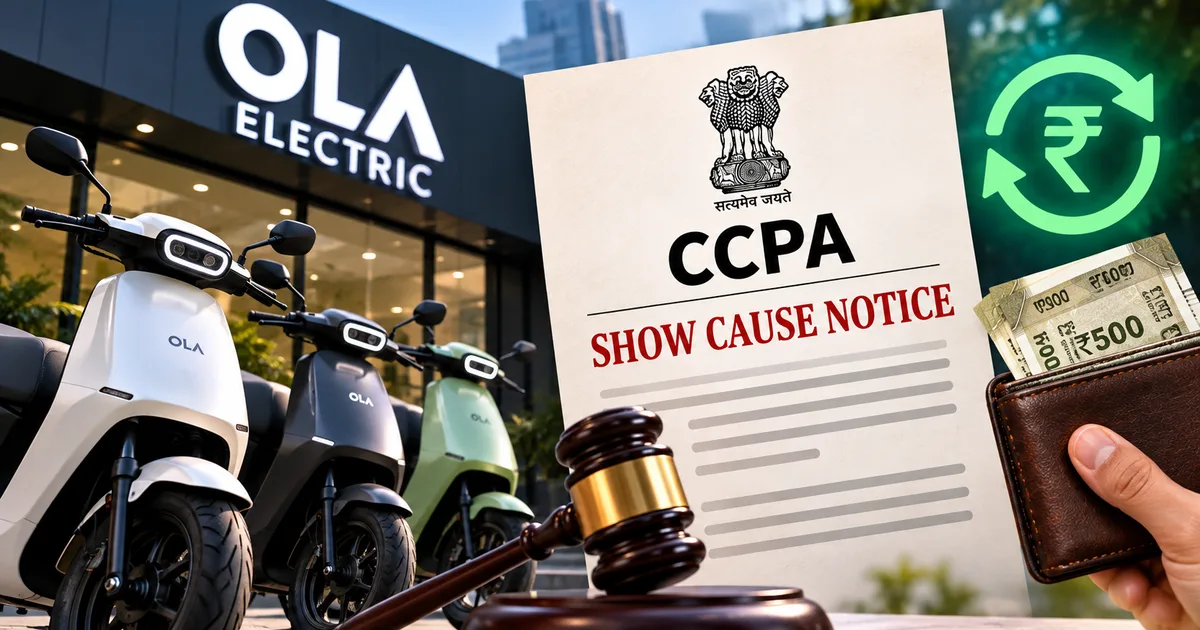
Imagine dropping ₹1.5 lakh of your hard-earned money on a shiny new EV scooter. You ride it home, feeling good about saving on petrol. Two weeks later, the software glitches. The scooter won't start. You drag it to the service center, only to see a mountain of dead scooters and a frustrated manager who tells you it'll take a month just to get a spare part. That exact nightmare scenario is why the government finally stepped in. The Ola Electric CCPA show cause notice 2026 has become a major talking point in the Indian EV space right now. And honestly, it was a long time coming.
This means a lot for the average buyer who just wants a reliable commute to work. Because this isn't just some boring regulatory paperwork. It's a direct response to thousands of frustrated Indians venting their anger online and on the National Consumer Helpline.
If you read our Tech Explainers section often, you probably know that buying an EV is a big leap for most Indian families. You calculate the EMI. You factor in the charging cost. You expect peace of mind. But when that peace of mind is broken by a scooter that randomly stops in traffic, things get ugly. The company just doesn't answer your calls.
Understanding the CCPA notice
Look, the CCPA is the Central Consumer Protection Authority. They're the government's watchdog for consumer rights in India. If a company does something unfair to a ton of people, the CCPA pulls them up. A show cause notice is basically just a legal demand asking a company to explain themselves. The government is seeing all these complaints. And they're asking the company why strict action shouldn't happen.
The numbers are wild. Thousands of complaints piled up against Ola Electric on the government's official consumer helpline (which is actually working, surprisingly). People complained about delivery delays and faulty batteries. Some scooters reversed without warning. But the biggest issue by far was the after-sales service.
Thing is, when your petrol Activa breaks down, you take it to the local mechanic at the corner. He fixes it for ₹500. When your smart EV breaks down, you're entirely stuck with the company's official service center. You can't just take it to a random garage. This creates a massive mess when the company doesn't have enough mechanics to handle all the vehicles they're selling.
The core issues behind the consumer complaints
The anger comes from very specific, repeated failures. I've spent the last few days reading through actual consumer court judgments and forum posts. The stories are just wild.
Here are the most common problems buyers face:
- Service centers simply don't have enough spare parts, meaning your scooter sits in the dust for three months for a basic repair.
- Software bugs cause the digital screens to freeze, batteries to drain overnight, and the scooter to lock up completely while you are riding.
- Build quality issues like broken front forks and loose panels are common during the monsoon season.
- Customer support is largely automated, giving you pre-recorded responses instead of actual help from a human being.
This "service center paralysis" is highly unique to electric vehicles right now. If your petrol scooter breaks down, any local mechanic can open the carburetor and get you moving. They have decades of experience. Spare parts are everywhere. An electric scooter is entirely different. The battery management system and the motor controller are proprietary hardware. Local mechanics refuse to touch them. A wrong wire can cause a short circuit or even a fire, if you ask me.
So you're completely at the mercy of the official service center. When an EV company scales up production and sells 30,000 scooters a month but only has the service capacity for 5,000, the system just breaks. You end up with a massive backlog. This is exactly what triggered the CCPA to act. The government realized that selling a vehicle without a capable service network is highly unfair.
This frustration even spilled over onto social media. You probably saw the massive public fight on X between comedian Kunal Kamra and Ola CEO Bhavish Aggarwal. Kamra posted a photo of dozens of dusty, broken scooters sitting outside an Ola service center. Aggarwal fired back. He told Kamra to come work at the service center if he cared so much. It was a total mess. But it proved a point. When you buy a vehicle, you're paying for the service network just as much as the metal and plastic.
How the company responded to the government
A public notice from a central authority is bad for business. Especially when the Ola Electric share price 2026 has already been reacting to the negative sentiment in the market.
Ola Electric responded to the CCPA notice quickly. They filed an official reply. They stated they have a solid mechanism to handle grievances. The interesting part is that Ola claims they've resolved 99.1% of the 10,000-plus complaints cited by the CCPA.
"We have resolved 99.1% of the complaints to the complete satisfaction of the customers," the company stated in their official regulatory filing.
Does that number sound realistic to you? I'm not sure exactly how they got that figure. If you ask the people still waiting outside the service centers, they might disagree. A resolved ticket in a corporate IT system sometimes just means the customer care executive closed the chat window. But legally, Ola has stated on record that they've fixed the vast majority of the issues.
And they also announced they're finally bringing in third-party dealers. For years, Ola insisted on a direct-to-consumer model. You order on the app, and they deliver it to your house. No middlemen. It sounded great in theory. In practice, it meant they had no local partners to handle the chaos when things broke. Now they're setting up a traditional dealer network. Better late than never.
Consumer rights and refund rules
Basically, if you're currently stuck with a defective scooter, this is the part you need to read carefully. You aren't helpless. The Consumer Protection Act, 2019 gives you serious ammunition. In India, we often assume fighting a big company is useless. That's just completely false. Consumer courts are actually coming down hard on EV manufacturers recently.
Consumer courts have handled a bunch of these cases lately.
- A district consumer commission ordered Ola to pay ₹1.30 lakh to a consumer for deficiency in service and unfair trade practice after their scooter sat in the service center for months.
- Another court ordered the company to pay ₹45,000 in compensation to an advocate because the scooter defect hurt their daily work and commute.
- One user got a full refund of ₹1.04 lakh plus extra compensation for mental agony because the company failed to provide proper service.
Many people think a refund is impossible once the vehicle is registered with the RTO in your name. That's simply untrue. If a vehicle has a manufacturing defect that can't be fixed after multiple attempts, consumer courts routinely order the company to take the vehicle back and refund the full invoice amount. They often add interest from the date of purchase, plus legal expenses.
For example, if your scooter's battery dies twice within the first six months, and the service center keeps the vehicle for 40 days each time, you're paying EMIs for a vehicle you can't use. You can argue in consumer court that the product is unfit for the purpose it was sold for. When you draft your legal notice (which is easier than it sounds), demand the specific RTO registration charges and insurance premium back as well. You shouldn't lose money on the road tax for a scooter that the company failed to build properly.
If you want a refund, follow this exact process:
- Document every single interaction by taking photos at the service center and keeping all your job cards and emails.
- Send a formal legal notice stating the facts and demanding a refund within 15 days.
- File a formal complaint on the government's eDaakhil portal without needing to hire an expensive lawyer.
- Call 1915 to register a grievance on the National Consumer Helpline before taking the legal route.
The bigger picture for the Indian EV industry
This whole mess is a massive wake-up call for every single electric vehicle maker in India. We cover a lot of these shifts in our Latest Tech News section. The pattern is clear. Indians are adopting EVs at an incredible rate. We want to ditch petrol. We like the instant torque and the silent ride. But we're also highly demanding consumers. We expect our vehicles to survive potholed roads and flooded streets. And when something breaks, we expect someone to fix it fast.
When companies prioritize sales over service, they eventually hit a wall. You can spend crores on marketing and flashy launch events. But if a buyer from a tier-2 city posts a video of his scooter's handle breaking in half on a bumpy road, that video will reach millions on WhatsApp in an hour. Brand trust is just very hard to build and incredibly easy to lose.
The CCPA action proves that the government is watching. It sets a precedent. If you sell a premium product to an Indian consumer, you have to back it up with premium support.
What to check before buying an EV
If you're in the market for a new electric scooter right now, I have some simple advice. Don't just look at the spec sheet. The battery range and the top speed don't matter if the scooter won't turn on.
Visit the nearest service center before you visit the showroom. I mean it. Just walk into the service area and look around. Talk to the customers waiting there. Ask them how long they've been waiting. Ask them if the staff is helpful. If you see angry people fighting with the mechanics, just walk away.
Check the warranty terms closely. See if they offer extended warranties on the battery and the motor. And honestly, stick to brands that have a proven, physical dealer network in your specific city. An app interface is nice. But a grumpy local dealer who knows how to source a spare part is much more valuable when you're stranded on the side of the road.
The EV shift in India is happening right in front of us. But the growing pains are a mess. The Ola Electric CCPA show cause notice 2026 is just the first regulatory check on an industry that was moving a bit too fast for its own good. As a buyer, you have rights. Know them and use them. Don't settle for bad service.