You're watching the Mumbai monsoon flood the streets. Water rushes around car tyres and creates chaotic whirlpools near open drains. Now imagine trying to write a mathematical formula to predict exactly where every single drop of that water will go. Sounds impossible, right?
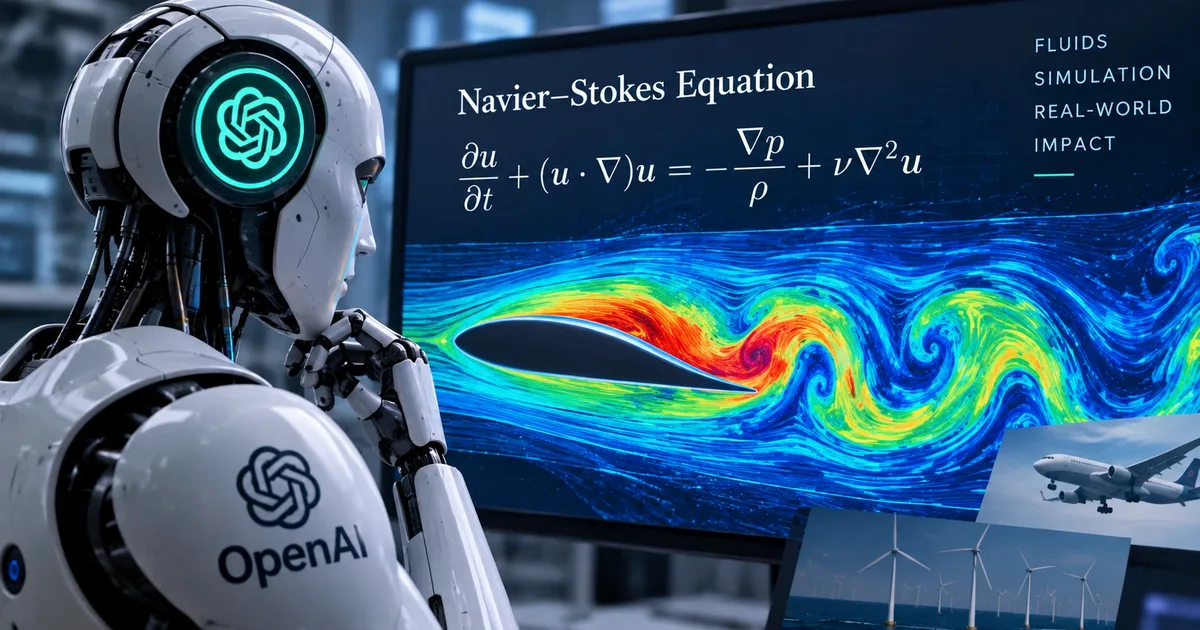
This is basically the Navier-Stokes problem. And right now, the tech world is buzzing because the new OpenAI Navier-Stokes Equation Solver 2026 claims to have finally cracked it after almost 90 years.
Honestly, this is one of the more interesting claims from OpenAI. They built an internal model specifically to tackle this. It supposedly took just 88 hours and millions of dollars in computing power.
But human mathematicians are already disputing who gets the credit.
I spent the morning reading through the research papers and the angry statements from mathematicians. The math can be explained in plain English, and the controversy is intense. The implications for the future of tech are huge. You don't need a PhD to understand this. We cover complex topics like this in our tech explainers section often.
What are the Navier-Stokes equations?
To understand the problem, you have to look at how physicists view liquids and gases. They call them fluids. The Navier-Stokes equations use Newton's second law of motion. You probably remember F=ma from school physics. These equations apply that same logic to fluids. (Which makes sense, actually).
They treat water or air as a continuous medium instead of tracking individual molecules. So instead of working out what a billion separate water molecules are doing, the equations treat the fluid as one smooth mass. I'm not sure exactly why, but Claude-Louis Navier and George Gabriel Stokes came up with this back in the nineteenth century.
But there's a catch. The math works perfectly for most everyday situations. Engineers use these equations right now. The problem is nobody actually knows if the equations always work under extreme pressure.
The smooth flow problem
In 1934, a mathematician named Jean Leray proved that solutions exist in a general sense. But a major open question remained: can the math break down entirely?
Think of a water pipe in your house. The water normally flows smoothly. But if you increase the pressure, the flow becomes a mess. In mathematics, they want to know if these equations can lead to a singularity. A singularity means the math predicts the fluid will start moving infinitely fast in a finite amount of time.
Since real water can't move infinitely fast, finding a singularity would mean the equations are broken. They fail to model reality under certain extreme conditions. UCLA mathematician Terence Tao explained this in very clear terms. He said that proving these equations don't always behave as expected implies that the actual laws of physics can break down. This is a massive gap in how we understand the physical universe.
How the OpenAI Navier-Stokes Equation Solver 2026 works
Look, OpenAI claims their internal system produced an analytical proof showing that the dynamics of the Navier-Stokes equations can indeed develop a singularity in finite time. This means the smooth motion can break down.
They did this using an unreleased model that Mark Chen, OpenAI's chief research officer, says is much more capable than GPT-6 Astra. The system generated the proof in just 88 hours. And they also created a formalization in a programming language called Lean to check the logic.
When OpenAI claimed they solved this, they didn't just release a PDF with some equations. They created the proof in the Lean programming language. Lean is like an automated referee. You write your proof in code, and the computer checks every single logical step to find any errors.
This is an important detail. In the past, when a human mathematician published a massive proof, other humans had to read hundreds of pages to check for mistakes. By providing the Lean code, OpenAI is giving the mathematical community a way to instantly check the logic. The machine checks the machine.
The computing power needed to get this is staggering. The numbers here are a bit fuzzy, but we know OpenAI spent millions of dollars on computing resources just for this single 88-hour run. In Indian rupees, we're talking about tens of crores spent on electricity and processor time to solve one math problem.
This shows a growing divide in research. A typical university math department in India can't easily afford to run an experiment that costs 20 crore rupees in compute time. In my experience, it shows how large tech companies with massive data centers are now dominating pure scientific research. They have resources that traditional academia simply can't match.
We're seeing AI move from generating text and images to solving hard logic problems. If you've been following the recent updates on OpenAI's AI futures, you know they've been pushing hard towards reasoning systems. This solver is a direct result of that push.
The $1 million Millennium Prize math problem
Back in 2000, the Clay Mathematics Institute released a list of seven Millennium Prize Problems. These are the hardest open questions in mathematics. Anyone who solves one gets a $1 million reward. That's about ₹8.3 crore today.
So far, only one of the seven problems has been solved. That was the Poincare conjecture, solved by Grigori Perelman in 2003.
OpenAI says they won't claim the money if their finding is confirmed. But getting confirmation is a long process. The rules state a solution has to be published in a peer-reviewed journal, and then it has to survive two years of intense scrutiny from the global mathematical community. Only then will the institute convene a committee to evaluate it.
Professor Martin Bridson, President of the Clay Mathematics Institute, said the evaluation process is deliberately unhurried. He promised it will be absolutely rigorous. The math community doesn't accept rushed claims, even from highly advanced AI models.
The controversy with human mathematicians
This is where the story gets a bit sketchy. Some human researchers are furious.
New York University professor Tristan Buckmaster and Anthropic researcher Levent Alpöge say they've spent much of the past year working on this exact problem. They think OpenAI learned of their progress. Then they raced to solve the problem using a similar route to beat them to the punch.
Buckmaster released a statement saying they built on research done by mathematicians Diego Cordoba and Luis Martinez-Zoroa. He claims the AI essentially mashed up existing human work without giving proper credit.
OpenAI flatly denies this. They told USA Today that the claims are categorically false. They insist their researchers didn't see any of the independent work before it was released publicly, and no specific user data was accessed to solve the problem.
This dispute hits on a raw nerve in the tech world today. Who owns an idea when an AI generates it? (A question we all have, honestly). We see this debate constantly in our latest tech news coverage. If an AI reads a million math papers and spits out a solution, did it invent the solution? Or did it just connect the dots that human mathematicians left behind?
Buckmaster made a sharp point about this in his public statement:
The significance of this with respect to the way we train students, assign credit, referee, and decide what is worth one human life's attention cannot be understated.
I think he argues that the way we assign credit and value human effort is completely changing.
Why this AI breakthrough in fluid dynamics matters
You might be wondering why you should care about a 90-year-old math problem. Fluid dynamics affects your daily life in ways you might not realise.
Here's how fluid dynamics impacts everyday systems in India:
- The India Meteorological Department relies on complex fluid dynamics to predict the monsoon. If standard equations have mathematical limits, meteorologists can start building better models for more accurate rainfall predictions.
- Airlines use these equations to design aircraft and plan flight routes. Better math could eventually lead to more fuel-efficient planes and cheaper domestic flight tickets.
- Doctors and engineers study blood flow using fluid approximations. Upgrading the baseline math helps improve the design of artificial heart valves and medical stents.
Beyond fluids, this shows AI can reason. When OpenAI launched tools like the OpenAI Sora text-to-video AI coming to India, people were impressed by the visuals. But solving a Millennium Prize problem requires logical thinking. This means future AI can find flaws in complex software code or optimize the UPI payment network even further.
What happens next
The mathematical community is going to spend the next two years tearing this proof apart. Mathematicians are professional skeptics. They'll look for any tiny error in the logic.
If the proof holds up, it changes mathematics forever. It will show that AI can do more than just write emails or generate pictures, and it will show that AI can push the boundaries of human knowledge in pure science.
If you ask me, we're going to see a lot more of these announcements. Anthropic and OpenAI are both building models focused on hard reasoning. The Navier-Stokes problem is just the first domino to fall.
But the human element remains complicated. If AI companies keep scooping human researchers using massive server farms, we have to rethink how academic credit works. You can't compete with an AI system working 88 hours straight on millions of dollars of hardware. The rules of scientific discovery are being rewritten right now. And nobody is entirely sure how it will end.