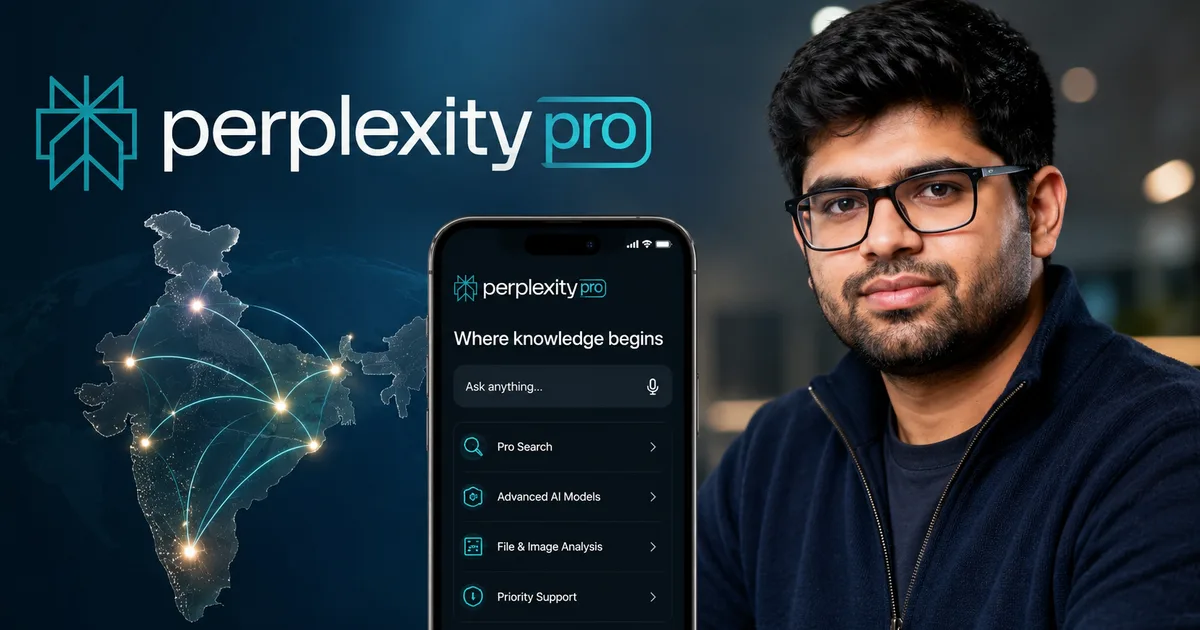
Look, the AI space moves ridiculously fast. But right now, everyone in the tech world is watching Perplexity AI CEO Aravind Srinivas in 2026. The guy from Chennai who couldn't get into IIT Madras computer science just made a $34.5 billion bid to buy Google Chrome. Let that sink in for a second.
He was rejected by MIT. His first startup failed entirely. He basically just dreamed of a safe middle-class job at Google. Now he's sitting at the table with Nvidia. And he's negotiating funding that could push his company's valuation past $30 billion.
So what does this actually mean for everyday Indian users? If you ask me, that's the only question that matters. If you're a student in Bengaluru or a freelance graphic designer in Delhi, you're probably wondering if Perplexity Pro is worth your hard-earned rupees. I've spent the last few weeks digging into their latest announcements and testing how Perplexity Computer handles Indian context.
Thing is, it's actually quite good. But you need to understand exactly what you're paying for before you subscribe.
From IIT rejections to a $30 billion valuation
You have to respect the hustle. Aravind Srinivas didn't have a straight path to becoming a tech billionaire. We cover a lot of latest tech news. And usually, the founder stories are pretty standard. Not this one.
Srinivas was rejected from the computer science program at IIT Madras. He faced rejection from MIT. His early attempts at starting a company didn't work out. He just wanted a solid job at Google so he could settle down.
Fast forward to August 2025. Perplexity offered $34.5 billion to buy Google Chrome. Think about that. A startup trying to buy the biggest web browser on the planet from the biggest search company on the planet. It was an incredibly bold move. It showed Perplexity wasn't just playing around in the background anymore.
And it doesn't stop there. Now in 2026 they're in deep talks with Nvidia. Reports suggest Nvidia might invest at a valuation of more than $30 billion. That's a massive jump from the $20 billion they were valued at just recently.
Why is Nvidia so interested? Because Perplexity is growing like crazy. Their annualised revenue has shot up to $750 million this year. They were sitting at under $250 million at the start of 2026 (wild, I know). They handle over 400 million search queries every single month. Plus they signed a massive $750 million Azure deal with Microsoft earlier this year. The numbers are staggering.
What is Perplexity Computer? (And why you should care)
This is the big update for 2026. After being completely quiet for two months, Srinivas announced Perplexity Computer on X.
Perplexity Computer goes way beyond traditional search. Srinivas pitches it as a general-purpose digital worker.
When you ask a normal AI a question, it predicts the next word and gives you an answer. Perplexity Computer is entirely different. When you give it a task, it breaks that task down into smaller steps. It then uses up to 19 different specialised AI models to handle those specific subtasks. One model might do the web research. Another might write the Python code. It orchestrates all these models behind the scenes and stitches the final result together.
Srinivas explained that it unifies files and tools into one system. It can research, code, and deploy a project end-to-end.
"What has Perplexity been up to last two months? We've silently been working on the next big thing: Perplexity Computer. Computer unifies every current capability of AI into a single system." - Aravind Srinivas
I tried using it for a research project last week. Honestly, it remembered the context of what I was working on days earlier. You can leave a project. Close your laptop. Come back to it on Tuesday. And the AI picks up exactly where it left off. That memory feature is incredibly useful if you're working on something complex over several days.
Suppose you're a small business owner in India trying to understand new GST compliance rules. You can ask Perplexity Computer to research the latest circulars from the Finance Ministry. It can cross-reference them with your business type and draft an email to your accountant. It handles all those steps automatically.
If you're looking for AI tools and software that actually save you time, this is one to watch carefully.
The India expansion and R&D plans
Perplexity is clearly looking at India as a major market for both users and engineering talent. They're currently exploring setting up a research and development presence in Gujarat.
During his recent visit to the US, Gujarat Chief Minister Bhupendra Patel actively courted global tech giants. He met with Perplexity AI and Google to build out the state's AI ecosystem.
This makes a lot of sense. India has the engineering talent. Companies like Perplexity need massive amounts of skilled labor to keep improving their 19-model orchestration system. If they set up an office in Gujarat, we could see a lot of high-paying AI jobs opening up locally.
The cost: Is Perplexity Pro worth Rs 1,650 a month?
Pricing is the real hurdle here. Perplexity Pro generally costs around $20 a month. That translates to roughly Rs 1,650 depending on exchange rates and bank markups. For a student or a young professional in India, that's a significant monthly expense. You're basically paying the price of a premium Netflix subscription and a good broadband connection combined.
Is it actually worth it?
If you just need basic answers to everyday questions, the free version is completely fine. It cites sources. It gives you links. And it's usually much faster than traditional scrolling.
But if you're doing heavy research or coding, the Pro tier gives you access to the new Perplexity Computer features. You also get their new browser, called Comet. It's designed for what Srinivas calls "agentic browsing". Essentially, the browser does the navigating and clicking for you.
There's a silver lining for students, though. You might want to read our guide on how Indian students can get free Pro access. This makes the technology much more accessible for academic research.
A quick comparison with Google clarifies things.
| Feature | Perplexity Pro | Google Gemini Advanced |
|---|---|---|
| Monthly cost in India | ~$20 (approx Rs 1,650) | Rs 1,950 |
| Core strength | Deep web research, citations, speed | Google Workspace integration |
| Task management | Perplexity Computer (19 models) | Gemini 1.5 Pro |
| Best user profile | Researchers, coders, analysts | General users, writers, office workers |
It's a tough choice. I'm not sure exactly why Google hasn't caught up on speed. If you're already deeply tied into the Google ecosystem, you might prefer checking out the latest Gemini India features. But Perplexity feels significantly faster for pure information retrieval.
Will AI take your job? Srinivas has thoughts
This is the question everyone is asking. From corporate glass towers in Mumbai to startup hubs in HSR Layout, people are genuinely worried about their livelihoods.
Aravind Srinivas has a somewhat controversial take on this. During an appearance on the All-In podcast, he bluntly stated that most people don't actually enjoy their jobs.
His argument is that AI tools are lowering the barrier to entry for creating a business. In the past, if you wanted to build a digital service in India, you needed a team of coders and designers. You needed capital. Now, a single person can do a lot of that heavy lifting using AI.
He acknowledges that there will be short-term job losses. But he calls the long-term outcome a "glorious future" where people can learn these tools and start their own mini businesses.
In my experience, starting a business still requires money and a massive tolerance for risk. Not everyone in India has the financial safety net to just quit their desk job and become a solo entrepreneur overnight. But he's right about one thing. The cost of building something new has never been lower. If you have an idea, you can prototype it today using AI tools for almost zero cost.
How agentic browsing handles the Indian internet
Consider Comet, Perplexity's new browser that focuses on agentic browsing. The idea is that you tell the browser what you want, and it navigates the web for you. But does this actually work on the Indian internet?
We all know how frustrating it can be to navigate government websites. I tested Comet with a few basic tasks. It's reasonably good at pulling public information from sites like the RBI or TRAI. If you ask it to summarize the latest telecom regulations, it handles it beautifully.
But don't expect it to magically log into your DigiLocker or file your income tax returns just yet. Indian digital infrastructure relies heavily on two-factor authentication and Aadhaar OTPs. AI agents still struggle with these security layers. You can't just tell Perplexity Computer to "download my Aadhaar card" and walk away. You still need to be in the driver's seat for anything involving secure personal data. To be honest, a lot of the government portal stuff is a mess anyway.
Where it shines is research. If you need to cross-reference a specific CERT-In advisory with a piece of software you're using, the AI can read the government press releases and give you a straight answer in seconds. It's a massive time-saver for professionals who deal with compliance.
Working closely with Nvidia chips
There's an interesting technical detail buried in the recent announcements. Perplexity is heavily tied to Nvidia hardware. And the relationship goes both ways.
Nvidia isn't just an investor sitting on the cap table alongside Jeff Bezos and SoftBank. Perplexity was one of the first companies to use Nvidia's new Vera CPU. The numbers here are a bit fuzzy, but according to their enterprise infrastructure VP Nate Kupp, running agentic coding tasks on the Vera chip is about 1.5 times faster than their previous setup.
When you're handling 400 million queries a month, speed matters immensely. And Nvidia is clearly happy to invest in companies that turn around and buy their hardware. Nvidia's equity commitments hit $40 billion in 2026 alone. Almost all of it went to firms that buy its silicon.
Final thoughts for Indian users
The tech landscape is shifting rapidly. Aravind Srinivas has positioned Perplexity as a serious alternative to Google (which is wild considering where he started).
If you're a student, absolutely try to get the free Pro tier. If you're a professional making Rs 50,000 a month, think carefully before adding a Rs 1,650 monthly subscription to your credit card statement. Try the free version of Perplexity first. Test it against the free versions of ChatGPT and Claude. See which one naturally fits your daily workflow.
The Perplexity Computer update is genuinely impressive. Breaking tasks down across 19 different models solves a lot of the hallucination problems older AIs had. It's smart. It actually cites its sources. And it remembers context better than almost anything else I've tested.
But remember, it's just a tool. It won't build a mini business for you automatically. You still have to do the hard work.