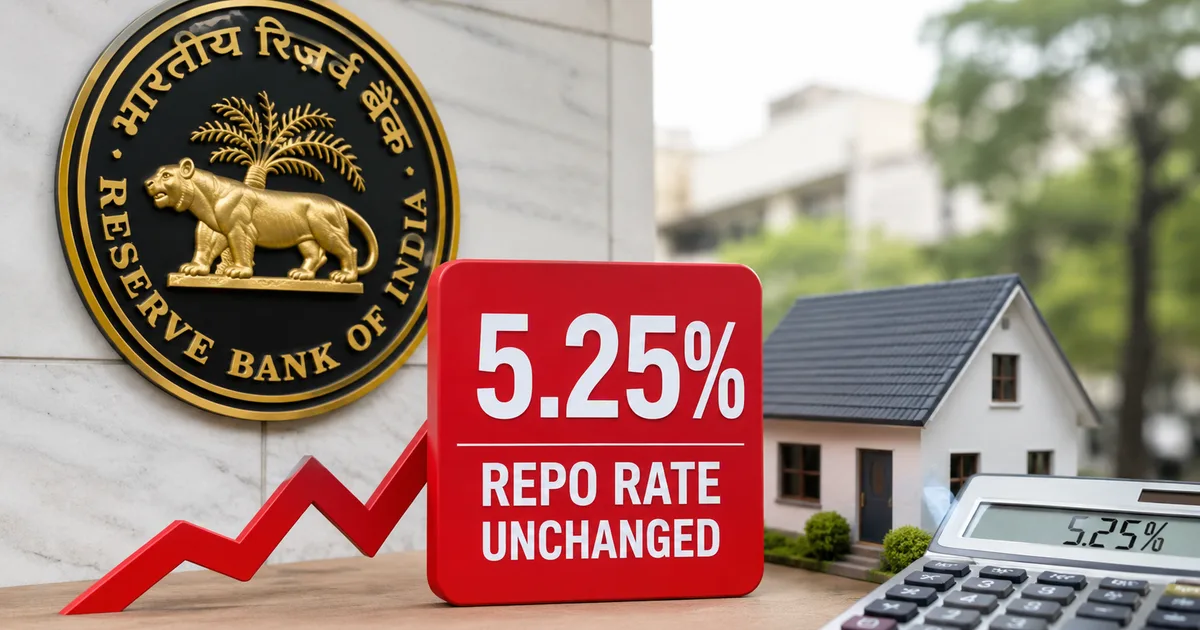
The RBI MPC meeting in August 2026 ended on 5 August with a decision that most people in the market were expecting. The repo rate stays at 5.25%, unchanged for the fourth meeting in a row. Governor Sanjay Malhotra announced it as a unanimous decision. And if you have a home loan, or you're thinking of taking one, this matters more than you might think.
What actually happened at the MPC meeting
The Monetary Policy Committee met from 3 August to 5 August 2026. Six members sat down for three days. They reviewed a ton of data on inflation and GDP growth. They also looked closely at global oil prices and the ongoing West Asia conflict. After all that, Sanjay Malhotra read out their decisions in a press conference.
Here is the big headline. The repo rate stays at 5.25%. That's the interest rate banks pay when they borrow overnight money from the RBI. It has been stuck right there since the last cut earlier in 2026. Since then, the committee has just hit pause four times in a row.
Thing is, Malhotra flagged a few other items too. They pushed the FY27 GDP growth forecast up to 6.7%. But he warned everyone about higher headline inflation because fuel and food prices are still pretty high. And we saw some signals pointing to a stronger rupee. I think the West Asia war is basically the elephant in the room right now. Global oil prices are a total mess, and that directly pushes India's inflation numbers higher.
Why should you care about the repo rate?
Honestly, the repo rate feels super abstract if you've never taken a loan. Just think of it this way. The RBI is basically the bank for banks. When your bank needs money overnight, it borrows from the RBI at this exact repo rate. If that rate drops, banks can borrow cheaper. They usually pass some of those savings on to you with lower loan rates (which makes sense, actually). When the rate goes up, your loans simply get more expensive.
Right now we're sitting at 5.25%. That's a fairly moderate level. The rate was much higher back in the inflation-fighting days of 2022 and 2023. Those cuts in early 2026 finally gave borrowers some relief. So this current pause means no new relief is coming today. But we don't have any new pressure either.
What this means for home loan borrowers
Look, here is where it gets practical.
Most home loans in India today are linked to either the repo rate (via EBLR, the External Benchmark Lending Rate) or MCLR (the Marginal Cost of Funds based Lending Rate). If your loan is on EBLR, your rate moves almost automatically whenever the RBI changes the repo rate. Loans linked to MCLR move a lot more slowly. Banks reset those every 3 or 6 months depending on their own cost of funds.
That difference between EBLR and MCLR really matters. When rates were dropping earlier in 2026, EBLR borrowers felt the benefit much faster. Now that rates are totally paused, both groups of borrowers are just stuck in a holding pattern. We aren't seeing new cuts. So don't expect your EMI to drop anytime soon.
Let's say you have a ₹50 lakh home loan at 8.5% interest for 20 years. Your monthly EMI is roughly ₹43,000. If the RBI had cut rates by 25 basis points (0.25%), your EMI would have dropped to around ₹42,300. That would save you about ₹700 a month. That comes out to ₹8,400 a year. It isn't a massive amount of cash, but it is definitely real money. Sadly, that saving just isn't happening in August.
Are you planning to buy a house in the next few months? The calculation is pretty simple right now. Rates aren't going up, which is good. But they aren't coming down right now either. So this isn't a moment of urgency for anyone.
What about people looking to take a new home loan?
Honestly, the current rate environment is pretty decent. Big lenders like SBI and HDFC Bank are offering home loans starting from around 8.3% to 8.75%. That depends on your credit score and your loan amount, of course. Those rates have already absorbed the earlier cuts from 2026. And waiting around for another cut isn't guaranteed at all. The MPC is very clearly watching global conditions before making their next move.
The whole fixed-rate vs floating-rate loans debate gets really interesting in this kind of environment. If you think rates will drop more in the next year or two, floating makes total sense. But maybe you just want stability. If you can lock in a decent rate right now, fixed loans have a solid case too. Most borrowers in India just default to floating loans. That is usually fine over a long tenure.
The bigger picture: inflation and global uncertainty
The RBI isn't only looking at India. That West Asia conflict is actively pushing oil prices up. Brent crude has been volatile for months. India imports most of its oil. So higher crude directly means higher fuel prices. That extra cost then seeps into everything else you buy, from daily vegetables to transport costs.
Malhotra's warning about higher headline inflation is a massive signal. If inflation picks up sharply, the MPC will be forced to pause even longer. They might even consider a rate hike (which literally nobody wants). The numbers here are a bit fuzzy, but that GDP upgrade to 6.7% for FY27 is definitely a positive sign. It shows the RBI believes India's economy is on a decent track, even with the global mess.
The rupee outlook matters a lot too. A stronger rupee actually makes our imports cheaper. That can help cool down inflation. So Malhotra's signal there is pretty interesting. It might indicate some real optimism about the currency trajectory.
What the experts (and the data) are saying
The August 2026 MPC decision to hold the repo rate at 5.25% was unanimous — all six members agreed — reflecting a consensus that the current rate is appropriate given persistent global risks and improving domestic growth momentum.
The unanimous nature of this decision is actually very significant. In some previous meetings, we saw dissent from one or two members pushing for cuts. But a unanimous hold suggests the whole committee has a clear shared view to just wait and watch. I think that is reassuring because it means no random policy shifts. But it's also a bit frustrating if you were really hoping for an EMI reduction this month.
Economic Times and Livemint both reported that the market had already priced in this pause. So we didn't see a major reaction in bond yields or equities right after the big announcement. The Sensex and Nifty just took the whole thing in stride.
How does the repo rate affect your fixed deposits too?
I have to mention this since so many Indian families keep their savings in fixed deposits. The repo rate pause means FD rates at banks probably won't change much in the near term. Most major banks are offering 6.5% to 7.5% on FDs right now. A few small finance banks are offering higher rates. If you locked in a high FD rate earlier, just hold it. But if you haven't, these current rates are still completely reasonable.
Senior citizens get an extra 0.25% to 0.5% on most FDs. And if you're using DigiLocker or your bank's mobile app, checking and booking FDs has gotten much easier. You don't ever need to walk into a physical branch anymore.
When is the next MPC meeting?
The RBI holds these MPC meetings roughly every two months. The next bi-monthly meeting will happen in October 2026. Between now and then, people will watch the inflation data for August and September. They will also track any major shifts in the West Asia situation.
If inflation stays controlled and global conditions stabilise, there is a reasonable chance the MPC could discuss cuts again in October or December. But that is highly speculative. I'm not sure exactly why, but the exact numbers are really hard to pin down right now. Ultimately, the RBI will just go wherever the data takes them.
What should you actually do?
Here are a few practical takeaways if you are an Indian borrower or saver.
- If you have a floating rate home loan, your EMI stays the same for now. No action needed.
- If you're on a higher MCLR-linked rate and haven't switched to EBLR, talk to your bank — you may be missing out on lower rates even within the current environment.
- If you're planning to buy a home, don't wait for a rate cut that may or may not come. Buy when the property price and your finances make sense.
- If you have FD investments, the current rates are still workable — don't panic-withdraw hoping for something better soon.
- Keep an eye on the October MPC meeting for the next signal on direction.
And if you want to understand more about how monetary policy actually works, check out our explainers section. You can learn why the RBI does what it does and how all of that flows through to your own bank account. We've covered everything from banking scams to watch for to the way digital payments work under the hood.
Basically, the August 2026 MPC meeting wasn't dramatic at all. We got no major surprises or shocks. The RBI is just playing it very cautious right now. Given what's happening globally with oil and conflicts, that is probably the right call to make. We'll just have to wait for the next set of data in October.