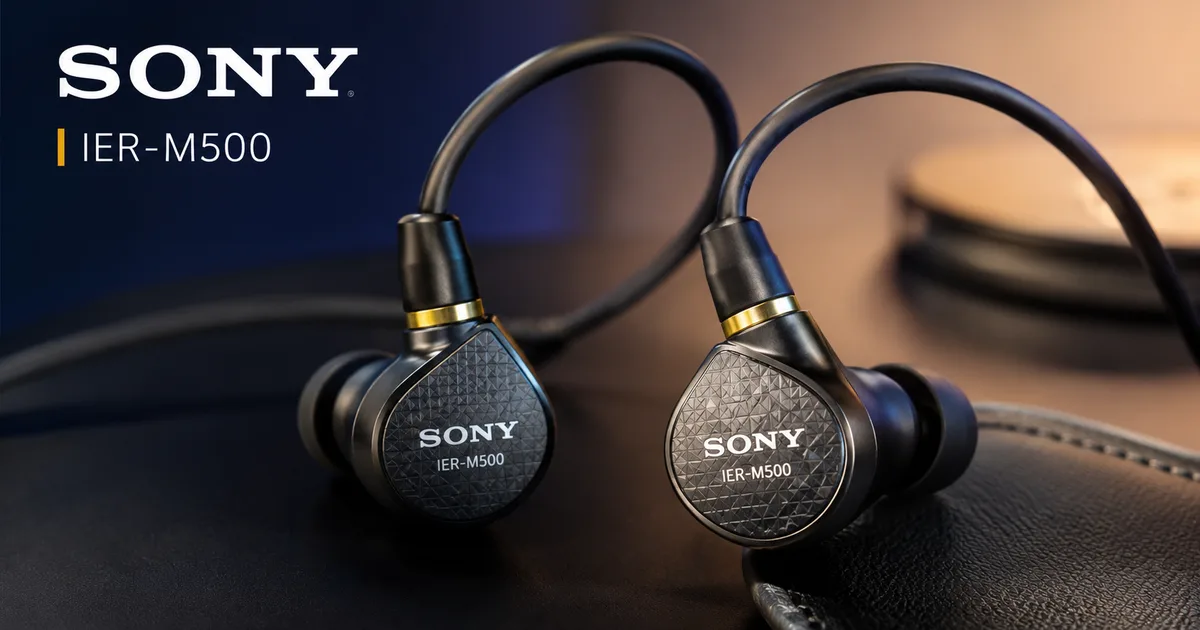
So, the new Sony IER-M500 Monitors are finally here. For anyone who has ever tried to find decent professional audio gear without taking out a small loan, this is actually big news. We're talking about a proper set of in-ear monitors aimed directly at live musicians and serious audio nerds. But instead of slapping a crazy fifty-thousand rupee price tag on them, Sony has kept things surprisingly reasonable.
Look, if you play in a band in India, you know the struggle. You either buy cheap earphones that distort when the drummer hits the crash cymbal, or you save up for months to buy entry-level gear from boutique brands. The gap in the market is massive. And honestly, this is exactly where Sony is trying to squeeze in.
Sony IER-M500 specs and hardware details
The hardware spec sheet is interesting because it doesn't try to do too much. Instead of cramming five different drivers into each earpiece, Sony went with a single 5mm dynamic driver. I know, it sounds basic on paper. But size isn't everything in audio. A single well-tuned dynamic driver usually handles phase coherence much better than a bunch of cheap balanced armatures fighting each other.
They also included Hi-Res Audio support. This is pretty standard for Sony these days. But it's nice to have if you're plugging into a high-end DAC or a good audio interface. The housing is completely transparent. You can see the internal wiring and the driver itself. I've always been a sucker for transparent electronics. They remind me of those old Game Boys we used to play in the nineties (which makes sense, actually).
Passive noise isolation is another big selling point here. Sony claims these are built for high noise environments like live stages. If you're playing a gig in a crowded pub in Bangalore or Mumbai, you need to hear your own mix clearly. Even if you're just taking the metro to work in Delhi, good passive isolation beats active noise cancellation any day of the week. It just doesn't drain your phone battery.
The expected India price tag
Pricing is where things get interesting. Globally, the Sony IER-M500 monitors are launching at $119.99. If you do the raw math, that's just under Rs 10,000. But we all know electronics don't work like that in India. Once you add import duties and GST, we're probably looking at an Indian price tag somewhere between Rs 11,000 and Rs 12,500. I'm not sure exactly why our tech taxes are still this punishing.
For a professional tool, that's practically budget territory. Usually, when a company says "professional in-ear monitor," they mean you need to hand over at least Rs 30,000. Putting this out at a lower price point is a smart move. It makes professional monitoring accessible to independent artists and college bands. These musicians rely on UPI payments from local cafes just to cover travel costs. You can check out our other guides on setting up a home studio on a budget to see how this fits into a beginner setup.
Who should actually buy these?
You might be wondering if you should buy these for listening to Spotify on your commute. Honestly, maybe not. In-ear monitors, or IEMs, are tuned differently than consumer earphones. Consumer gear boosts the bass and the treble to make everything sound exciting. IEMs are flat. They tell you the truth about the recording. If a song is mixed badly, these monitors will make it sound bad.
But if you're a musician or someone who just wants to hear the exact mix the producer intended, these are perfect. I've seen so many kids editing reels and YouTube videos using heavily bass-boosted Bluetooth earbuds. That's a terrible idea. You end up reducing the bass in your video to compensate. Then it sounds thin on everyone else's phone. A flat monitor fixes that problem.
They are primarily built for:
- Live musicians who need an affordable stage mix solution
- Podcast editors and video creators working on laptops
- Audiophiles who prefer a neutral sound signature
- Anyone tired of true wireless earbuds dying after three years
India launch dates and availability
Sony has confirmed a global launch for August 2026. For India, they usually lag behind by a few weeks. My guess is we'll see these pop up on Amazon and offline Sony Centers by late August or the first week of September. Just keep an eye out before the big Diwali sales start. Sometimes they bundle these with audio players or offer launch discounts.
When they do launch, make sure you buy from an authorized seller. There's a huge market for fake audio gear online right now. We have covered several fake electronics scams where people pay Rs 8,000 for what they think are premium earphones. They end up receiving a plastic toy with terrible sound instead. Always check the seller reviews and look for the official Sony warranty tag.
How they handle passive noise isolation
Most modern earphones push active noise cancellation. The technology works by using microphones to listen to outside noise and then playing an inverted sound wave to cancel it out. It's basically black magic. It works beautifully for low-frequency drones like airplane engines or AC units. But it struggles with sudden, sharp sounds. If a drummer hits a snare drum right next to you, active cancellation isn't going to save your hearing.
This is why professional stage monitors rely entirely on passive isolation. The housing of the Sony IER-M500 is shaped to physically block your ear canal. It acts like a high-tech earplug. When you get the right silicone or foam tip installed, the physical barrier drops the ambient noise by a massive amount. It protects your hearing on stage. And it ensures the monitor mix is the only thing hitting your eardrum.
For Indian users, this has real-world benefits off the stage too. If you're studying in a noisy college hostel or working in a loud open-plan office in Gurgaon, putting these in will physically mute the room. You don't need to charge them. You don't need to worry about a battery degrading after two years. They just work purely through good physical design. If you're tired of charging four different devices every night, going back to a good wired earphone is incredibly refreshing. For more on managing your digital life, check out our explainers on tech minimalism.
The return of wired earphones
There's a weird trend happening right now. For the last five years, everyone was obsessed with cutting the cord. Bluetooth was the future. But recently, younger users are actively going back to wired earphones. Part of it is the aesthetic. Wearing wired earphones has become a bit of a vintage statement. Practically, wired audio is just better.
Bluetooth compresses audio. Even with fancy codecs, you're losing some data in the wireless transmission. When you use the Sony IER-M500 with a physical cable, you get a zero-latency, uncompressed analog signal straight from your device. If you play competitive games on your phone, latency is a killer. A fraction of a second delay means you hear the footstep after the enemy has already shot you in Battlegrounds Mobile India. A wired connection fixes that entirely.
Then there's the longevity factor. True wireless earbuds are basically disposable tech. The tiny lithium batteries inside them degrade quickly (annoying, I know). After three years of daily use, a pair of Rs 15,000 wireless buds might only hold a charge for forty minutes. Wired monitors like the IER-M500 can last a decade if you take care of them. Because the cables are detachable, if a rat chews through your wire or you catch it on a door handle, you just buy a Rs 1,000 replacement wire. The expensive earpieces themselves are perfectly fine.
The only catch is that most modern smartphones don't have headphone jacks anymore. If you want to use these monitors with a new iPhone or a high-end Samsung Galaxy, you'll need to buy a separate Type-C to 3.5mm DAC dongle. Fortunately, decent dongles are cheap now. You can pick up a good one for around Rs 1,000 on Indian audiophile websites. Just make sure it has a good DAC chip inside. Then it won't bottleneck the quality of the Sony monitors. You can use our tools section to compare different audio accessories.
Comparing them to the competition
The Rs 10,000 price bracket is already packed with Chinese IEMs from brands like Moondrop and Fiio. Those brands offer incredible value. They often give you multiple drivers for the exact same price. But Sony brings a different kind of reliability. When you buy a Sony product, you get a massive service network across India. If one of the MMCX connectors breaks, you can actually get it fixed without shipping the earphones back to China.
That peace of mind matters. I broke a cable on a boutique brand IEM right before a recording session last year. Finding a replacement cable locally was an absolute mess. Sony uses standard detachable cables for the IER-M500. This means you can easily swap them out if they get damaged. They even include several different ear tip sizes in the box to make sure you get a proper seal.
"A good seal is eighty percent of the sound quality when it comes to in-ear monitors. If they do not fit right, all the bass simply leaks out."
The 5mm driver is also an interesting choice. Most budget IEMs go for a 10mm driver to push more air for bass. By choosing a smaller driver, Sony is clearly focusing on speed and detail rather than thumping low-end. This makes total sense for a stage monitor. A vocalist needs to hear the crispness of their own voice. They don't need a muddy bass guitar overpowering everything else.
Will they be worth the money?
I think Sony is going to sell a ton of these. The brand name carries a lot of weight in India. My dad still talks about his old Sony Walkman from the eighties. Taking that legacy and applying it to an affordable professional product is just good business. If you ask me, we needed this. If you're looking for more updates on audio gear, keep an eye on our news section.
The Indian audio market has matured significantly over the last few years. Five years ago, nobody outside of professional circles knew what an in-ear monitor was. Now, you have college students debating the merits of different dynamic drivers on Reddit forums. Sony entering this specific budget segment validates that growth. They aren't just selling to a handful of touring musicians anymore. They are selling to bedroom producers and hardcore music fans who want a taste of professional audio without emptying their bank accounts. It's a smart strategy. I suspect it will force other mainstream audio brands to rethink their own pricing structures in the region. When big players start competing on value, the consumer usually wins.
I'll try to get a review unit once they launch in India. I want to test them properly on a noisy street. Maybe I'll plug them into a proper headphone amplifier to see how they scale. Until then, the specs look solid. The pricing is aggressive. And the transparent design is just flat out cool.
If you're currently saving up for your first pair of real monitors, you might want to wait a month before pulling the trigger. The Sony IER-M500 monitors seem like they could easily become the new default recommendation for under Rs 15,000. Let's just hope the Indian pricing stays close to the global announcement. Because if they try to mark these up to Rs 18,000, the whole value proposition falls apart instantly. We'll have to wait and see what the exact MRP comes out to be. The numbers here are a bit fuzzy right now.