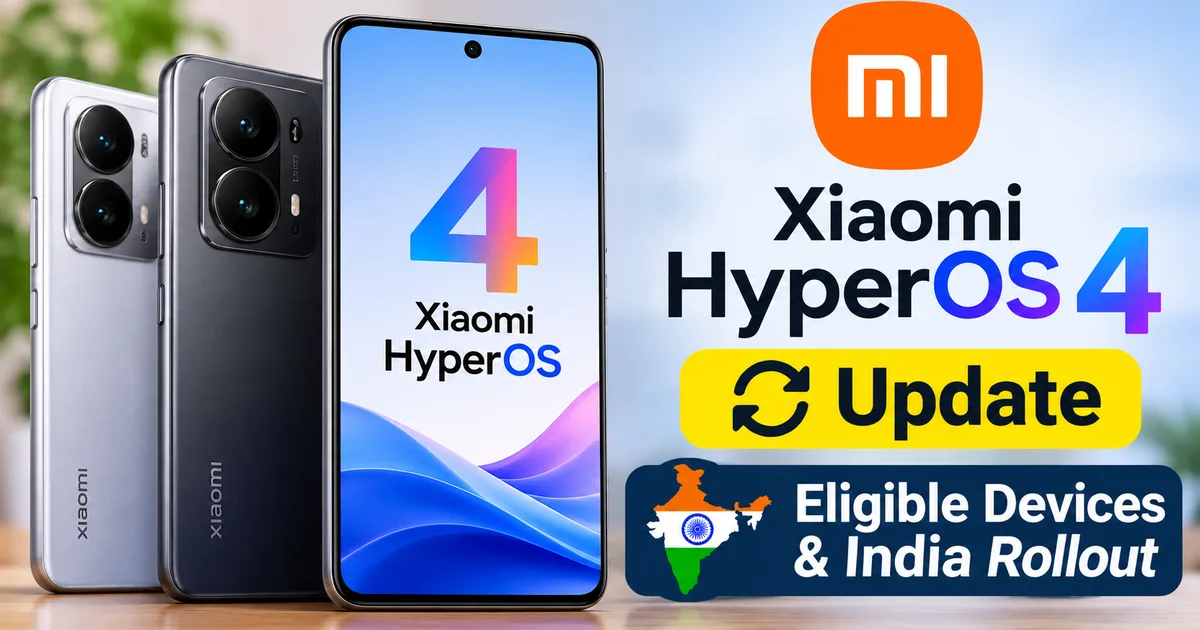
Xiaomi has officially published its global release schedule for the Xiaomi HyperOS 4 update, confirming that 82 devices will jump to the new Android 17 base before the end of 2026. If you bought a Redmi Note handset during festive sales or picked up an affordable Poco phone for college, you probably want to know when your phone gets the new software. The rollout covers hardware released over the past four years across three staggered phases between early November and late December 2026.
That's surprisingly broad support for a brand that used to abandon budget phones after just one version bump.
Look, we've all dealt with messy Android rollouts in India (annoying, I know). You know the drill. A global announcement drops, and everyone gets hyped on Telegram. In my experience, Indian units always end up waiting for months while local testing drags on. But this time, Xiaomi wants to move faster. Heavy competition from the Oppo ColorOS 17 rollout plan and the latest Nothing OS 3.0 update schedule is putting real heat on their mid-range dominance. Still, before you spam that update button, you need to know how the company is splitting these releases and which phones actually get the upgrade first.
Xiaomi HyperOS 4 rollout schedule across three waves
Xiaomi is splitting the global rollout into three distinct batches. The rollout started in China back in October 2026, and the global calendar kicks off right now in November.
Here's how the three phases break down:
Wave 1 devices arriving in early November 2026
The first batch targets current flagships along with some surprising high-volume budget models. Most brands make budget buyers wait for months. But Xiaomi pushed their popular Redmi Note 15 family straight into this first group. That's huge. Millions of everyday users who spent between ₹15,000 and ₹25,000 won't have to wait behind people who bought ₹70,000 flagships.
- Xiaomi 17 Ultra, Xiaomi 17, Xiaomi 17T Pro, and Xiaomi 17T
- Leica Leitzphone powered by Xiaomi
- Redmi Note 15 Pro+ 5G, Note 15 Pro 5G, Note 15 Pro, Note 15 5G, and Note 15
- Redmi 17 5G, Redmi 17, Redmi 17C 5G, Redmi 15C 5G, and Redmi 15C
- POCO F8 Ultra, POCO F8 Pro, and POCO X8 Pro Max
- POCO X8 Pro, POCO X8 Pro Iron Man Edition, POCO M8 Pro, and POCO M8
- POCO C95 Pro and POCO C85
- Xiaomi Pad 8 Pro and Xiaomi Pad 8
Honestly, seeing sub-₹10,000 hardware like the Redmi 17C and POCO C85 in the very first wave is wild. (Usually, budget buyers get treated like second-class citizens, so this is refreshing.) If you picked up one of those entry-level phones, you're getting Android 17 way earlier than expected.
Wave 2 devices rolling out in mid-November 2026
The second wave lands about two weeks later. It picks up previous-generation flagships and newer upper-midrange hardware.
If your handset launched earlier this year or late last year, this is where your phone sits (though the exact day-to-day timing per batch is still a bit fuzzy):
- Xiaomi 15 Ultra, Xiaomi 15, Xiaomi 15T Pro, and Xiaomi 15T
- Redmi Note 17 Pro Max 5G, Note 17 Pro 5G, Note 17 5G, and Note 17
- POCO F9 Ultra, POCO F9 Pro, and POCO F7 series (F7 Ultra, F7 Pro, F7)
- POCO X8, POCO X7 Pro, and POCO X7 Pro Iron Man Edition
- Xiaomi Pad 7 Pro, Xiaomi Pad 7, and Xiaomi Pad Mini
- Redmi Pad 2 Pro 5G, Redmi Pad 2 Pro, POCO Pad X1, and POCO Pad M1
Tablet owners get plenty of attention here. Five different slates are getting the update in mid-November. That's a lot. Xiaomi wants to build out its ecosystem for college students and remote workers who rely on tablets daily. If you ask me, this aggressive tablet schedule shows they're taking cross-device software seriously.
Wave 3 devices scheduled for December 2026
The third and final wave arrives in December 2026. It catches older flagships and older budget models that sold in huge numbers.
You'll find several older favorites in this wave (I'm not sure exactly why the MIX Flip is sitting here instead of wave one, but here we are):
- Xiaomi MIX Flip
- Xiaomi 14 Ultra, Xiaomi 14, Xiaomi 14T Pro, and Xiaomi 14T
- Xiaomi 13 Ultra, Xiaomi 13 Pro, Xiaomi 13, Xiaomi 13T Pro, and Xiaomi 13T
- Redmi Note 14 Pro+ 5G, Note 14 Pro 5G, Note 14 Pro, Note 14 5G, and Note 14
- Redmi 15 5G, Redmi 15, Redmi 14S, and Redmi A7 Pro
- POCO F6 Pro, POCO F6, POCO X8s, POCO X7, and POCO X6 series
- Xiaomi Pad 6S Pro 12.4
Seeing the Xiaomi 13 series from 2023 on this active list is genuinely great. Xiaomi used to drop older phones without a second thought. Now, they're actually sticking to their update promises.
Full list of HyperOS 4 eligible devices
Basically, tracking 82 devices across Xiaomi's messy catalog is no joke. The company spreads its releases across four categories: flagship Xiaomi phones, budget Redmi devices, Poco handsets, plus their standalone tablets. It gets confusing fast.
Here's how all 67 phones and 15 tablets split up:
Eligible Xiaomi flagship and numbered series
The premium Xiaomi family includes 19 phones and 7 tablets:
- Xiaomi 18 Pro, 18 Pro Max, and 18 Fold (shipped with stable firmware)
- Xiaomi 17 Ultra, 17 Pro, 17 Pro Max, 17, 17T Pro, and 17T
- Xiaomi 15 Ultra, 15, 15T Pro, and 15T
- Xiaomi 14 Ultra, 14, 14T Pro, and 14T
- Xiaomi 13 Ultra, 13 Pro, 13, 13T Pro, and 13T
- Xiaomi MIX Flip
- Xiaomi Pad 9, Pad 9 Pro, and Pad 9 Max
- Xiaomi Pad 8, Pad 8 Pro, Pad 7, Pad 7 Pro, Pad Mini, and Pad 6S Pro 12.4
Eligible Redmi smartphones and tablets
Redmi represents the bulk of Xiaomi sales in India, especially through local retail shops and Amazon festive sales. In my experience, these are the phones most people actually carry. The list covers 24 smartphones and 2 tablets (which is huge for budget buyers):
- Redmi Note 17 Pro Max 5G, Note 17 Pro 5G, Note 17 5G, and Note 17
- Redmi Note 15 Pro+ 5G, Note 15 Pro 5G, Note 15 Pro, Note 15 5G, and Note 15
- Redmi Note 14 Pro+ 5G, Note 14 Pro 5G, Note 14 Pro, Note 14 5G, and Note 14
- Redmi 17 5G, Redmi 17, and Redmi 17C 5G
- Redmi 15 5G, Redmi 15, Redmi 15C 5G, and Redmi 15C
- Redmi 14S and Redmi A7 Pro
- Redmi Pad 2 Pro 5G and Redmi Pad 2 Pro
Eligible POCO smartphones and tablets
Poco focuses squarely on gamers and spec hunters who buy during Flipkart flash sales. Their update list includes 24 phones and 2 tablets:
- POCO F9 Ultra, F9 Pro, F8 Ultra, F8 Pro, F7 Ultra, F7 Pro, F7, F6 Pro, and F6
- POCO X8 Pro Max, X8 Pro, X8 Pro Iron Man Edition, X8, X8s, X7 Pro, X7 Pro Iron Man Edition, X7, and X6 series
- POCO M8 Pro and POCO M8
- POCO C95 Pro and POCO C85
- POCO Pad X1 and POCO Pad M1
What changes when your phone upgrades to Android 17
HyperOS 4 is built directly on Android 17, but Xiaomi puts its own heavy skin on top. It doesn't look like stock Android at all.
The visual style is the most noticeable change. Xiaomi is using soft textures and translucent glass styling across notification cards and quick settings toggles. It looks much cleaner than older MIUI builds, which often felt like a cluttered mess with heavy drop shadows.
Animations are noticeably better too. App switching, folder animations, floating windows, and lock screen transitions now use an updated physics engine. It reacts to your finger speed instead of making you sit through clunky pre-baked animations.
Lock screen tweaks are also here. You can finally customize depth effects behind clock fonts and place stacked widgets on your home screen without installing sketchy third-party launchers from the Play Store.
Cross-device sync is another area that got attention. Clipboard sharing and notification sync between Xiaomi phones and Xiaomi pads actually work smoothly now. If you copy an OTP or a tracking number on your phone, it pops right up on your tablet screen (which makes sense, actually).
Thing is, not every phone gets every single feature. Xiaomi's marketing posts tend to brush past this, but the gap is real.
Premium chips like the Snapdragon 8 Elite and Dimensity 9400 easily handle on-device photo expansion and live audio translation. But budget processors on phones like the Redmi 15C or Poco C85 simply lack the neural silicon for local AI tasks. Those budget handsets still get the Android 17 privacy dashboard and improved battery management, along with fresh lock screen clocks. The heavy generative tools remain exclusive to pricier phones.
I think that makes total sense. Forcing heavy AI models onto a ₹9,000 phone with 4GB of RAM is just going to cause lag and sudden battery drain.
How to install the update safely on Indian networks
When Xiaomi pushes a major update, it doesn't blast out files to every phone at the exact same second. Instead, the company relies on a staged rollout system based on batch IMEI numbers and telecom testing.
If you're in India, carrier testing with Reliance Jio and Bharti Airtel takes a few extra days. They need to verify that 5G Standalone calling, VoNR handoffs, network slicing, and emergency alert broadcasts operate without glitches.
Xiaomi India firmware notices advise users to maintain at least 10GB of free internal storage and a 50 percent battery level before installing major platform upgrades.
If you carry the Xiaomi 17 or Xiaomi 17 Pro, or older flagships like the Xiaomi 15 Ultra, you can already check for beta builds through the Mi Pilot testing channel. But if you prefer waiting for the stable over-the-air package, follow these straightforward steps:
- Connect your phone to an unmetered Wi-Fi connection so you do not burn through your daily mobile data limit.
- Open your phone's Settings menu, tap About Phone, and tap the HyperOS version graphic at the top.
- Tap Check for Updates to see if an over-the-air update package is currently available for your batch.
- Back up your WhatsApp conversations, contacts, and photos to Google Drive or local storage before starting the installation.
- Tap Download and allow the device to reboot completely without pressing the power button during the write sequence.
You should also test your critical daily apps right after your phone reboots. Make sure UPI payments on PhonePe, Google Pay, Paytm, or BHIM verify properly with your SIM card, and open DigiLocker to confirm your Aadhaar and driving license tokens remain intact. If you follow Indian mobile technology news, you know that major Android updates occasionally require a quick re-registration on banking apps due to updated cryptographic security rules in Android 17.
That extra five minutes of verification saves you from being stuck at a local kirana store unable to scan a QR code (annoying, but necessary). If you ask me, skipping that check isn't worth the headache.
If you want to compare how other brands are handling their timelines, take a look at our Samsung Android 17 update tracker to see how Galaxy devices stack up against Xiaomi's three-wave schedule.
And if your buddy has the exact same phone but gets the update notification two days before you do, don't panic. That's just how batch delivery works. Your phone will get its turn soon enough.