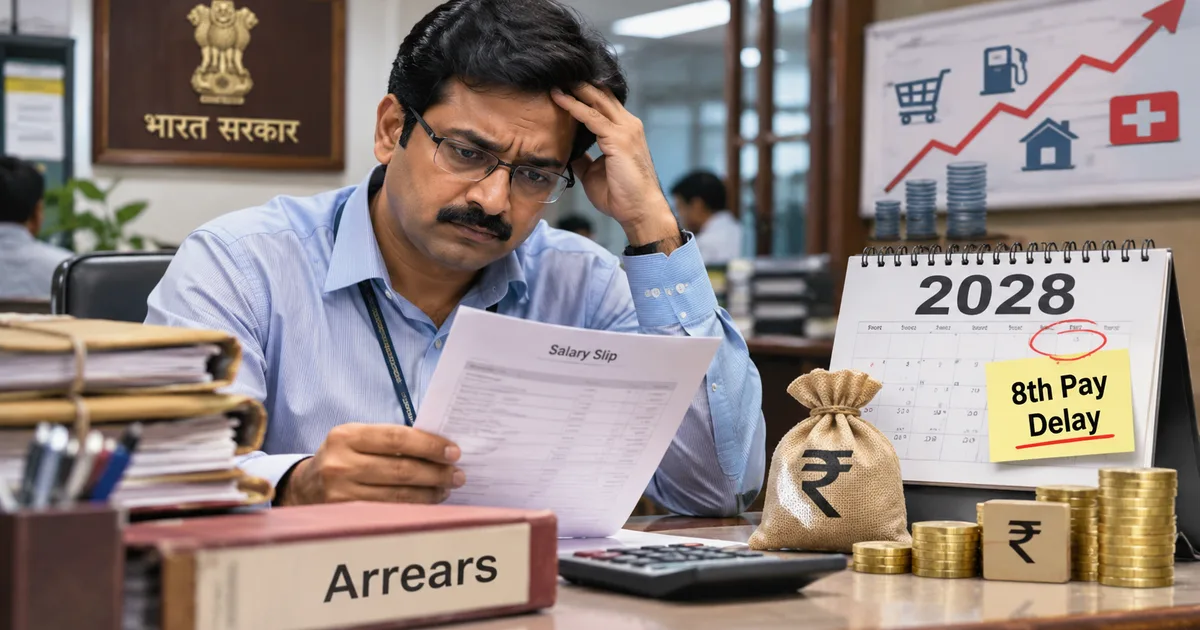
Picture a central government section officer in Jaipur or a railway engineer in Nagpur checking their phone on the last working day of November 2026. The bank SMS lands. Same basic pay and the same familiar number staring back at them. January 1, 2026 was supposed to be the start of a fresh ten-year pay cycle, yet almost eleven months later, nobody has seen a revised payslip. Now, fresh financial warnings are pointing toward an 8th Pay Commission 2028 delay, and honestly, the math behind that timeline is a bigger mess than most WhatsApp forwards let on.
You've probably seen ten different charts doing the rounds in office groups this month. Half of them promise an instant windfall, while the other half claim the government is quietly shelving the hike. Neither is true.
Thing is, pushing actual payouts out to 2028 does something weird to both the Union government's balance sheet and your personal bank account. On paper, it gives the Finance Ministry breathing room right now (which makes sense, actually). But every month without a notification still adds to a pile of unpaid salary dues. That bill has to be settled later. Here's what's going on with Deutsche Bank's Rs 3 lakh crore warning, and what the wait means for your money, if you ask me.
Why the 8th Pay Commission rollout may stretch to 2028
If you're wondering why a pay revision takes so long in India, think of it like renovating a huge joint-family house while over 50 lakh people still live inside it. You can't knock down a wall overnight. The 8th Central Pay Commission, led by Justice Ranjana Desai, has to check pay scales and allowances for more than 50 lakh central government employees. It also has to review pension rules for lakhs of retired staff across civil ministries and defence, plus the railways.
That takes real groundwork. Employee unions send in formal memoranda while ministries flag cadre gaps. State finance departments weigh in too, because whatever the Centre does eventually triggers matching pay demands across the states.
Even after a commission hands over its final report, the clock keeps running. An Empowered Committee of Secretaries reviews the recommendations, and then the Union Cabinet debates which parts to accept or change. Only after that does the Finance Ministry issue formal gazette notifications. Accounting offices and payroll software across thousands of departments then need updates to calculate fresh basic pay and Dearness Allowance resets. Pension orders have to be revised as well. Reports from HR Katha and Livemint say this entire chain of approvals and software updates could push actual payouts well into 2027 or early 2028. In my experience watching large government IT rollouts, early 2028 wouldn't shock me at all. If you like tracking how public systems actually run behind the scenes, we break down similar topics in our detailed policy and tech explainers.
Is a delay like this rare? Not even close. The 6th Pay Commission was effective from January 1, 2006, yet employees didn't see notified changes until August 2008. Even the 7th Pay Commission took until mid-2016 to get cleared after its January 2016 effective date. Waiting is just part of how the Indian pay commission cycle works.
The Rs 3 lakh crore headache for the Centre's finances
Here's where the numbers get scary. A research note from Deutsche Bank Research, reported by CNBC-TV18 and Businessworld, says the 8th Pay Commission could add at least Rs 3 lakh crore to central government spending. Stop and think about that number for a second. Rs 3 lakh crore isn't pocket change, even for an economy India's size.
Right now, the Centre is trying hard to stick to a strict fiscal path. Deutsche Bank expects India's FY28 fiscal deficit to stay unchanged at 4.3% of GDP. If the government suddenly absorbs a Rs 3 lakh crore jump in salary and pension bills all at once, holding that 4.3% line gets a lot harder. Either the Finance Ministry has to cut capital spending on projects like highways and railways, or cut back on digital infrastructure. The other option is borrowing more from the bond market, which can push interest rates up.
Delaying the 8th Pay Commission until 2028 could offer temporary relief to government finances, but it risks piling up a much larger salary arrears bill when payouts finally begin, Deutsche Bank Research warned.
Think of it like putting off a major car repair because money is tight this month. Your bank balance looks fine today. Next year, though, you're still paying for the repair (and nobody likes paying extra for waiting). By letting payouts slip toward 2028, the Centre protects its near-term budget math, yet it builds up a giant lump-sum bill down the road.
Still, there's a flip side to big payouts. Deutsche Bank also pointed out that higher government salaries give domestic spending a real boost. When 50 lakh households get revised pay and lump-sum arrears, that cash doesn't sit idle in a locker. People pay down home loan principal, book two-wheelers or compact SUVs, buy appliances during Diwali sales, and spend across local markets over UPI. That spending brings in GST collections and income tax revenue, which softens some of the blow for the Centre. Even so, the first cheque the government has to write is huge, and I think the Finance Ministry knows it.
How salary arrears actually pile up during a delay
This part confuses a lot of people, so keep in mind—wait, no—let's keep the rules simple: every pay commission runs on two completely different dates, the effective date and the actual implementation date.
For the 8th Pay Commission, multiple reports including News18 point to January 1, 2026 as the effective date, which follows the usual ten-year cycle after January 1, 2016. Suppose the Union Cabinet finally notifies the new pay matrix in April 2027. Or worse, suppose it stretches into early 2028. Your new monthly salary hits your bank account from that notification month onward. What about all the months in between? That unpaid gap between your old basic pay (plus DA) and your revised pay is your salary arrears.
The math is simple. If payouts start in early or mid-2027, staff are looking at around 15 months of unpaid salary dues. That matches recent estimates reported by Upstox. Push the rollout to January 2028, and the Centre suddenly owes 24 full months of arrears to over 50 lakh serving staff and millions of pensioners at once (which is always a gamble with government timelines). That's why Deutsche Bank warned a 2028 timeline could backfire on the budget.
And don't assume every rupee gets paid out in one clean swipe. Looking at how past pay commissions handled big arrears gives a pretty realistic picture of what the Finance Ministry might do:
- Under the 7th Pay Commission, the lag between January 2016 and the mid-2016 rollout was relatively short, so the Centre paid the roughly six-to-eight months of arrears in a single cash lump sum in August 2016.
- Under the 6th Pay Commission, the delay dragged past two full years, creating a massive arrears mountain that the government split into two instalments of 40% in the first year and 60% in the next.
- In both commissions, core basic pay revisions were applied retrospectively from January 1, while several revised allowances like House Rent Allowance (HRA) and Transport Allowance kicked in only prospectively from the actual notification date.
That third point matters way more than most people realize, in my view. An Economic Times calculation showed that Level 7 central government employees could see around Rs 3.32 lakh affected by report implementation delays, though the exact hit depends on how allowances play out. I'm not sure whether allowances will get treated the exact same way this time, because I couldn't find an official Finance Ministry circular and the final Cabinet order isn't out yet. Historically, though, waiting longer means you permanently miss out on upgraded monthly allowances during the delay window, even if basic pay arrears arrive later. Meanwhile, your interim relief comes purely from bi-annual Dearness Allowance revisions. So it's worth checking our breakdown of October 2026 DA hike rates to see how your current payslip holds up.
What the fitment factor means for your revised basic pay
Whenever pay commission news trends, everybody asks the exact same question over office chai: what's the multiplier? In official jargon, that's the fitment factor. Right now, News18 and other financial estimates put the expected 8th Pay Commission fitment factor somewhere between 1.83 and 2.46 (though the final number is still a bit fuzzy).
Look, here's how the math actually works so you don't fall for fake social media thumbnails. When a new pay commission starts, your existing Dearness Allowance drops straight back to 0%. Basically, the fitment factor isn't a free bonus slapped on top of your total take-home pay. It's a multiplier applied to your existing basic pay to merge past inflation (which DA covered) and add a real raise on top.
Let's run two quick rupee examples so you can see the difference:
- Take a Level 1 employee currently earning Rs 18,000 in basic pay. A fitment factor of 1.83 moves their revised basic pay to around Rs 32,940, while a 2.46 factor pushes it up to Rs 44,280.
- Take a mid-career Level 7 employee on Rs 44,900 basic pay. At a 1.92 or 2.0 multiplier, revised basic pay lands near Rs 86,200 to Rs 89,800. At the upper 2.46 estimate, it crosses Rs 1.10 lakh.
Sounds huge, right? Hold on. In late 2026, you aren't living on basic pay alone. You're already getting basic pay plus over 50% in Dearness Allowance. So when DA resets to zero on day one of the new pay matrix, the actual jump in your monthly in-hand salary is smaller than the raw multiplier suggests. It's still a solid raise, I think, just not the magical doubling viral YouTube thumbnails scream about. For a deeper look at the formula and family unit math, check out our 8th Pay Commission fitment factor breakdown, or head straight over to calculate your revised basic pay across pay levels.
Why pensioners watch the same multiplier
Central government retirees have just as much riding on this. Under the parity principle used in the 7th CPC, revised basic pensions use the same fitment multiplier applied to the retiree's existing basic pension (before Dearness Relief). If payouts stretch to 2028, I suspect senior citizens waiting on higher monthly pensions to cover rising healthcare and medicine bills will feel the pinch far worse than younger staff in their thirties.
Hidden catch for employees: taxes, inflation, and cash flow
A lot of employees shrug at a possible 2028 delay and say, 'Who cares? If the effective date is January 1, 2026, I'll get a huge lump sum of arrears anyway!' Honestly, I get why people feel that way. Seeing Rs 3 lakh or Rs 5 lakh credited into your SBI account in a single afternoon feels great (annoying to wait for, sure, but great when it lands). But financially, a two-year wait hurts you in three quiet ways that rarely show up on a payslip:
- Inflation quietly shrinks the real value of your arrears. Even at 4.5% to 5% annual retail inflation, Rs 1 lakh received in 2028 buys noticeably fewer groceries, less fuel, and less school tuition than Rs 1 lakh in your hand in early 2026. The government doesn't pay interest on delayed pay commission arrears.
- A giant lump sum can trigger an ugly Income Tax spike. Suppose your regular taxable income keeps you comfortably inside a lower tax slab, and suddenly 24 months of salary arrears land in one financial year. Without proper filing, that lump sum can bump you into a higher tax bracket, slicing off 20% or 30% straight away. Thankfully, Indian tax law offers relief under Section 89(1) of the Income Tax Act, which lets you file Form 10E online on the Income Tax e-filing portal to spread the tax calculation back across the years the arrears actually belonged to. Still, it's extra paperwork, and plenty of folks miss Form 10E and end up paying extra tax unnecessarily.
- You lose two years of compounding and upgraded allowances. Money paid to you on time in 2026 could have gone into a PPF account, an equity mutual fund SIP, or prepaying an 8.5% home loan. Plus, if revised HRA and other allowances apply only from the actual notification date, those two years of higher allowances are simply gone for good.
If you want to stay ahead of tax filing quirks like Form 10E or digital banking updates, browse our step-by-step finance and tech guides whenever you have ten free minutes.
What central government employees should do right now
So where does that leave you as 2026 wraps up? First, don't make big financial commitments today assuming a fat arrears payout will hit your bank account next quarter. I've seen colleagues upgrade to a bigger car EMI or book an expensive plot thinking arrears would clear the down payment by summer. They ended up stressed when files moved slower than expected. Plan your household budget strictly around your current payslip and routine DA hikes.
Second, use this waiting window to clean up your administrative records. Log into your department payroll portal and DigiLocker to verify that your service book dates, pay matrix level, bank account IFSC, and PAN-Aadhaar linking are completely spotless (trust me, HR offices love flagging tiny typos). When a nationwide arrears payout finally triggers, clerical mismatches are the main reason individual payments get stuck for months.
Finally, keep your eyes on the Union Budget 2027-28 speech coming up in February 2027. That document will give us the clearest real clue on whether the Finance Ministry is earmarking funds for an FY28 rollout or bracing for an even longer wait into 2028. Until an official gazette notification lands, treat every viral arrear table on WhatsApp as sketchy guesswork. The Centre still has to figure out how to pay a Rs 3 lakh crore bill without breaking its budget, so nobody is getting that cash overnight.