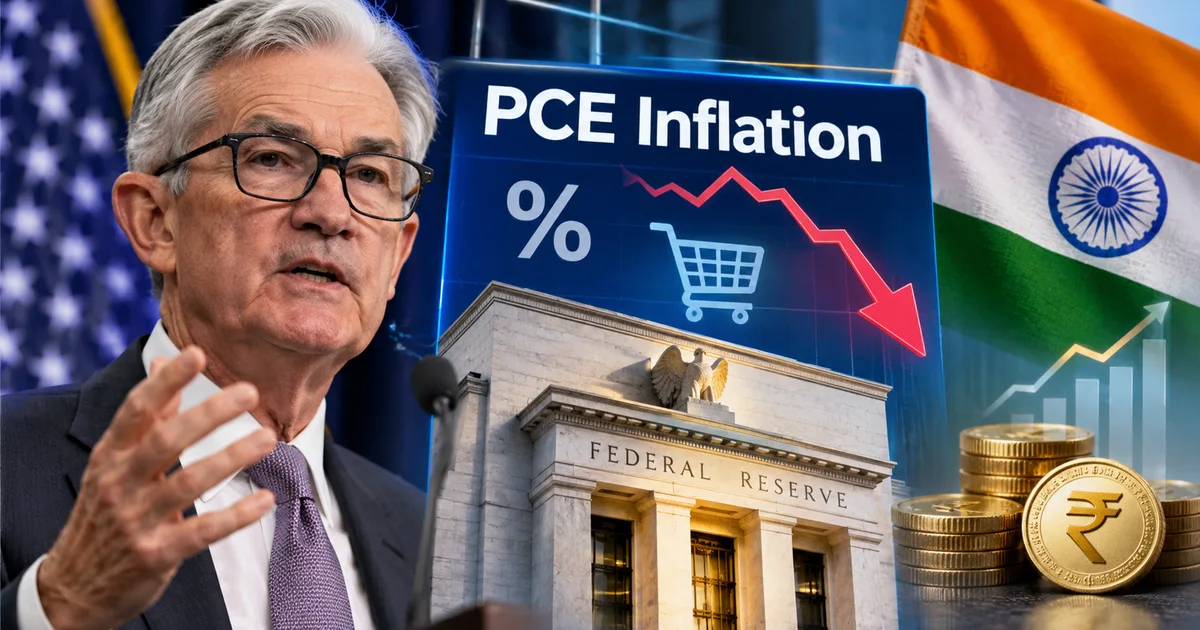
You open your Groww or Zerodha Kite app on a random Tuesday morning, expecting your monthly Nifty 50 SIP to look healthy, and instead the whole screen is bleeding red. Sensex has plunged nearly 1,000 points, Nifty has slipped below 22,300, and business news anchors are yelling about US PCE inflation data hitting 3.8%.
Wait. Why does a price number in America suddenly decide if your mutual fund portfolio in Mumbai or Bengaluru makes money this month?
It sounds absurd. Honestly, I used to skip over American economic acronyms until I noticed my gold ETF and Indian IT stocks reacting faster to Washington press releases than to local RBI announcements. In my experience, Dalal Street panics look completely random from the outside. Once you see how the money pipes connect, though, the whole mess makes sense.
What is US PCE inflation data, anyway?
PCE is short for Personal Consumption Expenditures. Basically, it's the US government's master receipt for everything American households buy every month, from groceries and apartment rent to doctor visits and Netflix subscriptions.
You've probably heard of CPI, the Consumer Price Index, which India uses to track retail inflation. Most folks assume CPI and PCE are basically identical. They aren't. And that gap is a big deal for central bankers.
Picture your monthly kirana list. Suppose you buy two kilos of tomatoes every week, and suddenly tomatoes jump to Rs 120 a kilo. A traditional CPI basket assumes you stubbornly keep buying those pricey tomatoes because its basket weights stay fixed for a long time. PCE is smarter, if you ask me. It notices you switched to buying onions and bottle gourd instead, and updates the math to match what people actually buy in real life. On top of that, PCE counts bills paid on your behalf, like employer health insurance, while CPI only tracks out-of-pocket cash. I'm not sure why India doesn't adjust its local numbers the same way, since switching items is how everyone shops. Because of those two quirks, the US Federal Reserve trusts PCE way more than CPI when it sets interest rates. Whenever finance websites say 'the Fed's preferred inflation gauge', they're talking about PCE.
Three figures show up in almost every report:
- Headline PCE tracks everything consumers buy, including petrol and food, and it accelerated to 3.8% in October 2026.
- Core PCE strips out food and energy because crude oil and grocery prices swing wildly every few weeks, and that figure sat at 3.3% in October 2026.
- The Fed's comfort zone is 2%, which is the line policymakers want inflation to hit before they stop worrying about runaway prices.
At 3.8% headline and 3.3% core, US inflation is stubbornly far above that 2% finish line. That single gap spooked global markets right before December.
Why Fed rate cuts just got pushed way back
Look, for most of 2026, stock markets acted like kids waiting for dessert. Investors kept betting the US Federal Reserve would smoothly roll out Fed rate cuts and make global borrowing cheaper so stock prices could climb.
October's data ruined that party. Because PCE climbed to 3.8% while US growth stayed solid, traders suddenly had to face the awkward reality that the Fed won't cut rates in December 2026 or January 2027. Worse, talk of fresh rate hikes is right back on the table (annoying, I know).
Goldman Sachs expects US core PCE inflation to ease to 2.4% only by December 2027, forecasting Fed rate hikes in December 2026 and March 2027 before interest rate cuts finally begin.
Look at that timeline. December 2027 is over a year away. If you were hoping cheap dollar cash would flood back into stock markets this winter, you're going to be waiting a while.
And the political noise around this is getting loud too. President Donald Trump recently accused the US Federal Reserve of being 'very political' for raising interest rates whenever America reports strong economic numbers, and he even praised India's lower interest rates as a growth model. Still, Fed officials rarely change course over speeches when core inflation sits above 3%. I think that's a good thing, honestly, because central banks aren't supposed to run on election cycles.
India market impact: why Sensex, Nifty, and your EMIs care
Okay, enough about Washington. You live in India, earn in rupees, and pay bills through UPI. Why should a 3.8% inflation number in America rattle Dalal Street or show up in your everyday tech and money explainers feed?
Four direct channels carry that shock straight into Indian wallets.
1. The FII money tap tightens
Foreign Institutional Investors, or FIIs, run trillions of dollars across pension funds and sovereign wealth funds, along with global banks. They're giant pools of restless cash.
When US interest rates stay high or climb further, ultra-safe US government bonds start paying good returns in dollars with almost zero risk. Suddenly, parking cash in emerging markets like India feels less rewarding. So FIIs dump Indian large-cap stocks like HDFC Bank and Reliance. They sell Infosys too, convert those rupees back into dollars, and move the cash back to New York.
We saw this exact pattern play out right after the September 2026 Fed rate hike and again when October's PCE print dropped. When thousands of crores leave in a few sessions, Sensex can easily slide 800 to 1,000 points in a single morning, even when Indian firms post solid quarterly earnings. High-growth Indian cloud IPO valuations also get tougher scrutiny from foreign funds whenever dollar borrowing gets pricey (which makes sense, actually).
2. RBI policy and your home loan EMI
This part stings if you're paying off a Rs 50 lakh apartment in Noida or Pune (or Bengaluru, for that matter).
The Reserve Bank of India already nudged the Indian repo rate up to 5.5% in October 2026 to keep local inflation in check. Normally, middle-class borrowers hope the RBI trims rates by 25 or 50 basis points so monthly home loan EMIs drop by Rs 1,500 to Rs 2,500. Thing is, the RBI has very little room to slash rates while the US Fed is pausing or hiking.
If Indian interest rates drop while American rates climb, the rupee weakens fast against the dollar. A weak rupee makes imported crude oil, cooking oil, smartphone processors, and MacBooks pricier in rupees, and local inflation shoots right back up. So until the Fed turns friendly, don't expect sudden EMI relief from SBI or HDFC. ICICI won't cut fast either, in my experience.
3. Indian IT firms, tech gadgets, and US stock apps
If you work in software services, US PCE inflation hits your appraisal cycle directly. Indian IT majors like TCS and Infosys (and Wipro too) earn well over half their revenue from American banks and retailers, plus big healthcare chains. When US inflation stays hot and rates stay high, American CFOs freeze tech budgets and hold off on fresh hiring. I think that's why bench times feel so tense right now.
It hits everyday tech buyers and retail investors in India as well. Most flagship smartphones and laptops are priced globally in dollars, and so are most cloud software subscriptions, so a stronger dollar pushes rupee price tags upward. Meanwhile, Indian users buying US tech stocks on apps like INDmoney or Vested, or holding Bitcoin, saw sharp swings too. High-rate fears hit crypto and tech shares almost right away when core PCE came in at 3.3%.
What happens to gold prices in India?
Gold gets strangely bipolar during US inflation weeks. Honestly, watching MCX gold during a PCE release feels like watching two people pull a rope in opposite directions.
On one hand, higher US interest rates usually hurt gold in the short run. Gold sitting in a bank locker or a mutual fund ETF doesn't pay monthly interest like a fixed deposit or a US Treasury bond does. So right around November 25, 2026, when the 3.8% US PCE shock hit screens, COMEX gold slid 2.4% and silver tumbled 4%. Indian MCX rates dropped lower in morning trade right alongside them.
But gold snaps back fast whenever investors worry inflation is sticky or stock markets might wobble. Sure enough, global gold quickly rebounded above $3,660 as traders hedged against the uncertainty. The exact bounce timing here is always a bit fuzzy, though.
For an Indian family buying 10 grams of 22-karat gold for wedding season, there's a second catch. It's the rupee-dollar exchange rate. Even when global dollar gold drops 2%, a softer rupee often wipes out half that discount before it reaches your local jeweller's billing counter. That's why I think Indian gold rates rarely drop as much as international headlines make them sound.
How everyday Indian investors should handle this noise
If you refresh your portfolio every hour or read panicked WhatsApp forwards whenever US macro numbers drop, you'll just ruin your week. Watching red candles won't move the Federal Reserve by a single basis point, if you ask me.
Here's a steadier way to approach volatile months like this:
- Keep your monthly equity SIPs running on autopilot, because red weeks when Nifty dips below 22,300 let your Rs 5,000 or Rs 15,000 instalment pick up more mutual fund units at cheaper valuations.
- Skip panic-selling strong Indian mutual funds just because FIIs are cashing out for a quarter, since steady domestic SIP inflows and local corporate growth still carry weight over five to seven years.
- Keep cash you need in the next 18 to 24 months inside safe fixed deposits or liquid funds earning steady rupee interest, instead of risking it in jumpy mid-cap stocks or crypto during a rate-hike scare.
- Spread your gold buying across three to four months using gold ETFs or small batches rather than trying to guess the exact bottom on MCX.
Keep following latest market and tech news so you actually understand why Sensex or your EMI changes, not so you make rushed trades at 9:30 AM. The 3.8% US PCE reading means global borrowing will likely stay expensive well into 2027. Build your monthly budget and SIPs around that reality. Let the TV anchors shout.