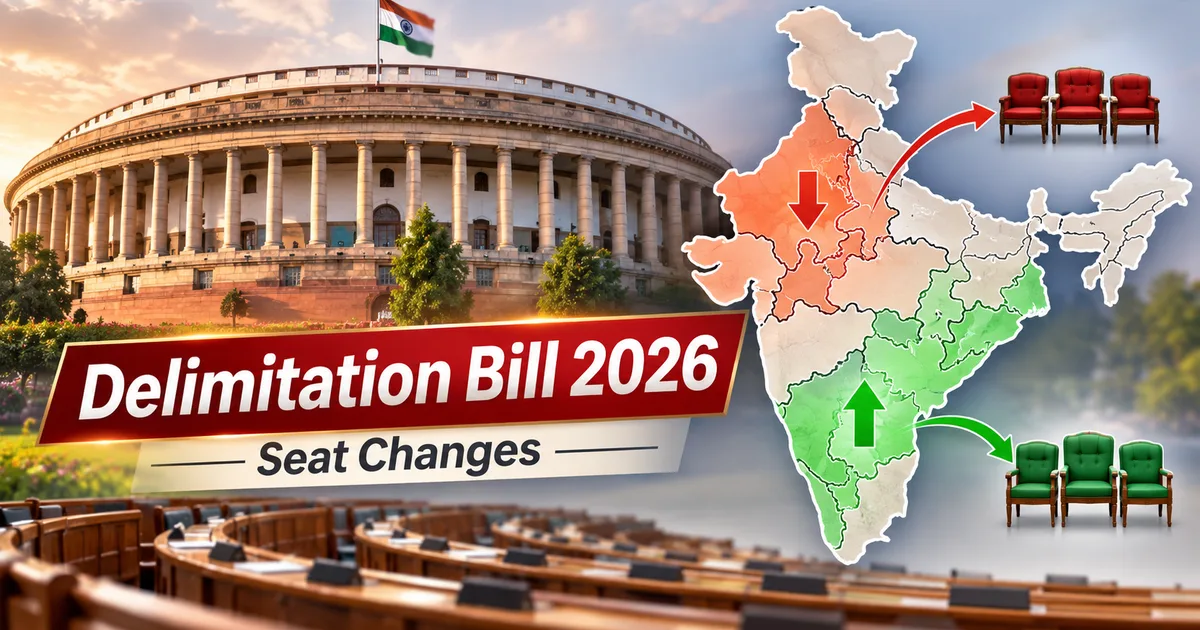
Picture checking your voter slip before a general election and finding out your Lok Sabha constituency has split into two, or that your state suddenly sends half again as many MPs to Parliament. That scenario is at the centre of the Delimitation Bill 2026, which is dominating political debate across India right now. According to reports from DD News and India Today, along with The Wire, the Union Cabinet cleared a revised Delimitation Bill alongside the Constitution (132nd Amendment) Bill, 2026 on Friday, ahead of a special Lok Sabha sitting scheduled for Monday. As covered by The Hindu and News18, the proposal has sparked sharp disagreement in Parliament. Parties like the DMK and BRS are backing it, while the Congress and other members of the INDIA bloc are strongly opposed.
It sounds dense on evening TV debates. Honestly, the basic idea isn't hard to follow once you cut out the legal jargon.
What is delimitation and how does Lok Sabha seat allocation work?
Delimitation simply means fixing the boundaries and total seat count for elections to the Lok Sabha and state assemblies. Think of it like redrawing committee seats in a big housing society after new towers open up. When a block jumps from 200 flats to 500 flats, one representative can't handle everyone's water and parking complaints alone. Redrawing the lines tries to balance how many people each representative speaks for.
In India, this process has two parts.
First is deciding how many Lok Sabha seats each state and Union Territory gets in Parliament. Second is splitting each state's map into individual parliamentary constituencies, and that includes picking which seats are reserved for Scheduled Castes and Scheduled Tribes. It's messy work, if you ask me (and nobody ever agrees on the final map). If you've tracked seat allocation systems in India for university admissions, you already know how fast changing a seat matrix starts a fight over fairness. But Parliament isn't any different. States worry about losing political weight against other states, while voters wonder if their polling booth is moving into a neighbouring constituency.
What the Delimitation Bill 2026 proposes for Lok Sabha seats
Based on reports from DD News, India Today, Manorama Yearbook, and The Wire, the government is bringing two linked bills to Monday's special sitting. News On AIR calls the statutory measure the Delimitation Second Bill 2026. It sits alongside the Constitution (132nd Amendment) Bill, 2026. Live Law notes this revised November version is quite different from an earlier bill introduced back in April 2026. Still, the exact fine print is a bit fuzzy until the full text hits the floor.
Here's what the Cabinet-approved proposals actually put on the table, according to those reports:
- Lok Sabha seats across all states and Union Territories would increase by 50%, taking the maximum strength of the House up to 850 seats, as reported by India Today, DD News, and The Hindu.
- The Constitution (132nd Amendment) Bill, 2026 sets up the framework to implement 33% women's reservation alongside the expanded House, according to India Today and Manorama Yearbook.
- The Wire reports that the revised expansion bill proposes a freeze on inter-state seat proportions until 2051, keeping the existing share of seats between different states unchanged.
- The New Indian Express notes that both the Lok Sabha and state assemblies are part of the broader delimitation plan as seat counts expand.
That mix of numbers is why the November draft looks nothing like what many voters expected earlier this year. You can browse our tech and policy explainers if you want similar breakdowns of how big national bills and digital public systems actually work.
Why the 50% increase and 2051 proportion freeze change the arithmetic
For years, the North-South population gap has been the biggest flashpoint around delimitation in India. States like Tamil Nadu, Kerala, Andhra Pradesh, and Telangana slowed down their population growth much earlier than several northern states. So southern leaders kept warning that redrawing Lok Sabha seats purely on updated census headcounts would shrink the share of southern MPs while giving more seats to populous northern states.
According to The Wire and MSN, the Cabinet's revised proposal tries to dodge that immediate clash. Rather than recalculating each state's share from scratch on fresh population counts, the bill raises seats by 50% across every state and Union Territory and freezes state-to-state proportions until 2051. Say a state currently has 20 Lok Sabha seats. It gets 30. A state with 40 seats jumps to 60, pushing the Lok Sabha to 850 seats while 33% women's reservation sits on top of that bigger pool. No state's percentage share changes right away (which makes sense, actually, if you're trying to get regional parties on board).
On paper, that simple math is why some regional parties gave the November draft a second look. But I think the real headache is still how boundaries get redrawn inside each state, and weekend news reports show Parliament is badly split.
Why political parties are split over the Lok Sabha seat changes
Monday's special sitting hasn't even started yet, and the revised Delimitation Bill 2026 has already scrambled floor alignments in New Delhi. Reports across The Hindu, India Today, NDTV, News18, and Rediff show sharp fault lines between the ruling coalition and the core opposition, with regional parties caught in the middle.
What the government and supporting parties say
The Union Cabinet cleared the proposals on Friday ahead of Monday's special sitting of the Lok Sabha, according to MSN and News On AIR. India Today reported that leaders from the DMK and YSRCP met Union Home Minister Amit Shah before the debate, while MSN noted that both the DMK and the BRS are backing the Centre's revised plan.
The DMK's support caught everyone's eye because the party had opposed the earlier delimitation bill. NDTV and The New Indian Express reported that DMK MPs got separate seats in the Lok Sabha as part of a wider seating shuffle affecting 97 MPs. India Today quoted DMK MP Kanimozhi saying the party hasn't changed its stand. She said the difference comes down to how the revised draft handles state proportions.
Why Congress and other INDIA bloc parties oppose the bill
The Congress and several other INDIA bloc parties have rejected the revised bill outright. According to The Hindu, Leader of the Opposition Rahul Gandhi slammed the jump to 850 seats during Saturday's build-up to the session.
'The number 850 represents murder of democracy,' Rahul Gandhi said, as quoted by The Hindu, while India Today reported he accused the BJP of pushing India towards a dictatorship and alleged the expansion would allow the ruling party to redraw boundaries.
The Times of India also quoted a Congress MP saying the opposition will unite to defend the Constitution and claiming the Delimitation Bill won't pass. Meanwhile, the DMK's switch caused real friction inside the opposition grouping. News18 reported that Congress leaders P. Chidambaram and Shashi Tharoor, along with Trinamool Congress MP Mahua Moitra, questioned the DMK's call and labelled it a 'complete U-turn.' Honestly, if you ask me, losing the DMK's vote over a seven-month span is a mess for the alliance. Rediff noted the episode shows growing disunity inside the INDIA bloc.
Where uncommitted parties like the BJD stand
Not every regional party has picked a side yet. According to The Week, both the NDA and the INDIA bloc have reached out to Naveen Patnaik's Biju Janata Dal (BJD) ahead of Monday's session. Constitutional amendments need special majorities instead of simple majority votes. That makes the BJD's final call one of the biggest things newsrooms are watching right now.
How delimitation affects everyday Indian voters and digital civic tools
It's easy to tune out parliamentary seat math when you're stuck in traffic or cramming for semester exams. Thing is, these changes don't stay locked inside Parliament House in New Delhi. Once delimitation actually happens on the ground, a few very real things shift for ordinary citizens.
First, your parliamentary constituency name and boundaries can change inside your state. Even if Tamil Nadu or Uttar Pradesh keeps the same percentage share of MPs until 2051, adding 50% more seats means chopping existing constituencies into smaller geographic areas. Someone living in a fast-growing suburb of Bengaluru or Pune might find their assembly segment moved into a newly carved Lok Sabha seat. Smaller areas can mean an MP handles fewer lakh voters, though in my experience people still argue over whether smaller maps actually bring better local representation.
Second, the 33% reservation for women means around a third of those 850 constituencies will be set aside for women candidates under the constitutional amendment's rotation or allocation rules. That directly changes who gets to contest from your specific seat in upcoming election cycles.
Third, boundary changes trigger big database updates for anyone checking their voter records online. Those updates will roll across Election Commission of India (ECI) portals and state Chief Electoral Officer websites, and the Voter Helpline app will have to reflect them too. And whenever huge bills hit the news, just like when readers look up FCRA Bill 2026 amendments explainer guides or follow latest India news updates, WhatsApp rumours and fake links spread fast.
So here's a quick practical tip from the tech side. Don't tap random WhatsApp forwards telling you to 're-verify your Voter ID for the new 850-seat delimitation' or pay a fee to update your constituency. Mapping updates happen automatically inside official ECI databases after formal notifications, and checking your EPIC details is always free on government voter portals (thankfully, because paying for a constituency update would be ridiculous). If you run into sketchy election-related APK files or fake verification messages doing the rounds, check scam alerts and safety guides to spot the red flags early.
What happens next in Parliament
According to News On AIR, the central government will introduce the Delimitation Second Bill 2026 during Monday's special sitting of the Lok Sabha alongside the Constitution (132nd Amendment) Bill, 2026. Amending the Constitution takes high voting thresholds in both the Lok Sabha and the Rajya Sabha. That means floor coordination across regional parties like the DMK, BRS, YSRCP, and BJD is going to decide how the vote plays out.
I couldn't find any finalized constituency-by-constituency maps in public government releases yet. That's because actual map drawing only starts after a bill becomes law and a Delimitation Commission runs the state-level exercise (and I'm not sure how long that whole mapping process would even take). Honestly, I think Monday's debate is mostly going to be about whether the government actually has the votes in both Houses, plus seeing the exact wording for the 850-seat formula and the 33% women's reservation.