Every few months, a forwarded message on WhatsApp or a dramatic YouTube thumbnail claims a 'city-killer asteroid' is heading straight for Earth next Tuesday. Most of the time, it's pure noise. The rock passes harmlessly millions of kilometres away, and the channel still collects a million views. But the fear behind those forwards is real, and space agencies actually spend serious money figuring out what humanity would do if a large rock genuinely had our name on it. That's why the ESA Hera spacecraft and its Didymos asteroid mission matter so much right now. In November 2026, Europe's probe finally arrived at the Didymos asteroid system and sent back close-up views of a massive, stadium-sized crater carved by a human-made spacecraft four years ago.
Honestly, the whole setup sounds like a Hollywood script. Except there's no Bruce Willis drilling into rock with a nuclear bomb. Just careful physics and two space agencies playing the longest game of cosmic billiards ever attempted. If you ask me, that's way better than the movie version.
What NASA's DART impact actually did to Dimorphos
Before we look at what Hera just found, let's rewind to 2022. Imagine trying to stop a slow-moving auto-rickshaw from rolling off a mountain road by ramming a scooter into its side at 200 kilometres an hour. Your goal isn't to smash the auto to pieces. You just want to nudge it sideways enough so it misses the edge.
That's basically what NASA tried back in September 2022 with DART, short for Double Asteroid Redirection Test. Its target was a binary asteroid pair sitting millions of kilometres away. A big space rock with its own tiny moon. Didymos, the larger parent rock, is around 780 metres across, while its smaller moonlet Dimorphos is about 160 metres wide.
Neither rock was any danger to Earth, so the pair was a safe test range. NASA steered DART straight into Dimorphos at crazy speed and wrecked the probe on impact. And it worked. Telescopes on Earth soon saw that Dimorphos's orbit around Didymos got shorter. I still think crashing an expensive machine into a rock on purpose is a wild way to do science, even if it made Dimorphos the first space object humans ever knocked off its natural orbit.
Why the ESA Hera spacecraft had to follow four years later
Thing is, hitting an asteroid is only half the experiment. Look at it this way. If a fast bowler cracks a cricket bat in the first over, you know the ball hit hard. Still, you inspect the wood afterwards to see whether the bat was solid English willow or cheap softwood inside. You need to know what the target is made of.
From Earth, even our best telescopes only saw Didymos and Dimorphos as a tiny speck of combined light. Astronomers could time how often the smaller moon passed in front of the bigger rock, which proved the orbit shifted. What they couldn't see from millions of kilometres away was the actual wreckage. Was Dimorphos a solid chunk of stone and iron, or a loose pile of gravel held together by weak gravity? Did DART leave a neat dent, or did it completely mess up the asteroid's shape?
So the European Space Agency built Hera to fly out there four years later and run a full crime scene investigation.
Waiting four years feels painfully slow when smartphone brands drop a new model every twelve months (which says way more about phone marketing than engineering, honestly). In my experience watching deep-space missions, that waiting game is always the toughest part. But matching speed and orbits with a tiny moving rock out there takes serious time.
Inside the first close-up views and that stadium-sized crater
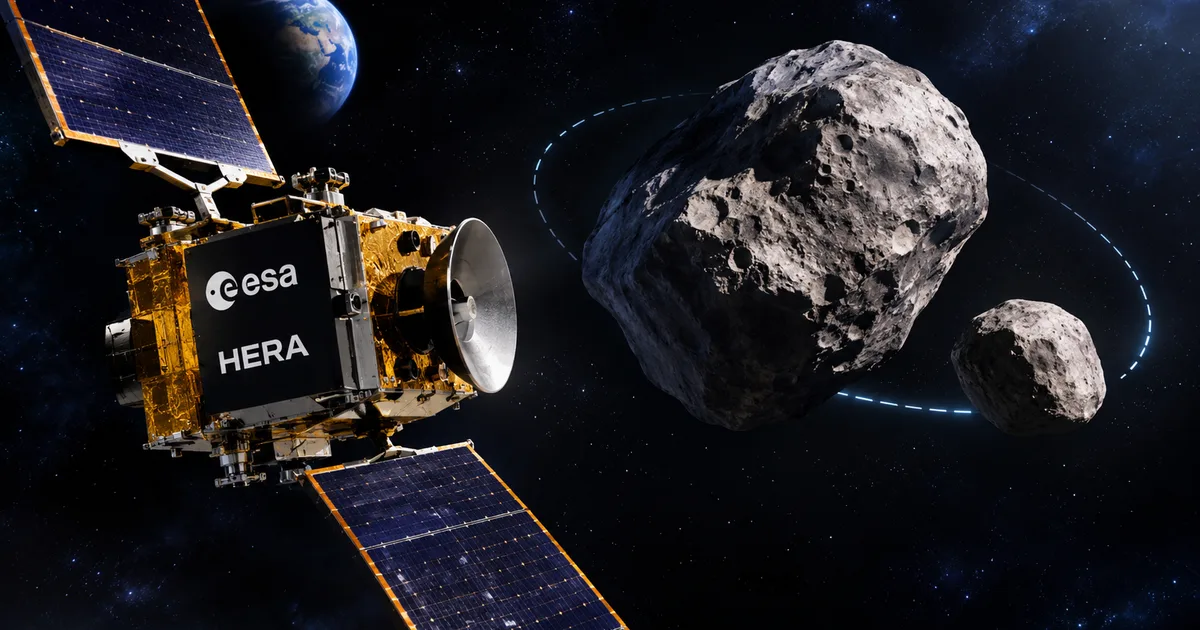
When Hera closed in on the binary system in November 2026, astronomers finally saw what DART left behind. Right there on the battered surface of Dimorphos sat a crater roughly the size of a sports stadium. Picture Wankhede Stadium in Mumbai or Chinnaswamy Stadium in Bengaluru. Now picture a hole that wide blasted into a space rock that's barely 160 metres across in total. I'm not sure exactly why, maybe it's the sheer scale, but imagining a whole cricket ground carved into a rock that small still messes with my head.
That single image tells scientists something huge. If Dimorphos had been a solid slab of stone or metal, a fridge-sized probe wouldn't have left an opening that massive. A crater that big suggests Dimorphos is basically a cosmic rubble pile, just a loose heap of boulders and dust held together lightly.
Why a rubble-pile asteroid reacts differently
Basically, here's the deal with rubble-pile asteroids. When a fast spacecraft hits loose rock, it doesn't just stop dead like a bullet hitting a steel wall. It blasts tons of broken stone and dust backward out of the crater into space. That flying debris acts like a makeshift rocket thruster. It pushes the asteroid forward and multiplies the punch of the original crash.
A stadium-sized crater on a 160-metre asteroid shows the 2022 impact threw out massive amounts of debris, turning DART's direct hit into a much stronger orbital push than raw momentum alone could explain.
And this explains why space agencies want to nudge an asteroid instead of trying to blow it up like in old sci-fi films. If you set off a bomb inside a loose rubble pile, you don't fix the problem. You turn one incoming cannonball into a giant cloud of shotgun pellets still flying straight toward Earth. Nudging the rock intact years early is way cleaner and safer, if you ask me.
If you like seeing how big science and engineering projects work behind the scenes, you can check out our other tech explainers for similar breakdowns. Having real numbers from a crater that size means scientists don't have to guess as much in their computer models anymore.
How Hera maps an asteroid without crashing into it
Black-and-white space photos get all the headlines. They look cool. But Hera has way more going on than just cameras, and I think the backup instruments are where the real work happens. Because the probe is millions of kilometres away, radio commands from European flight controllers take minutes to arrive. You can't fly it with a joystick like a drone in a park. Hera has to steer itself safely past boulders and floating dust on its own.
- Optical cameras capture sharp surface maps so researchers can see how loose boulders shifted or settled around Dimorphos after the 2022 crash.
- A thermal infrared imager tracks how fast the asteroid surface heats up in sunlight and cools down in shadow, which helps distinguish fine dust from dense rock.
- A laser altimeter bounces light pulses off the surface to build a 3D map of the crater's actual depth and slopes.
- Two miniature CubeSats ride aboard Hera to handle riskier close-up passes while the main spacecraft stays at a safer distance.
What the two mini CubeSats actually do
Think of those two CubeSats, named Juventas and Milani, as tiny shoebox-sized scouts riding in Hera's backpack. Juventas has a low-frequency radar built to peer right through Dimorphos and check its insides, almost like taking an X-ray. Milani has cameras and dust sensors to look at the surface minerals and any leftover debris still floating nearby.
Early November updates mostly cover Hera's first camera views of Didymos and that stadium-sized crater. As for the full radar and mineral readings from the CubeSats, the exact timeline is still a bit fuzzy because checking deep-space data takes months. Sending disposable mini-probes closer while keeping the main mothership safe is smart design, though. (I really wish phone makers built gadgets with replaceable parts like that instead of gluing everything shut.)
Why planetary defence matters to India and ISRO
You might be sitting in Pune, Bengaluru, Mumbai, or Jaipur wondering why a rock floating millions of kilometres away matters to everyday life here. The simple answer is that planetary defence is the one disaster plan where borders mean nothing. Asteroids don't apply for a visa before entering the atmosphere.
A 150-metre space rock like Dimorphos wouldn't wipe out all life on Earth the way the dinosaur asteroid did. Still, it's big enough to level a major city or trigger a huge tsunami if it slammed into the Arabian Sea or the Bay of Bengal. Even an airburst over land can shatter windows and knock down buildings across hundreds of square kilometres.
India already builds world-class space hardware, from weather satellites to lunar landers. Look at how far Indian space engineering has come through joint projects like the ISRO-NASA NISAR satellite mission and the steady build-up toward ISRO's Gaganyaan crewed spaceflight mission. If you ask me, helping with global asteroid tracking and planetary defence is an obvious next step for a country with big deep-space plans. Indian ground observatories already help track near-Earth objects, and ISRO officials have publicly talked about wanting to run future asteroid missions, especially with asteroid Apophis making a close flyby in 2029.
You can't wait until a dangerous rock shows up on radar to start figuring out the math. By the time an asteroid is spotted years out, space agencies in India and around the world need proven playbooks already sitting on the shelf.
What comes next for the Didymos mission
These first close-up photos are just the warm-up. Over the coming months, Hera will orbit and spiral closer to Didymos and Dimorphos so engineers can finally measure Dimorphos's exact mass.
How do you weigh an asteroid in empty space? You watch how much its tiny gravitational pull tugs the Hera spacecraft off course, then measure those tiny shifts in the radio signals sent back to Earth. Once scientists pair Dimorphos's exact weight with the 3D size of that crater, they can turn NASA's 2022 crash from a lucky one-off test into a repeatable engineering formula.
You can keep track of those radar findings and upcoming deep-space news in our latest space tech news. I still think it's funny that our best backup plan for saving Earth starts with smashing two expensive machines together in the dark.