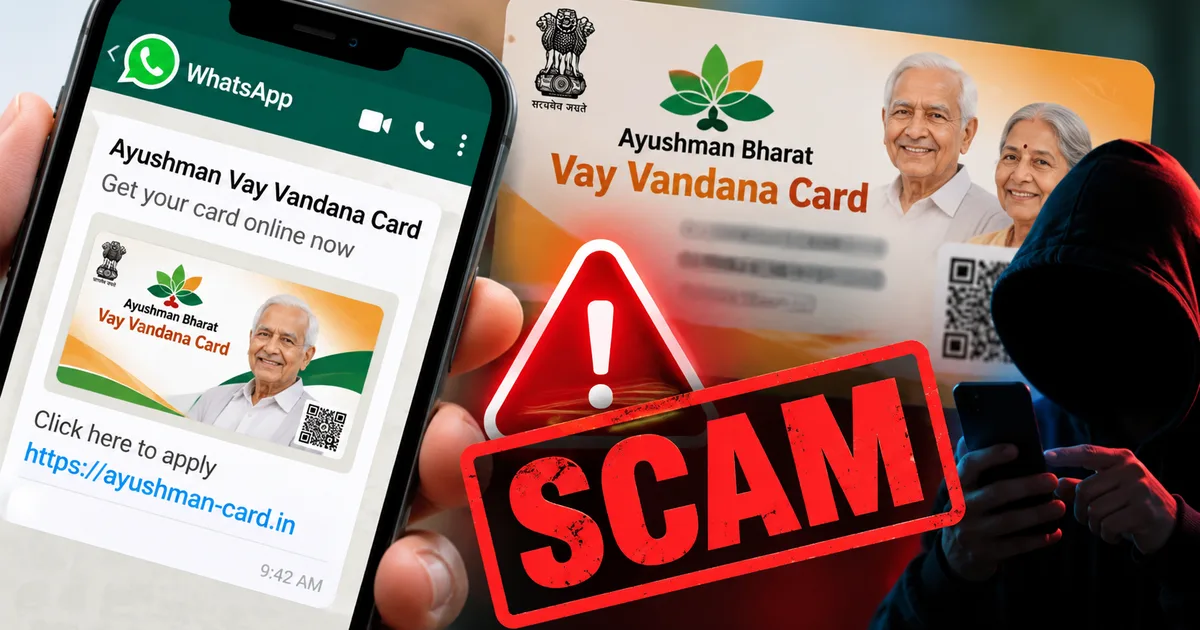
My uncle forwarded me a WhatsApp message yesterday morning, asking if he should fill out the attached form to get his pension health card. When I looked at his screen, my heart sank. It was an unmistakable fake Ayushman Vay Vandana Card registration WhatsApp link scam, dressed up with official-looking emblems and urgent text urging seniors to claim their free ₹5 lakh annual healthcare cover before seats run out.
Look, the Union Cabinet recently expanded the Ayushman Bharat PM-JAY scheme to give ₹5 lakh annual health coverage to every Indian citizen aged 70 and above, regardless of family income. That part is completely real. But scammers jump on good news faster than anyone else. Within days of the rollout announcement, WhatsApp family groups across India were flooded with bogus registration links and sketchy APK files targeting our parents.
It's sickening. And it's spreading fast.
Here's the deal: if anyone sends you a link claiming to register a senior citizen for the Vay Vandana card on WhatsApp, don't touch it. In my experience, the central government doesn't distribute health scheme registrations through chat forwards anyway. Not now, not ever.
What the fake Ayushman Vay Vandana Card registration WhatsApp link scam looks like
The messages circulating right now are made to look like urgent public service announcements. Most of them copy the national emblem and official government colour schemes to build quick trust. It looks convincing at first glance.
They usually start with a loud hook: "Good news for all citizens above 70! Government has started distribution of Ayushman Vay Vandana golden health cards. Apply today to secure ₹5 lakh free hospital treatment for life. Limited time portal." Below the message, there's a shortened link or a button pretending to be an official portal.
Some versions use web domains ending in .top or .site (which makes sense, actually, since cheap domains are easy to throw away). I'm not sure exactly why anyone trusts URLs like pmjay-seva-gov.in.net, but I've seen that specific one floating around. Other forwards take a different route. They attach an installer called Ayushman_Vay_Vandana_Register.apk and tell folks to put it straight onto their Android phone.
If you've spent any time reading our scam alerts and safety guides, you know this playbook. It's old. It's almost identical to the fake Ayushman Bharat PMJAY golden card scams that hit rural families last year. Only this time, if you ask me, the bait is aimed straight at older people who don't always catch these online tricks.
How the Ayushman Vay Vandana Card scam works step by step
The fraud isn't high-tech. Honestly, it relies on basic emotional panic and the deep trust our elders place in family WhatsApp forwards. Here's how the whole trap works from start to finish:
- A message arrives on WhatsApp from an acquaintance or an unknown sender, celebrating the new 70-plus health cover and urging quick registration before a fake deadline expires.
- The senior taps the provided link, which opens a webpage designed to mimic the National Health Authority portal, complete with familiar banners and forms.
- The site asks the user to enter sensitive personal information, including full name, date of birth, Aadhaar number, ration card details, and active mobile number.
- Next comes the financial hook. The site either requests a nominal processing charge of ₹50 via UPI or directs the user to enter their bank account number and debit card details under the guise of setting up direct reimbursement.
- If an APK file was downloaded instead, the malicious app asks for accessibility and SMS permissions. Once granted, it reads incoming OTPs in the background, allowing fraudsters to initiate unauthorized UPI transfers or drain bank accounts without the victim realizing anything happened.
By the time anyone in the family realizes what happened, the website is gone and the sender's WhatsApp number is disconnected. The victim's pension money is already sitting in a mule account (annoying, I know, but banks can rarely pull that cash back in time). In my experience, the whole disaster takes less than five minutes.
Why senior citizens are easy targets for health card frauds
Thing is, this scam is especially vicious because it goes after people who really need medical security but don't have the digital confidence to protect themselves. It's cruel.
According to a report titled "Understanding Intergenerational Dynamics and Perceptions on Ageing" by HelpAge India, senior citizens score just 50.71 out of 100 on the Digital Inclusion Index. That's a painfully low number. Around 66% of elderly respondents said digital tools feel too confusing, and 51% admitted they constantly worry about making mistakes on their phones.
Combine that self-doubt with the terror of massive private hospital bills, and you've got a total mess on your hands. Scammers know older folks won't question a scheme that promises dignity and free hospital treatment without bankrupting the household.
As elders come online, cybercrimes against seniors rose 86% between 2020 and 2022, exposing them to phishing, OTP fraud, digital arrest scams, and now AI deepfakes.
Kunal Kishore, Mission Head for Agecare at HelpAge India, pointed out this exact shift. We've all seen the fallout from this kind of vulnerability across the country lately. Remember when the Supreme Court took suo motu notice after an elderly couple lost ₹1.05 crore in a fake digital arrest trap? That was devastating. And I think this health card scheme uses that exact brand of emotional manipulation, playing directly on fear and confusion.
The scale of real fraud inside the Ayushman Bharat ecosystem
To understand why scammers find this scheme so profitable, you just have to look at what's going on inside the health system itself.
Data submitted to the Rajya Sabha shows that the National Anti-Fraud Unit detected 2.7 lakh inadmissible claims from private hospitals. That adds up to an astonishing ₹562.4 crore in fraudulent health claims across India. The northern states saw massive abuse. Private hospitals in Haryana submitted fake claims worth ₹45.03 crore, while Punjab accounted for ₹28.7 crore. Meanwhile, Himachal Pradesh logged ₹75.65 lakh in bogus claims.
Even more shocking is how phone numbers get manipulated. In response to questions raised in Parliament by MPs Javed Ali Khan and Ramji Lal Suman, the Union Health Ministry revealed that thousands of beneficiaries were linked to single phone numbers. I don't know how this slipped past audit systems for so long, but Punjab recorded 30,011 such cases, and Haryana found another 13,555. Up in Himachal Pradesh, the count was 2,892 (which is still a staggering number for a small state).
Minister of State for Health Prataprao Jadhav told the Lok Sabha that the government has a zero-tolerance policy against any fraud in the PM-JAY scheme. As of late November, 18,184 grievances were registered on the Centralized Grievance Redressal Management System, ranging from denied care to irregular billing. The National Anti-Fraud Unit and State Anti-Fraud Units have suspended errant hospitals and filed formal police FIRs.
So if organized hospital syndicates try to game the system for ₹562 crore, you can see why digital scam rings view WhatsApp as easy money. If you ask me, they know millions of elders are eager to sign up, and they're cashing in on the confusion.
Warning signs of an Ayushman WhatsApp scam
Spotting a fake message doesn't take technical expertise. Honestly, scammers are sloppy. In my experience, if you know what red flags to look for, the cracks show up right away:
- The message urges immediate action with threats that senior registrations will close in 24 hours.
- The link does not end in the official gov.in or nic.in domain extensions.
- The sender asks for a processing fee or verification charge via Google Pay, PhonePe, or Paytm.
- The message prompts you to download and install a raw APK file from a browser or cloud storage link.
- The web page asks for your bank account ATM PIN, net banking password, or UPI MPIN to verify eligibility.
- The sender messages from a regular ten-digit mobile number rather than a verified government service header.
How to protect your family and apply safely
Honestly, the smartest move is to take over the enrollment yourself using a phone or laptop you trust. If you ask me, leaving your parents to fiddle with forwarded links alone is asking for trouble.
Here's how you actually get them registered on the genuine portal without any nonsense:
- Open your computer browser and go directly to the verified official portal at beneficiary.nha.gov.in, or download the official Ayushman App from the Google Play Store.
- Log in as a beneficiary using your Aadhaar-linked mobile number and verify the login using the OTP sent to your phone.
- Select your state, district, and enter the Aadhaar number of the senior citizen aged 70 or above.
- Complete the e-KYC process using Aadhaar OTP authentication or face authentication on the mobile app.
- Once verified, download the Ayushman Vay Vandana Card directly to DigiLocker or save the PDF on your device.
Keep this clear: enrollment is completely free (it really is that simple). The government doesn't charge a single paisa or rupee to issue or download this card. If any website or agent asks for even ₹10 as a "processing fee", close the tab immediately.
And if you need help with other government sites, look through our tech explainers to see how official logins work without putting your personal data at risk. Fraudsters use these exact same tricks across multiple schemes. We saw the same playbook when we broke down the fake PM Internship Scheme registration WhatsApp scam earlier this year.
Where to report Ayushman card fraud in India
If someone in your home tapped a sketchy link or sent money, you've got to act fast. That first hour is what police call the golden hour (and time is everything here), because it's your only real shot at freezing stolen money before it disappears.
- Dial the national cybercrime helpline at 1930 immediately. State clearly that you experienced online financial fraud and provide your transaction reference numbers.
- File a formal cybercrime report online at the National Cyber Crime Reporting Portal at cybercrime.gov.in, attaching screenshots of the WhatsApp chat, the fake link, and bank transaction details.
- Contact your bank branch or customer service line to block your debit card, freeze your net banking, and disable UPI access on the affected phone.
- Report the incident to the Indian Computer Emergency Response Team through the CERT-In portal at https://www.cert-in.org.in/ so their security teams can track and dismantle the phishing infrastructure.
- If an APK file was installed, back up your photos, disconnect Wi-Fi and mobile data, and perform a complete factory reset on the smartphone to wipe persistent malware.
Talk to the elders in your house tonight. Sit down over evening chai, warn them that official government cards never come through forwarded chat messages, and help them apply the right way. It takes ten minutes. But I think it could easily save your family a massive headache and years of pension savings.