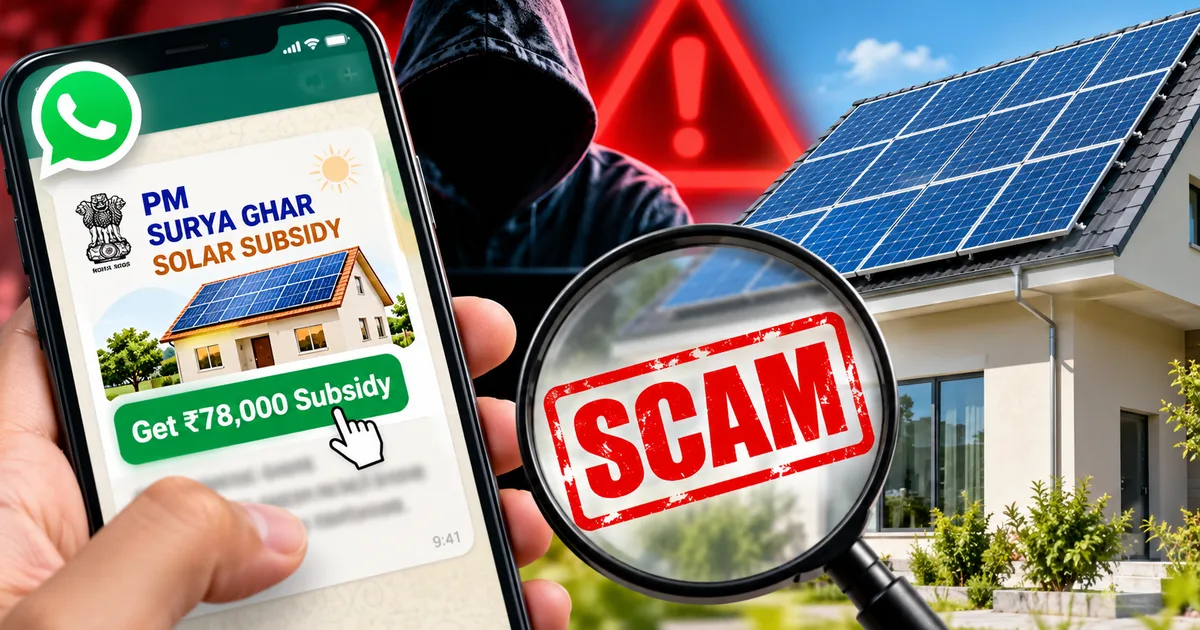
If you opened WhatsApp this morning to find a forwarded message claiming your home was pre-approved for free rooftop solar panels under a special government quota, hit pause. An aggressive fake PM Surya Ghar Muft Bijli Yojana solar rooftop subsidy WhatsApp scam 2026 is sweeping through family group chats across India right now. Fraudsters are exploiting the buzz around rooftop solar to siphon hard-earned money straight out of personal savings accounts. Over 50 lakh Indian homes have joined the genuine program, so people naturally assume these WhatsApp notifications are real. They aren't.
Look, the actual scheme is completely genuine and hugely popular. The Centre launched PM Surya Ghar: Muft Bijli Yojana, and it gives households up to ₹78,000 in direct central financial assistance for installing up to 3 kW of rooftop solar panels. That cash subsidy cuts residential power bills down to zero for millions of families. But scammers love any government welfare program tied to big payouts. People rush to get their paperwork approved before annual targets close, and scammers step right into that confusion.
I saw this first-hand earlier this week when my cousin forwarded an urgent post into our apartment WhatsApp group. The graphic had an official-looking Ashoka pillar emblem. It claimed the power ministry was releasing an emergency festival allocation for our pin code, and told everyone to tap a blue link to secure their kit. Honestly, it looked convincing. Anyone who hasn't tracked how government portals actually work would easily fall for it.
What the fake solar subsidy scam looks like
The scam starts with a forwarded message dressed up as an official notice from the Ministry of New and Renewable Energy, or your state power distribution company. You'll often see names of local discoms like Tata Power, BSES, Mahavitaran, or BESCOM stamped right across the top banner. And the text pushes manufactured panic. It claims your locality has only 50 subsidized solar kits left under the 2026 quota, or warns that power tariffs will spike next month if you don't grab your panels today.
These messages almost always promise things the government never gives out. They talk about 100% free rooftop solar and zero upfront costs without any roof inspection. But that's simply not how the program works. The actual central scheme has fixed financial support: ₹30,000 for a 1 kW setup, ₹60,000 for 2 kW, and a maximum of ₹78,000 for systems of 3 kW or higher. You still have to pay the remaining cost to the installer, or get a bank loan through the portal. Anyone claiming the entire solar setup is free without a single rupee from your pocket is lying.
If you ask me, this feels uncomfortably close to the fake PM Surya Ghar SMS scam that hit mobile users during earlier rollouts. Fraudsters just moved their operations over to chat apps. People trust forwards from friends and neighbours, so the scam spreads without friction.
Once you click the link, you land on a webpage built to mimic the national portal. It displays tricolor banners alongside minister photos, plus a form asking for your phone number and electricity consumer ID. Other variants take a nastier route (which is alarming, honestly). They tell you to download an Android APK file named something like SuryaGhar_Portal_v2.apk. That file is spyware. It grabs incoming OTP messages and gives scammers remote control over your phone.
How the WhatsApp solar subsidy fraud works step by step
Spotting this fraud early is much easier once you know their playbook. Scammers follow a rigid script to pull cash and private details out of you step by step.
- The pitch arrives as a WhatsApp forward or a direct chat from an unfamiliar business profile. It makes wild claims about free solar setups and warns that registrations shut down in 24 hours.
- When you tap the link, the fake site asks for your Aadhaar number and your electricity consumer account number. This data helps the scammers build a complete target profile.
- A fake solar representative messages you on WhatsApp or calls your phone. They address you by name and confirm that your home qualified under your local power company.
- The scammer says a technician must visit your roof for a shadow analysis survey. But to lock in that visit, they tell you to transfer an inspection fee of ₹1,500 to ₹3,500 via a UPI QR code sent right in the chat.
- Pay that initial fee, and their demands jump. They send a bogus work order with forged government stamps and ask for a 10% equipment reservation deposit, usually between ₹15,000 and ₹25,000. They swear this entire deposit comes back via DBT once your subsidy clears.
- The second that money hits their account, they vanish. The phone number goes dead, and their WhatsApp profile picture disappears. No solar technician ever shows up.
Thing is, widespread vendor confusion in the solar sector makes this fraud believable. Legitimate solar installers across India are dealing with supply bottlenecks and payment disputes. In Mumbai, for instance, solar vendors recently alleged a crore-rupee fraud by Malad distributor Sunroute Energy over undelivered equipment, which left hundreds of buyers stranded with half-finished setups. When the real supply chain is already a mess, scammers find it easy to pose as genuine distributors with shortcut approvals.
Warning signs hiding inside these WhatsApp forwards
Scammers always leave fingerprints behind. If you spot any of these signs, you're dealing with outright fraud.
- Demands to send inspection charges or booking fees to a personal UPI handle or mobile QR code. Real government programs never collect money through personal phone numbers.
- Web links ending in odd domains like .site, .xyz, .top, or .online instead of the official gov.in portal.
- Insistence that you download an APK file directly from a WhatsApp chat rather than using the Google Play Store.
- Promises that your subsidy cash will land in a private mobile wallet instead of the bank account linked to your Aadhaar through the National Payments Corporation of India mapper.
- Aggressive sales tactics that push arbitrary two-hour deadlines or threaten to disconnect your electricity consumer number if you don't pay on the spot.
In my experience, you should be particularly skeptical of messages claiming you can bypass the standard discom inspection. In the real world, your local electricity provider has to inspect the wiring and install a bi-directional net meter before any subsidy moves an inch. That inspection takes time (annoying, I know, but true). Anyone claiming they can bypass the power company through back channels is conning you.
How to protect yourself and your bank account
Look, you don't need technical expertise to stay safe from solar scams. You just need strict verification habits whenever someone asks for your documents or advance payments.
First, rely exclusively on pmsuryaghar.gov.in for every step of your solar journey. That's the only legitimate central portal for the scheme. If you want rooftop solar, register your application on that site yourself. You can read our detailed guide on how to apply for free solar power to check the real registration steps from start to finish.
Second, never pay inspection fees via personal UPI under any circumstances. Official vendors empanelled with your discom don't collect random site visit charges through WhatsApp QR codes. Any real payment for solar equipment happens under a formal, written contract after the vendor completes a physical site survey and hands you an itemized bill.
Third, never install APK files shared over chat. If a supposed government agent sends you a file claiming it's the national solar app, delete it immediately. The official PM Surya Ghar mobile app is on the Google Play Store, developed by the National Informatics Centre (which makes sense, actually). Unofficial APK packages are sketchy and often carry trojans that steal banking passwords or forward your two-factor SMS codes straight to hacker servers.
Fourth, cross-check vendor credentials against your state discom portal. Every state electricity board keeps an active public directory of empanelled solar vendors. If a representative reaches out, ask for their vendor ID and check it against that list. And if their company name doesn't show up, don't let them onto your roof or transfer a single rupee.
Fifth, keep your identity documents secure. The Ministry of New and Renewable Energy requires Aadhaar authentication for direct subsidy payouts to eliminate ghost applications. Genuine verification uses official UIDAI facial recognition or OTP prompts triggered through DigiLocker and the official portal. Don't ever send unmasked photocopies of your Aadhaar card or PAN card over WhatsApp chat to unverified strangers.
If you want to stay ahead of these threats, check our collection of how-to tech guides for practical walkthroughs on securing your phone and banking apps.
Where to report solar subsidy cyber fraud in India
If you suspect you spoke with a scammer or already transferred money, don't waste time feeling embarrassed. Act right away. Moving fast during those first couple of hours gives banks their best window to freeze stolen funds before scammers shift them through multiple mule accounts.
If you sent money to a fraudulent QR code or shared your banking details, dial the national cybercrime helpline immediately (and please, do it quickly). Every minute matters while local cyber cells work with banks to freeze unauthorized transactions before scammers move money out of mule accounts.
Your immediate first call has to be the 1930 helpline, run under the Indian Cyber Crime Coordination Centre (I4C). Explain that you got hit by a fake solar subsidy WhatsApp scam, and give them the transaction reference number from your UPI app along with the exact amount lost. The operators can flag the transaction across participating banks and payment aggregators to block the payout.
Next, log on to cybercrime.gov.in to file a formal digital complaint. Upload clear screenshots of the WhatsApp conversation, the fraudulent payment QR code, the scammer phone numbers, and your bank account debit statement. The portal automatically forwards the file to your local district cyber police station for FIR registration and legal action.
You should also report malicious domains and phishing links to the Indian Computer Emergency Response Team through the official CERT-In incident reporting portal at https://www.cert-in.org.in/. Flagging these links helps security teams sinkhole malicious servers and knock scam websites offline before other families get hit.
Finally, report and block the phone number right inside WhatsApp. Tap the contact details and select Report Contact. Be sure to check the box to block the sender and forward the last five messages to WhatsApp moderation. I'm not sure exactly why telecom networks still let these bulk numbers slip through so easily, but every report helps train spam filters. You can also visit our scam alerts and safety section to check recent patterns and warn your family before someone falls for this mess.