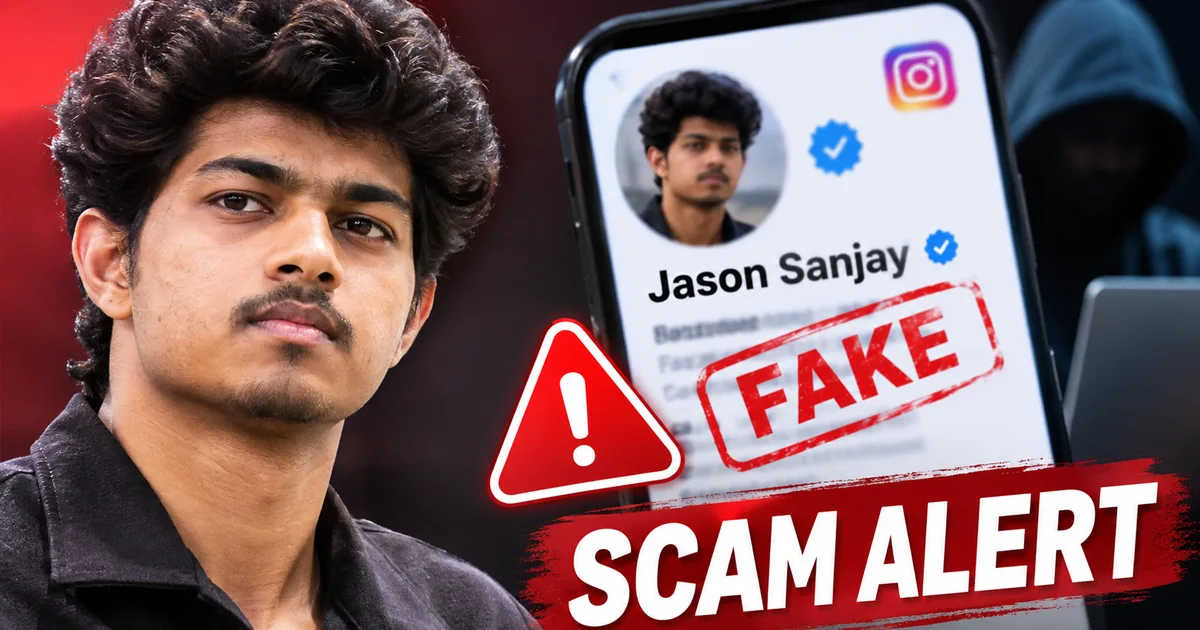
If you follow Tamil cinema or track new directors, you've probably noticed fan pages popping up for Jason Sanjay right after his directorial debut with Sigma in October 2026. Behind dozens of these handles lies an aggressive racket. The fake Jason Sanjay profile scam has spread across Instagram, Facebook, Telegram, and X. On October 29, the young filmmaker himself issued an official public disclaimer. Fraudsters clone his identity and set up bogus fan associations. Then they con cinema lovers into sending cash.
Honestly, celebrity impersonation on Indian social media drives me crazy. Con artists always hunt for fresh buzz. With his father Vijay entering politics with Tamilaga Vettri Kazhagam and Jason launching a film career, scammers found an easy target. They target young fans or aspiring actors. I'm not sure why people fall for it so fast, but hype blinds everyone.
I looked through several of these cloned profiles yesterday.
Many look convincing at first glance. They rip high-resolution stills from interviews and copy authentic captions, while buying cheap bot packages to inflate follower counts (annoying, I know). If you're scrolling on your phone on the metro, you'll easily fall for it. It's a mess.
What the fake Jason Sanjay scam actually is
Basically, cyber criminals create mirror accounts of Jason Sanjay across platforms for quick cash. Operators don't just repost updates. They message followers directly on Instagram and Telegram, claiming to represent his production team or an inner-circle fan club. In my experience, once these networks latch on, they don't let go.
On October 29, 2026, Jason Sanjay released a public disclaimer. He published the exact handles of his authentic profiles on Instagram and Facebook, plus X. He warned everyone that any other page using his photos is completely fake. Scammers copying him so openly is pretty bold (and ridiculous, honestly).
"I have not authorized any official fan club, association, or welfare community. I will not be responsible for any communications, commitments, or monetary transactions carried out by unauthorized profiles."
That disclaimer cuts right through the noise. Con artists frequently tell victims that a secret fan club is collecting money for charity, or that an assistant director is shortlisting newcomers for Jason's next movie. But Jason Sanjay made it crystal clear that no such club exists. None.
This isn't an isolated problem in Kollywood. Kamal Haasan's banner, Raaj Kamal Films International, issued a similar advisory when fake casting agencies charged for audition tokens. The playbook is identical. Scammers create a fake profile while promising insider access. Then they grab cash before anyone smells a rat. It's sketchy, yet it works on newcomers.
How the social media impersonation scam works
Scammers follow a clear routine. Cinema buffs want to feel connected to films, and con artists weaponize that excitement. If you ask me, that's where people slip up.
Step 1: Setting up cloned profiles and fake fan associations
The setup starts with handles that sound genuine. Fraudsters register variations like official_jasonsanjay, jason_sanjay_director, jasonsanjay_official_club, or jason_sanjay_films. They upload genuine photos and backdate posts to make the profile look older. Then they flood the feed with stolen video clips.
Next, they create private WhatsApp groups and Telegram channels. They drop invite links in bio sections, pitching them as exclusive VIP fan groups. The numbers here are fuzzy, but these groups pull in hundreds of eager followers. It looks organized and feels totally real.
Step 2: Baiting fans with auditions and exclusive access
Once someone joins, the conversation moves straight to private chat. A scammer posing as an assistant or casting coordinator sends a direct message offering insider perks. Sometimes it's an invite to a private screening. Other times it's an audition call for prospective assistant directors. Thing is, they know which buttons to press.
Similar patterns appear in Instagram ticket scams targeting popular artists, where con artists use emotional attachment to manufacture urgency. When you believe you're chatting with someone from a film director's office, your skepticism vanishes fast. (I know, it sounds tempting, but real directors don't recruit crew members over Instagram DMs). You want to believe it.
Step 3: Demanding quick UPI transfers
Here's where the financial trap snaps shut. The impersonator asks for a processing charge or verification deposit. They label it a refundable audition fee of ₹1,500, a welfare trust badge fee of ₹500, an ID card fee of ₹1,000, or a VIP club membership fee of ₹3,000. Then they send a personal UPI QR code or a Virtual Payment Address linked to Google Pay, PhonePe, Paytm, or BHIM.
To force quick decisions, they claim slots are restricted to the first thirty applicants. Don't do it. Just don't. The moment you transfer the money, the scammer either asks for another ₹2,500 for an identity badge or blocks you on the spot. Your money is gone, and there's nobody on the other end to hold accountable.
Clear warning signs of fake celebrity accounts
Catching an impersonator doesn't take special software. Two minutes of careful inspection before messaging or clicking an invite link is plenty. In my experience, spotting red flags is easy once you know what to check.
- The account asks for money through UPI, net banking, or gift cards for fan clubs, audition forms, or charity funds.
- The username has odd underscores, double letters, or trailing numbers that don't match official announcements.
- The profile urges you to leave the public platform to continue conversations on personal WhatsApp numbers or Telegram channels.
- Direct messages claim you won an exclusive meet-and-greet or private video session with the director.
- The account has thousands of followers but almost zero comments from real people on its posts.
- The person demands copies of your Aadhaar card or PAN card over chat for registration.
Look, legitimate film directors and production companies don't recruit talent or collect fan club dues through Instagram direct messages (which makes sense, actually). They run casting through accredited casting directors, trade bodies, talent agencies, or official studio notices. If someone in your inbox asks for ₹2,000 via Google Pay to review your portfolio, never pay upfront fees for movie opportunities. Walk away.
How to verify authentic profiles and protect yourself
Staying safe online doesn't mean unfollowing creators you admire. Not at all. You just need quick verification habits, because I think taking ten seconds to verify a profile saves you massive trouble later.
First, always check handles against official press announcements. When Jason Sanjay issued his clarification on October 29, he listed his exact social media handles. Bookmark those verified URLs and ignore everything else. Don't search for a name in the app search bar and click the first handle that pops up. Search algorithms frequently highlight impersonators that paid for fake engagement.
Second, treat identity requests as an immediate hazard. Big red flag. Scammers ask for unmasked Aadhaar photos under the guise of verification. Never send Aadhaar scans over messaging apps (annoying, I know, but it protects your identity). If a genuine organization needs ID, use secure platforms like DigiLocker instead of handing files to strangers.
Third, stay cautious around external links. Scammers often send links claiming to be fan club portals or audition submission forms. Clicking these links can trigger downloads of spyware, similar to the fraudulent APK links circulated on WhatsApp that compromise mobile banking apps. So never install unknown APK files received through private chats.
Fourth, inspect the comment section carefully. Fake accounts almost always buy bot followers to inflate numbers. Look at their posts. If thirty comments are just fire emojis from accounts with zero followers and random numbers in their handles, you're looking at a scam. Real accounts have actual conversations from real people.
You can check our scam alerts and safety archive to see how impersonation schemes spread across cinema, finance, entertainment, and social media. It happens everywhere. Reading through our practical tech safety guides will also help you secure your own profiles against unauthorized tagging and message requests.
Where to report impersonation and cyber fraud in India
If you lost money to a fake Jason Sanjay account or spotted a clone handle, act immediately. Speed is everything when tracing UPI payments. If you ask me, the first couple of hours are your best shot at getting cash back.
Call the national cyber crime helpline at 1930 right away. Managed by the Indian Cyber Crime Coordination Centre under the Ministry of Home Affairs, this helpline coordinates directly with banks and payment aggregators to freeze funds in destination accounts before fraudsters cash out. The faster you call after a UPI transfer, the higher your odds of recovering the money (and keep that complaint number handy).
Next, submit a formal complaint at cybercrime.gov.in. Attach screenshots of the chat, the impersonator profile link, the scammer's UPI handle, and transaction reference numbers from your banking app. These records help police connect the scam to the mule bank accounts used by the network.
Report the profile inside the app as well. On Instagram and Facebook, open the profile and tap the three dots in the top corner. Choose Report, then select Pretending to be someone else. Platforms aggregate these reports to trigger automated reviews and account suspensions.
Government agencies are pushing back against these tactics. The Computer Emergency Response Team of India (CERT-In) at cert-in.org.in regularly alerts citizens about social engineering scams. On top of that, the Central Government is reviewing proposed Know Your Customer rules for major social platforms including Facebook, Instagram, Snapchat, and X to curb untraceable impersonation rings.
Don't let fandom blind you to basic financial risks. If any account claiming to represent Jason Sanjay asks you for money, block the profile immediately.