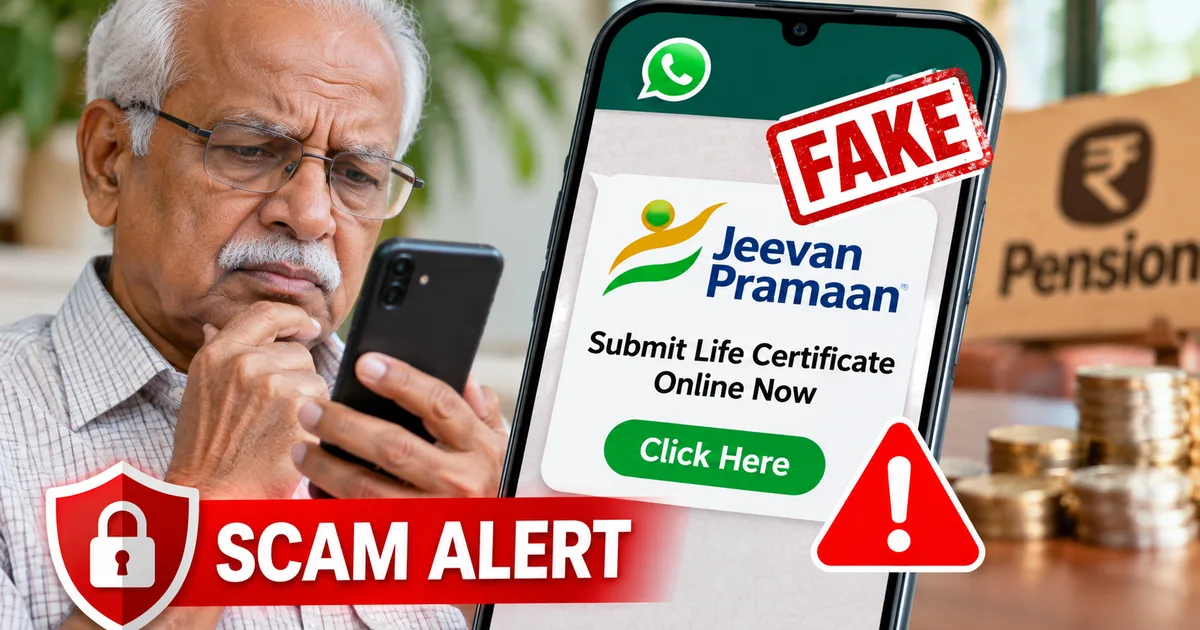
If you or your aging parents draw a monthly pension, November brings one unavoidable task: submitting the annual life certificate so the bank keeps crediting the money. But right now, cybercriminals are running an aggressive fake Jeevan Pramaan Digital Life Certificate WhatsApp scam targeting seniors across India. I saw a case just last week where an elderly uncle in Pune got an urgent WhatsApp message claiming his pension would stop within forty-eight hours unless he verified his documents through a link. He panicked. And that exact panic is what these fraudsters depend on every single year.
Every year, millions of central and state pensioners, along with defence retirees, have to complete this mandatory verification. While super senior citizens aged eighty and above got an early window starting October 1, everyone else has between November 1 and November 30 to submit their proof of life. Miss the deadline, and the bank pauses your December pension payment. Scammers know this, so they exploit that anxiety ruthlessly.
Real people are losing their entire life savings to this scam.
The numbers here are a bit fuzzy, but the ground reality is terrifying. A retired Indian Air Force officer in Pune lost ₹4.5 lakh after responding to a fake verification message. Another retired police officer lost ₹2.40 lakh in minutes. He downloaded what he thought was an official government update app, and just like that, the money was gone.
Look, submitting a Digital Life Certificate has actually become way easier over the last two years. You don't need to stand in long queues at your pension bank branch or pay shady agents anymore (which is a relief, honestly). But because the whole process is online now, scam networks have built slick traps to catch seniors off guard. If you ask me, once you understand how this sketchy WhatsApp operation works, dodging the trap is pretty straightforward.
What the fake Jeevan Pramaan WhatsApp scam looks like
The trap usually starts with a text arriving on WhatsApp from a random ten-digit mobile number. The message often displays the official Ashoka emblem or the Ministry of Electronics and Information Technology logo as its profile picture. Sometimes it's your own pension bank's logo. I'm not sure exactly why so many people trust a WhatsApp profile picture, but that fake official look fools seniors immediately.
The text itself is engineered to cause panic. It usually looks like this:
"Dear Pensioner, your Jeevan Pramaan Digital Life Certificate for 2026 is pending. As per CPAO and SPARSH guidelines, your pension will be suspended from December 1. Click here to download the JeevanPramaan_Update.apk file and complete Aadhaar biometric verification immediately."
Sometimes there's no attachment right away. Instead, the message points to a link disguised as an official government portal, with sketchy addresses like jeevanpramaan-pension-update.in or sparsh-life-certificate-kyc.com. Tap that link, and it immediately prompts you to install an Android package file on your phone.
Thing is, real government departments don't operate over WhatsApp. The Central Pension Accounting Office (CPAO) and the Controller General of Defence Accounts (CGDA) never send APK files to your personal phone number. Your pension branch won't either. In my experience, any APK file attached to a chat is straight-up malware. Stop right there.
How digital life certificate fraud drains pensioner bank accounts
How does a simple WhatsApp chat empty a bank account holding lakhs of rupees? Criminals use malicious software alongside aggressive psychological pressure. It basically happens in two ways.
The malicious APK download trap
When an elderly person downloads the file, Android pops up a security warning about unknown apps. Panic takes over. Worried that their pension will vanish in forty-eight hours, they ignore the warning and tap install anyway.
The moment that fake app opens, it starts demanding permissions. It wants access to your SMS inbox. It wants Android accessibility controls, which basically lets the software monitor every tap on the screen. (Annoying, I know, but seniors usually tap 'Allow' on every prompt just to clear the popups). Once granted, the rogue app sits quietly in the background, waiting for its cue.
Next, the app shows a neat form asking for your Pension Payment Order (PPO) number, date of birth, Aadhaar number, and linked bank account details. As soon as the victim types that in, the scammers move. Fast. They initiate unauthorized fund transfers or reset net banking credentials on the spot. Because the malware already reads incoming SMS texts, it intercepts every single bank OTP. The victim doesn't even hear a notification ping. Within fifteen minutes, the entire balance is swept into mule accounts scattered across different states.
The fake PPO verification phone call
Sometimes there's an immediate follow-up phone call. The caller claims to be an executive from the CPAO helpdesk or the SPARSH support team. Polite and reassuring. They speak fluent Hindi or English, or whatever regional language the pensioner prefers.
The caller already has basic personal details handy, like the pensioner's name and former government department (which makes sense, actually, given how much leaked data is floating around). That builds instant credibility. Then comes the story: the system hit a glitch with the biometric record, but don't worry, they can finish the digital verification right over the call. All the pensioner has to do is read out a six-digit verification code sent to their mobile. That code isn't for Jeevan Pramaan. It's a banking login OTP or a UPI debit confirmation code.
We see these exact same psychological tricks in the fake PM Kisan pension scam targeting rural beneficiaries. Criminals also borrow intimidation tactics from fake digital arrest scam tactics, making seniors feel like they're breaking serious government rules if they don't cooperate. I think the core playbook is always the same: trigger panic and harvest login credentials before anyone has time to think.
Clear warning signs of a pension verification fraud
Spotting these attacks is actually simple once you know what genuine government messages look like. If you ask me, these specific red flags give the game away every time:
- The sender contacts you from an ordinary ten-digit mobile number on WhatsApp rather than an authorized government SMS sender ID such as AD-GOV or BP-EPFOHO.
- The message includes an APK file attachment ending in .apk or directs you to a third-party file sharing site instead of Google Play Store.
- The communication threatens that your pension will be permanently terminated or frozen within twenty-four to forty-eight hours if you do not click immediately.
- The caller demands your Pension Payment Order (PPO) number, bank account number, debit card PIN, or Aadhaar OTP over the phone.
- The caller asks you to install remote desktop tools like AnyDesk, TeamViewer, or RustDesk to help you complete the face authentication process.
- The sender asks for a registration fee, service charge, or small UPI payment to process your life certificate.
Here's the golden rule: nobody from the pension office or bank will ever call you to update your certificate. Ever. They don't have the staff or the mandate to verify individuals over phone calls.
How to protect your pension account from cyber fraud
Protecting yourself or your parents doesn't take technical expertise. It just takes a few basic habits that shut down ninety-nine percent of fraud attempts cold.
First and most important: never download any APK file sent over WhatsApp. If an app isn't on the official Google Play Store or Apple App Store, keep it off your phone. Even inside the Play Store, check that the publisher is National Informatics Centre (NIC) or Unique Identification Authority of India (UIDAI).
Second, never share your Pension Payment Order (PPO) number, Aadhaar OTP, or banking password with anyone claiming to represent a bank or government agency. Real verification systems never need an agent to ask for your password or OTP. Verification happens directly inside secure government software.
"Pensioners must note that government offices and banks never ask for PPO details, Aadhaar OTPs, or third-party app installations over phone calls or WhatsApp messages." - Central Pension Accounting Office advisory
Third, turn off automatic media downloads in WhatsApp. That prevents sketchy files sent by strangers from saving to your phone storage automatically (and that happens more often than you'd think). Just go to WhatsApp Settings, tap Storage and Data, and switch off auto-downloads for media files and documents across both mobile data and Wi-Fi.
Fourth, remember that your pension is not permanently lost if you miss the deadline. That's the single biggest misconception scammers exploit. If your certificate doesn't reach the bank by November 30, the bank merely pauses your monthly credit starting in December. The money isn't cancelled, and it isn't taken back by the government. The moment you submit your life certificate in December or January, your bank releases all withheld funds as arrears in the very next payment cycle. In my experience, knowing this completely kills the fake rush that causes seniors to make costly mistakes.
The safe and official ways to submit your digital life certificate
You don't need an agent or some random WhatsApp contact to get your certificate sorted. Not at all. The government already has multiple official options that make the whole thing straightforward.
Here are the legitimate methods available right now:
- Face authentication at home on Android: This is completely free and takes two minutes. Install the AadhaarFaceRD app from UIDAI and the Jeevan Pramaan Face application from the Google Play Store. Open the Jeevan Pramaan app, enter your Aadhaar and PPO details, look into the front camera, and blink when prompted. The software validates your face directly against UIDAI records and generates a Pramaan ID instantly.
- Doorstep service through your local postman: India Post Payments Bank (IPPB) runs a nationwide doorstep service. A local Gramin Dak Sevak or postman visits your home with a biometric fingerprint scanner and submits the certificate electronically. The official fee is approximately ₹70, and you can book this service through the Post Info mobile app or your nearest post office.
- Doorstep banking services from public sector banks: Major pension disbursing banks like State Bank of India, Punjab National Bank, and Bank of Baroda provide doorstep banking agents for senior citizens and persons with disabilities for a nominal fee.
- Physical visit to a bank branch or Citizen Service Centre (CSC): If technology feels overwhelming, visit your home branch with your pension passbook, PPO, and Aadhaar card. Branch staff will take your physical signature or run a biometric scan at no charge.
If you need help setting up the official apps, check our collection of step-by-step tech guides for older adults. Honestly, if you ask me, bookmarking our scam safety alerts hub is also a smart move so you can keep track of new scams as they pop up.
Where to report pension cyber fraud in India
If someone in your family clicked a sketchy link or shared an OTP with a caller, speed is everything. Act immediately. Moving within the first two hours gives police the best shot at freezing the money before scammers pull it from an ATM or move it through crypto wallets.
Take these emergency actions without waiting:
- Call the national cyber crime reporting helpline without delay: dial the 1930 cyber fraud helpline immediately. This toll-free number connects you directly to emergency dispatchers. Give them your bank account number, the transaction reference ID, and the scammer's phone number. The police trigger an automatic lien request to hold the money in the recipient bank.
- Lodge a detailed formal complaint on the official portal at cybercrime.gov.in. Upload screenshots of the WhatsApp conversation, the caller phone number, and your bank account statement showing the fraudulent debits.
- Call your bank's emergency debit card and net banking blocking helpline. Ask them to freeze your account immediately to prevent further unauthorized transfers.
- If you installed any unfamiliar APK file, disconnect your phone from Wi-Fi and mobile data. Back up your essential photos and contacts, and perform a complete factory reset to remove hidden spyware completely.
Pension fraud is brutal because it targets seniors who count on every single rupee for medicine and daily groceries. If you ask me, the best defense is simply talking about it before it happens. Share this breakdown with your parents and retired relatives. Drop it in your family WhatsApp groups too. A quick five-minute chat right now could save their life savings tomorrow.