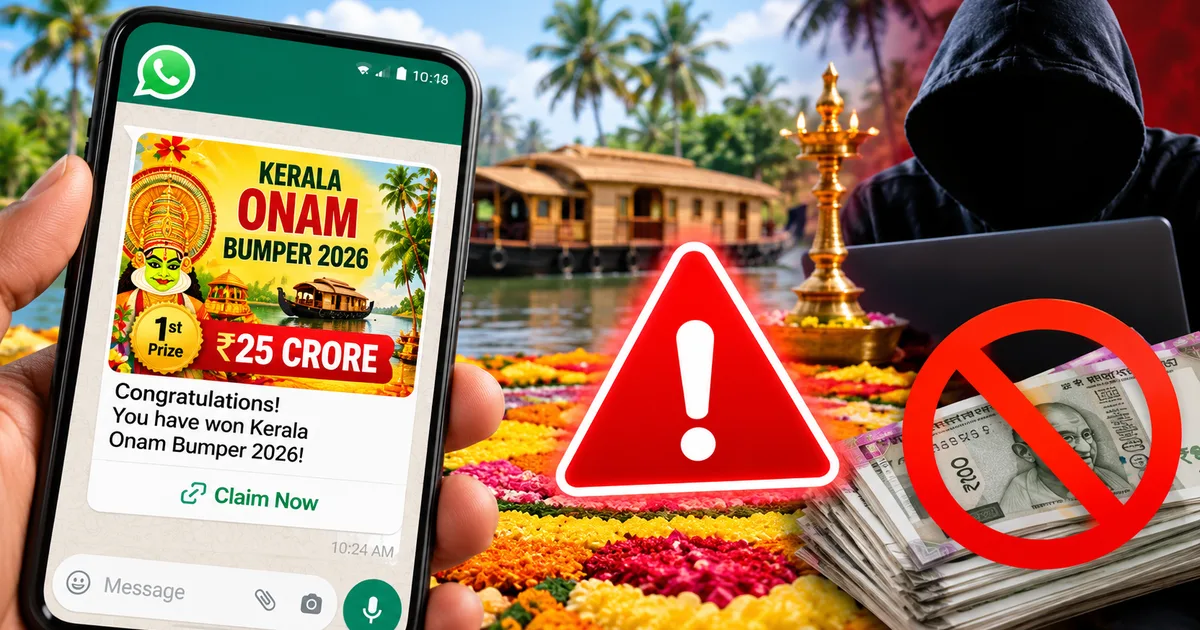
If you recently got an unexpected PDF or audio recording claiming you won the ₹25 crore grand prize, you are looking at the fake Kerala Onam Bumper 2026 lottery prize WhatsApp scam. Thousands of people across Kerala, Tamil Nadu, Karnataka, and Maharashtra have reported getting these forwarded letters over the past two weeks. The message looks convincing at first glance. It carries official-looking government seals, photos of Kerala state ministers, and a certificate signed by someone pretending to be a lottery director. But make no mistake about it: this is an organized advance-fee fraud designed to drain your bank balance.
Every year around festival season, the Thiruvonam Bumper captures nationwide attention. Millions buy genuine ₹500 paper tickets, hoping for a life-altering windfall. In 2026, sales crossed 75 lakh tickets within weeks of release. Cyber criminals watch these trends closely. They know ordinary people are dreaming about winning. So, they exploit that hope by sending fake winning notices right to your phone number.
What the fake Kerala Onam Bumper WhatsApp message looks like
The scam almost always starts with a random WhatsApp message from a strange number. Often, the country code isn't even Indian. You might spot a +92 from Pakistan, a +1 from North America, or some weird VoIP number. The sender's profile picture usually shows the Kerala Government emblem or an official poster of the Thiruvonam Bumper 2026 lottery.
Open the chat, and you'll find a sketchy photoshopped certificate or a PDF named something like Kerala-State-Lottery-Winner-2026.pdf. It announces that your mobile number won a special lucky draw. Some scammers send an audio note recorded in broken Malayalam, Hindi, or Tamil. The voice congratulates you. It says your payout of ₹25 crore or ₹1 crore is ready. And then it tells you to keep everything secret so your relatives don't come asking for cash.
That secrecy trick is purely mental manipulation (and it works way too often, unfortunately). If you hide the message from your kids, your spouse, or your friends, nobody can warn you before you send cash to a criminal.
The Kerala State Lottery Department has repeatedly clarified that paper lottery tickets can only be bought in person from licensed agents within Kerala, and the government never informs winners through WhatsApp, Telegram, or email.
We saw identical tactics when analyzing the fake KBC Season 18 lottery scam earlier this year, where scammers circulated voice notes claiming random SIM cards won big cash in a computer draw. The playbook doesn't change much. Only the logo on the fake certificate gets swapped.
How the lottery prize fraud works step by step
Look, to stay safe, you have to understand the trap. The scammers don't hack your phone. They just mess with your head.
- The initial hook: You receive an image of a winning ticket matching the current 2026 Onam Bumper series, with your phone number pasted at the bottom. The message instructs you to contact a specific "lottery officer" on WhatsApp to process your claim.
- Verification through personal documents: When you call or text the number, the scammer asks for your Aadhaar card copy, PAN card, and bank account details under the pretext of "identity verification" and "prize disbursement." Handing these over immediately puts you at risk of identity theft.
- The demand for processing charges: Once they have your trust, they drop the first financial barrier. They tell you that transferring ₹25 crore requires a registration fee or clearance charges, usually starting small at ₹5,500 or ₹12,000. They insist this must be paid through UPI to a specific ID.
- Escalating demands for TDS and GST: If you pay that initial amount, they do not stop. They tell you that under Indian tax law, 30 percent TDS plus GST applies to lottery earnings. They claim their department needs an advance deposit of ₹45,000 or ₹90,000 to file the tax paperwork before the Reserve Bank of India can release the funds.
- Total cutoff and disappearance: The demands continue until you either run out of money or realize something is wrong. The second you question their identity or refuse to send more funds via UPI, they block your number and delete their chat history.
Thing is, real taxes don't work like this. When someone wins an authentic lottery prize, the government cuts TDS straight from the winnings before sending the rest to your bank account. No government office asks you to pay advance tax from your personal Google Pay, PhonePe, or Paytm account. In my experience, any talk of sending tax money over UPI is an immediate sign of a scam.
Red flags in these viral Onam Bumper WhatsApp messages
Spotting these messages takes only a few seconds. Here are the immediate signs that scream fraud:
- You never bought an actual paper ticket in Kerala: The Kerala Lotteries Act strictly prohibits the online sale of tickets. If you did not physically visit Kerala or buy a printed ticket from an authorized physical vendor, you cannot possibly hold a valid ticket. Period.
- The sender demands money to release your prize: Legitimate lotteries never demand an advance deposit to hand over prize money. Asking for fees, stamp duty, or clearance fees upfront is always a sign of a scam.
- Urgency and time limits: Scammers insist you must claim the prize within 2 hours or 24 hours, claiming the ticket will otherwise be transferred to another citizen. They want you panicking and moving fast so logic does not get in the way.
- Unofficial email and UPI IDs: Official government communications never ask you to transfer funds to personal savings accounts registered to random individuals on PhonePe or GPay. If the handle ends in @okaxis, @ybl, or @paytm belonging to an individual name, it is a money mule account.
- Awkward formatting and spelling errors: Look closely at the scanned certificates. The text often mixes fonts randomly, features skewed seals, and contains obvious spelling mistakes like "Govt of Keralam" or "Directorate of State Loterry."
If you read our ongoing scam alerts, you know how this goes. Fake urgency mixed with a massive prize is the oldest trick on the internet.
The truth about buying Kerala lotteries online
Let's clear up a huge misconception right now. Kerala lottery tickets are completely analog. There's no official mobile app, no website to buy shares, and no authorized postal delivery approved by the state government. Nothing digital exists here.
Kerala police and the state lottery department have already shut down over 60 rogue websites and fake apps that claimed to sell Onam Bumper tickets online. The High Court of Kerala has made it clear that selling tickets across state lines without paper stubs is totally illegal under the Lotteries (Regulation) Act, 1998. Even so, gangs operating out of Tamil Nadu or Karnataka still set up shady pages offering discounted ticket bundles for ₹149 or ₹299. People pay through UPI. They get a ticket photo on WhatsApp. They think they're set. But on draw day, those tickets turn out to be cheap photocopies, recycled numbers, or complete fiction.
We saw this exact scheme play out in our coverage of the Flipkart prize campaign scam, where criminals used festival sales to push fake prizes. Anytime an event gets huge publicity in India, scammers build fake promotions around it.
Practical steps to protect your bank account and UPI apps
If you got one of these messages or already replied to one, take these defensive steps right away:
- Do not send any money: Stop all communication. Even if you already paid an initial registration fee of ₹2,000, do not fall for the sunk-cost trap. Sending another ₹10,000 will not get your previous money back.
- Never share OTPs or approve UPI collect requests: Scammers sometimes send a "collect request" on PhonePe or Google Pay while convincing you that approving it will credit money to your account. Remember that you never need to enter your UPI PIN or approve a request to receive funds. Entering your PIN always sends money away from your account.
- Lock your Aadhaar biometrics: If you sent copies of your Aadhaar card to the scammer, open the official mAadhaar app or visit the UIDAI portal right away and lock your biometric authentication. This stops anyone from misusing your identity for SIM card issuance or micro-ATM withdrawals.
- Block and report on WhatsApp: Tap the sender profile inside WhatsApp, scroll to the bottom, and tap "Report and Block". This flags the offending phone number directly to WhatsApp security teams for automated banning.
Never share your bank account statements, debit card details, or internet banking passwords with anyone on messaging apps. Real prize verification happens in person at the Kerala State Lotteries office in Thiruvananthapuram, or through a nationalized bank branch where you have to show your physical paper ticket and original ID cards.
Where to report Kerala lottery scams immediately
If you or someone in your family already sent money to these people, move fast. The first hour is when you have the best shot at freezing the cash before it's gone.
Call 1930 right away. That's the national cybercrime helpline run by the Ministry of Home Affairs. Have your UPI transaction IDs, the recipient's virtual payment address, your bank details, and the scammer's phone number sitting in front of you. The 1930 staff can contact the banks directly to lock the criminal's account before they pull the money out through an ATM.
After that call, file an official report online at cybercrime.gov.in. Upload your WhatsApp screenshots, the fake PDF, and the UPI payment receipts. If you want more security walkthroughs, check our collection of tech safety guides.
You can also email your evidence to the Indian Computer Emergency Response Team at CERT-In (incident@cert-in.org.in). They track these fraud syndicates across state borders.
I'm not sure why people still believe random lottery messages, but greed makes us do strange things. Just hold onto the basic rule: if you didn't buy a real paper ticket with your own hands, you didn't win the lottery.