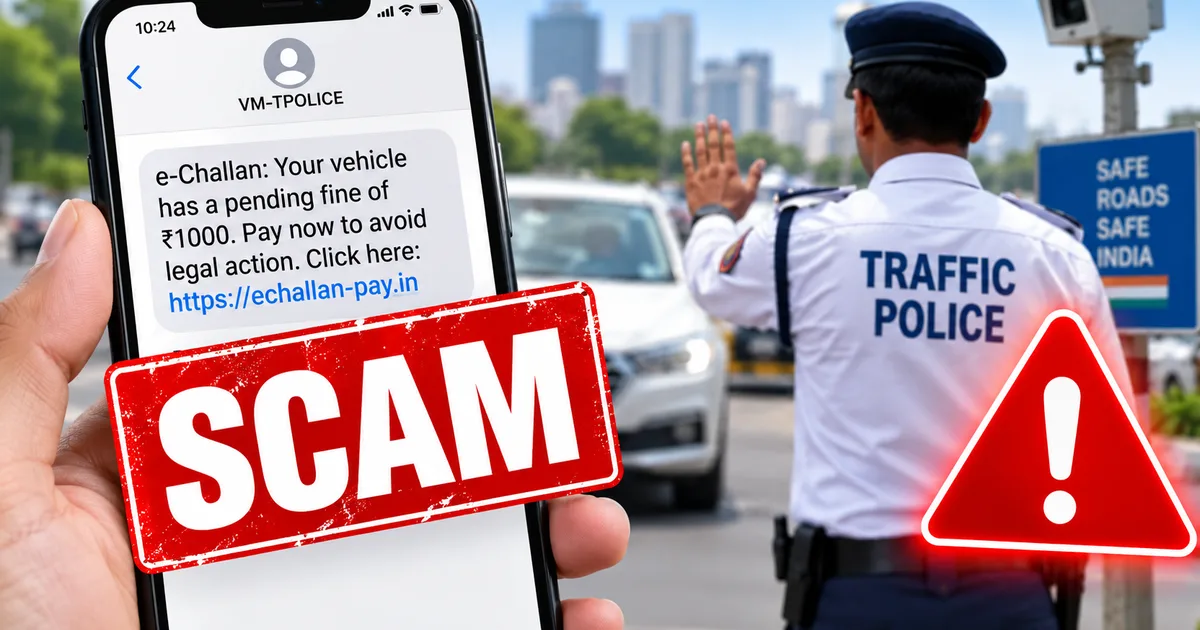
You're sitting at home, having your morning chai, and your phone buzzes. It's a text message claiming you have a pending traffic challan of INR 500. There's a link to pay it immediately. If you don't pay, they threaten to suspend your driving licence or seize your vehicle.
The Fake Traffic Police e-Challan 2026 SMS Payment Link Scam is destroying savings accounts across India right now.
Your heart rate spikes. You don't remember breaking any rules, but the roads in India are a mess. Maybe the cameras caught you crossing a red light. So you click the link. You enter your vehicle details. You pay the 500 rupees.
And just like that, you've handed criminals the keys to your bank account.
This isn't a hypothetical situation. I saw a report from Vizag where over 20 people lost more than 30 lakh rupees in just one month to this exact scam. In east Delhi, a 65-year-old man from Laxmi Nagar tried to pay a 500 rupee fine and lost 2.49 lakh rupees in minutes (which is awful, honestly). The money was routed through an international transaction in Saudi riyals.
Look, these scammers are getting incredibly sophisticated. They want your 500 rupees. And they want everything else you have, too.
What exactly is the fake e-challan scam?
The fake e-challan scam is a highly coordinated phishing attack designed to steal your credit card details or UPI PIN. Fraudsters send bulk SMS or WhatsApp messages to random numbers. They pose as the official traffic police or the Parivahan department.
The message usually includes a link. That link looks official. It might even have the word "echallan" or "parivahan" in the URL. But it doesn't end in ".gov.in". That's the trap.
When you open the link, you get a website that is a near-perfect clone of the real government portal. The state emblem is there. The layout matches. If you enter a random vehicle number, it will still show a pending fine. That's a dead giveaway. Factly reporters tried entering "ABCD" as a vehicle number on one of these fake links, and it cheerfully told them they owed 500 rupees for speeding. A car that doesn't exist was apparently breaking the speed limit.
The scammers are preying on your fear of authority. No one wants to deal with the courts or have their vehicle impounded. So you rush to settle the fine. And in that panic, you miss the red flags. You might also want to read up on India Post delivery scams, which use the exact same psychological tricks to make you click without thinking.
I find it infuriating that they target older people specifically. The Delhi victim's wife received the message, and he tried to handle it for her. They rely on the fact that older internet users might not check the URL bar. They use the same urgency tactics we see in the CBI digital arrest scams, threatening immediate legal action to force a fast payment.
How the 2026 e-challan fraud empties your account
Understanding the mechanics of this fraud is your best defence. Here's exactly how they drain your account.
The panic-inducing message
You get an SMS or a WhatsApp message. It looks urgent. It says your vehicle has a pending traffic violation ticket. They throw in some legal-sounding jargon. They say your licence will be suspended if you don't act fast. The sender name might even look like it comes from the police (they use a spoofed header for this). They want you scared. A scared person doesn't stop to check if the website address is correct.
The malicious link or app download
The message has a URL. Sometimes it's a shortened link. Sometimes it's a long URL that almost looks right. Or worse, they ask you to download a fake 'mParivahan' app. A businessman in Nashik recently lost 6 lakh rupees because he downloaded a sketchy APK file disguised as an e-challan app. Basically, if you download random APK files from WhatsApp, you give hackers full control of your phone. They can read your incoming OTPs without you ever typing them. We've seen similar tactics with the fake KFintech IPO allotment recently.
The fake payment gateway
If you click the link instead of the APK, you land on a fake website. You type in your vehicle registration number. It shows a fine. You click pay. The site redirects you to a payment page that asks for your credit card details and CVV. Or it asks for your UPI PIN. They make it look like a standard Razorpay or BillDesk page. It's all fake. If you use UPI, they might send a collect request for a massive amount. They just hope you enter your PIN without looking at the screen.
The massive deduction
You think you're authorising a 500 rupee payment. But the hackers are sitting on the other end, capturing your card details in real time. They use those details to initiate a massive transaction on an international gateway or a crypto exchange. You get an OTP. You enter it on the fake site, thinking it's for the 500 rupees. Instead, you just authorised a transfer for 50,000 rupees (I know, it sounds obvious now, but when you're panicked, you miss things). The money is gone in seconds. They quickly route it through multiple mule accounts. This makes it incredibly hard for the police to trace.
Clear warning signs you shouldn't ignore
You don't need a degree in cybersecurity to spot these frauds. You just need to know what to look for. And honestly, once you see the pattern, it's incredibly obvious.
- The link doesn't end in .gov.in. This is the absolute biggest red flag.
- The message comes from a 10-digit mobile number. Official government messages come from specific sender IDs like VD-ECHALN. They don't come from regular personal mobile numbers. If you get a challan notice from a random Jio or Airtel number, it's a scam.
- They ask for your CVV or PIN directly. Legitimate government sites use secure payment gateways. If the site itself is asking for your banking passwords or UPI PIN, run. Remember, a UPI PIN is only used to send money, never to receive it, and legitimate government portals will route you to your actual UPI app (like PhonePe or Paytm) to complete the transaction safely.
- Threats of immediate arrest or impoundment. The real traffic police don't send WhatsApp messages threatening to seize your car by evening. The legal process takes time. You get notices in the mail. Scammers use urgency to make you irrational.
- They ask you to download an app. Never, ever download an APK file sent via SMS or WhatsApp. The real mParivahan app is only available on the official Google Play Store or Apple App Store. Side-loading apps is the fastest way to get hacked.
The official Parivahan website is strictly hosted on a .gov.in domain. If the link ends in .com, .in, or is a bit.ly link, close it immediately. The government doesn't use bit.ly links to collect fines.
How to protect your bank account
Look, the internet in India is a minefield right now. You have to be paranoid to stay safe. Here's exactly what you need to do to protect your hard-earned money from these cybercrooks.
First, never click on links in unsolicited messages. I know it's tempting. I know you want to see if you actually have a fine. Don't do it. Instead, manually type the official website address into your browser. The only legitimate place to check and pay traffic fines across most of India is echallan.parivahan.gov.in. Go there directly. Enter your vehicle number or driving licence number. If you have a real fine, it will show up there.
Also, use official government apps for your documents. Keep your vehicle registration and driving licence safely stored in DigiLocker or the official mParivahan app downloaded from the Play Store. If you have a pending fine, it will usually reflect in these official apps. Never assume a message is real just because it has an official-looking logo.
Keep your transaction limits low. Go into your bank's app and set strict limits for online and international transactions. If you only ever buy groceries online, you don't need a 5 lakh rupee daily limit. Lower it to 10,000 rupees. If a hacker does get your details, they can't drain your life savings in one go.
Block international transactions completely on your credit and debit cards unless you are actively traveling abroad. You can toggle this setting in seconds on your banking app. The elderly man in Delhi lost his money to an international transaction (which makes sense, actually, since they want to bypass local OTPs). If international usage was disabled on his card, the transaction would have failed, and his money would be safe today.
Verify before you pay. Ask someone else to look at the message. Sometimes a second pair of eyes can spot the scam immediately. Don't let panic dictate your actions. Scammers win when you stop thinking logically.
For more details on the latest threats, keep an eye on our Scam Alerts & Safety section.
Where to report the fake e-challan scam
If you made the mistake of clicking the link and entering your details, you need to act immediately. The first 60 minutes are the golden hour in cyber fraud. Every second counts. Don't waste time feeling embarrassed. These scammers are professionals. They trick hundreds of people every day.
Call your bank instantly and block your cards. Freeze your account. Tell them you've been a victim of phishing and to stop any pending transactions. Request a chargeback for the fraudulent amount. If the money was sent via UPI, call your UPI app's customer support immediately.
Then, pick up your phone and dial 1930. This is the National Cyber Crime Helpline. It's a dedicated number set up by the Ministry of Home Affairs to handle exactly these kinds of financial frauds. The operators can sometimes freeze the stolen funds before the scammers manage to withdraw them from the destination account. The faster you call, the better your chances of getting your money back.
After calling the helpline, you must file a formal complaint online at cybercrime.gov.in. This is the official portal. Provide all the evidence you have. Take screenshots of the SMS, the fake URL, your bank statements showing the deduction and the phone number the message came from. Upload all of this to the portal. The police need this data to track the syndicates that run these operations.
You should also report the malicious link to CERT-In. They're the national nodal agency for responding to computer security incidents in India. You can visit their website at https://www.cert-in.org.in/ to report phishing domains. They track down these fake websites and get them blocked at the ISP level.
The fake traffic police e-challan scam is brutal. It takes advantage of responsible citizens trying to follow the law. But now you know how it works. Don't let a 500 rupee fake fine cost you your entire bank balance. Delete the message. Block the number. And share this information with your parents and older relatives.