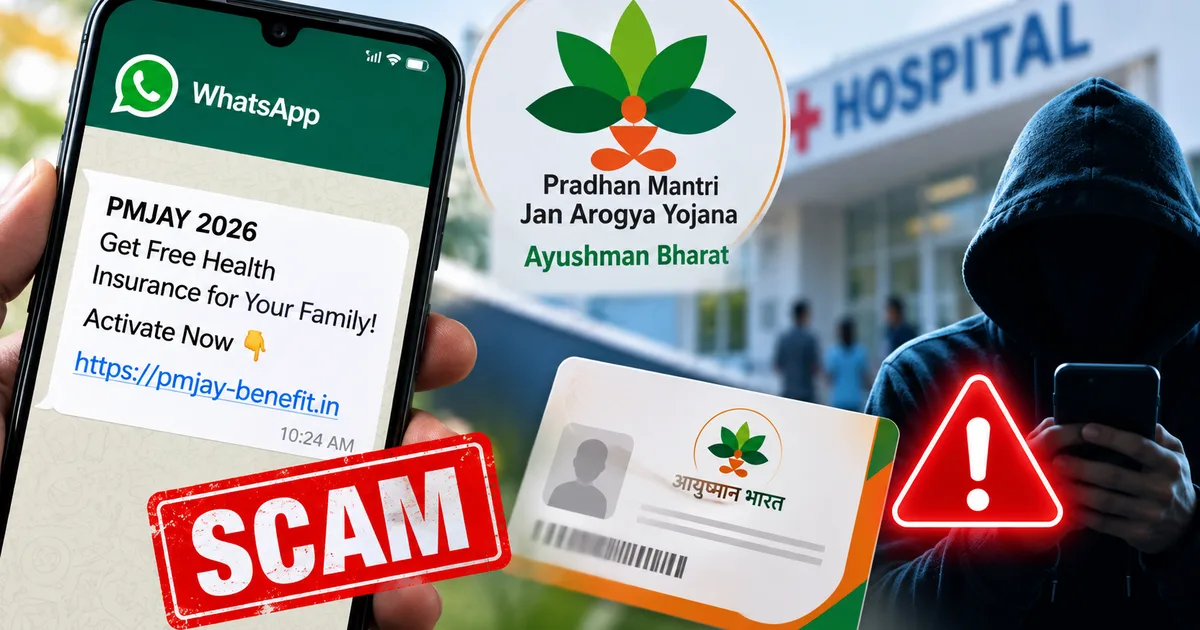
Look, I get it. Healthcare in India is expensive. When you see a message about a fake PMJAY 2026 free health insurance activation WhatsApp scam, you might not realise it's a scam right away. It just looks like a government update. You get a text saying your Ayushman Bharat card is ready for activation. It promises Rs 5 lakh in free cover. And honestly, who wouldn't want that kind of financial safety net for their family?
But here's the deal. Scammers know exactly how desperate people are for affordable medical care. They use that fear to empty bank accounts. I spent the last few weeks digging into this specific fraud network. What I found is honestly pretty terrifying. They stopped blasting random messages. Instead, they're faking government IDs and hacking official portals. Basically, they make everything look completely legitimate (which makes sense, actually).
If you or your parents receive a WhatsApp message claiming you need to pay a small fee to activate your PMJAY benefits, stop right there. It's a trap. Let me walk you through exactly how this scam works. You can spot the scam before it costs you your savings.
What the fake Ayushman Bharat health card scam actually is
This isn't your standard phishing attempt. The current wave of the fake PMJAY 2026 free health insurance activation WhatsApp scam is a highly coordinated operation. Criminals are actually targeting the backend systems of the Ayushman Bharat-Pradhan Mantri Jan Arogya Yojana (AB-PMJAY). This scheme is supposed to provide Rs 5 lakh annual coverage per family. Instead, it's just used as bait.
Recently, authorities in Uttar Pradesh and Punjab uncovered a massive racket. Criminals generated over 300 counterfeit IDs. They did this by forging the identities of government health officials from the State Agencies for Comprehensive Health and Integrated Services (SACHIS). They logged into the official portal. Then they issued fake health cards that looked 100% real. They even matched Aadhaar-linked mobile numbers with official records to block real officers from getting the OTPs needed to catch the scam.
So when you get a message with a card that looks official, there's a chance it was actually generated on the real government portal by a hacker. That makes it incredibly hard to tell fact from fiction. And it's exactly why so many smart people are falling for the scam. The hackers manipulated the mobile numbers linked to genuine officers. They totally bypassed the security layer. That's scary stuff, if you ask me.
How this PMJAY WhatsApp fraud works step by step
You need to understand the mechanics of this fraud. Scammers follow a very specific playbook to build trust and then steal your money. They rely completely on social engineering. They want you to panic. Honestly, they want you to act without thinking at all. This is the timeline of the attack.
Step 1: The initial WhatsApp contact
You receive a message from an unknown number. Usually, the profile picture is the official National Health Authority logo or a picture of PM Modi. The message claims your family has been selected for the 2026 Ayushman Bharat scheme. It includes a link to download your provisional card. The numbers here are a bit fuzzy, but many of these links are actually APK files disguised as PDF documents. This is a common tactic we see across various frauds, much like the fake Bank of Baroda data leak compensation WhatsApp scam.
Step 2: The fake verification call
Within a few hours, you get a call. The person on the other end speaks professional Hindi or English. They tell you they work as a verification officer for the Ministry of Health. They might even read out your correct address or family members' names. Where did they get this info? Usually from leaked databases or compromised government portals. This insane level of detail lowers your guard completely. You instantly start believing they're who they say they are.
Step 3: The processing fee demand
This is the hook. The caller tells you the insurance is completely free. But there's a one-time biometric verification or KYC processing fee of Rs 50 or Rs 100. It sounds like a tiny amount for Rs 5 lakh in health cover. They send you a UPI payment link on WhatsApp or ask you to download a screen-sharing app to complete the payment. They might say you need to verify your Aadhaar on DigiLocker while they watch.
Step 4: The final account drain
Once you click that link or share your screen, it's over. If it's a malicious link, they capture your UPI PIN. If it's a screen-sharing app, they watch you enter your banking details. Before you can even process what's happening, they wipe out your entire bank balance. They steal the Rs 50 fee. Then they take everything else they can get their hands on.
The wider problem of hospital fraud
The WhatsApp scam is only part of the problem. We also see massive fraud right at the hospital level. Even if you have a real card, you have to be careful. In Gujarat recently, the government had to file an FIR against an empanelled hospital. They performed unnecessary surgeries just to claim the insurance money.
"The AB-PMJAY ensures quality healthcare services to the scheme beneficiaries. The scheme is governed on a zero-tolerance approach to any kind of fraud and abuse and various steps are taken for prevention, detection and deterrence of different kinds of fraud that could occur in the scheme at different stages of its implementation." - Prataprao Jadhav, Minister of State for Health.
The government suspended the hospital and the doctors involved. The National Anti-Fraud Unit is now actively investigating these cases. And then you have situations like in Himachal Pradesh. The High Court there had to slam the state government for not paying legitimate hospitals their dues under the scheme. The system has cracks. Scammers know this, and they exploit the confusion.
Clear warning signs you are talking to a scammer
Honestly, I think you have to stay alert. The government doesn't operate the way these scammers claim they do. Watch out for these obvious warning signs.
- The National Health Authority will never initiate your PMJAY registration via a random WhatsApp message. They just do not work that way. Unsolicited messages are always fake.
- Ayushman Bharat registration is entirely free. There is no Rs 50 processing fee or biometric charge. If anyone asks for money, they are a criminal.
- Scammers always create fake deadlines. They will say your slot expires in 24 hours. The real PMJAY scheme does not have flash sales or urgent ultimatums.
- Government apps are on the Google Play Store or Apple App Store. They will never ask you to install an app directly from a WhatsApp link. Be just as cautious here as you would with the fake LIC government dividend cheque WhatsApp scam.
- Never install apps like AnyDesk or TeamViewer on your phone if someone on a call asks you to. They use these screen-sharing apps to steal your OTPs and UPI PINs.
How to protect yourself and your family
Knowing the signs is half the battle. The other half is taking active steps to secure your digital life. Verify your eligibility through official channels only. Don't click links in messages. Go directly to the official website at pmjay.gov.in or use the Ayushman app from the official app store. You can also call the national toll-free helpline at 14555 to check your status. That's the only safe way to do it.
Lock down your WhatsApp privacy settings. Go to your settings and ensure that only your contacts can see your profile photo and status. This stops scammers from scraping your personal details for social engineering attacks. You should also turn on two-step verification for your WhatsApp account today. CERT-In has repeatedly advised Indian users to avoid clicking unknown links and to keep their apps updated to the latest security patches (annoying, I know, but essential).
Talk to your parents and elderly relatives. They're the primary targets for these healthcare frauds.
Sit down with them and explain that the government will never ask for money on WhatsApp. Tell them to call you immediately if anyone asks them for an OTP or to click a link.
Where to report PMJAY WhatsApp scams in India
If you realise you've made a mistake and shared your details or money, you need to act fast. Don't panic, but don't wait around either. Time is the most important factor in recovering stolen funds.
Call the national cybercrime helpline at 1930 immediately. Tell them exactly what happened. The faster you call, the higher the chance they freeze the fraudulent transaction before the scammers withdraw the cash.
Next, file a detailed complaint on the official cybercrime portal at cybercrime.gov.in. Keep all your evidence. Take screenshots of the WhatsApp chat and the phone numbers they called from. Also save any payment receipts. Don't delete the chat until you've saved this evidence.
You also need to contact your bank immediately. Call their emergency hotline and tell them your account has been compromised. Ask them to block your debit cards and freeze your UPI access. They must also halt any pending transactions. If you suspect your phone itself is compromised from an APK download, turn off your internet and backup your photos. Then do a factory reset.
For more detailed info on protecting yourself online, I recommend checking out our Scam Alerts and Safety section. In my experience, staying updated is the best defense. We update it constantly with the newest threats that target Indian users. You can also read our coverage of the fake JioHotstar free subscription APK scam 2026 to see how similar tactics are used across different domains.
Healthcare fraud is particularly nasty because it preys on people when they're most vulnerable. We only stop these networks if we stay informed and warn each other. Share this info with your family groups. Let's make sure nobody else loses their hard-earned money to these criminals.