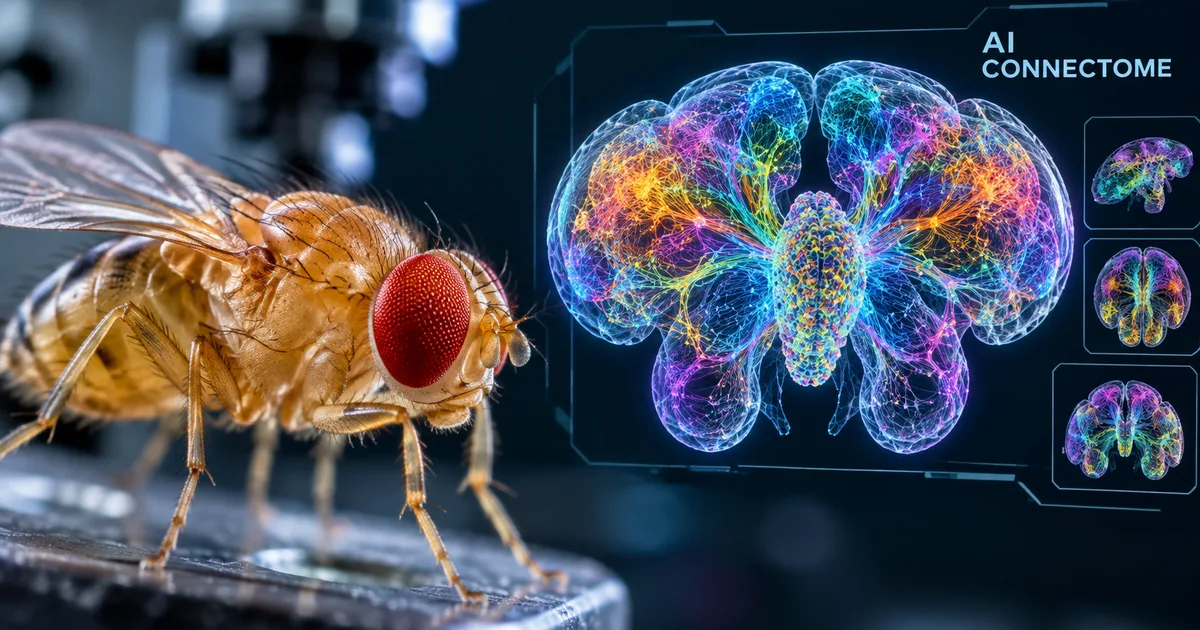
Scientists just pulled off something incredible. I mean, actually mind-blowing. They mapped out every single connection in an adult male fruit fly's brain. This Fruit Fly Brain Mapping Breakthrough 2026 isn't some abstract biology project that you can ignore. It is the largest brain map ever made, packing over 166,000 neurons and around 125 million synaptic connections. It completely rewires how we understand the brain.
You might be wondering why a tiny insect matters to you sitting in Bengaluru or Delhi. Here's the deal. Understanding the fly brain is step one to understanding human brains. The way researchers pulled this off, using heavy AI automation from Google Research, changes everything for Latest Tech News and the future of computation itself. I'm not sure exactly why it took ten years to get here, but it did. I think we're looking at a total reset of how neuroscientists work. Let's look at what happened.
Breaking down the numbers: 166,000 neurons
Let's get the scale right. A human brain has roughly 86 billion neurons.
Mapping that is impossible right now. We simply don't have the compute power. Or the storage. So, scientists start smaller. But even a fruit fly, the common Drosophila melanogaster, has a very complex nervous system.
This map includes 166,000 neurons. And it tracks 125 million synaptic connections between those neurons. The project went beyond just the brain itself. Researchers mapped the ventral nerve cord (which is basically the fly's spinal cord, if you think about it). They mapped how the fly thinks and how the brain controls the physical body.
They identified almost 11,700 different types of neurons in the central nervous system. Some neurons process smell from the fly's proboscis. Others handle visual input from their big compound eyes. Then you have the motor neurons that tell the wings to buzz. In my experience, data this dense is usually a mess to navigate at first.
Doing this manually would have taken around 50,000 person-years. Let that sink in. That is fifty thousand years of a human sitting at a desk tracing lines on a screen. Nobody has time for that. So AI stepped in to help.
How AI reconstructed the complete connectome
The Howard Hughes Medical Institute (HHMI) Janelia Research Campus teamed up with Google for a decade-long project. They didn't take a picture of a fly brain. They took a physical fly brain and sliced it into super thin sections. Then they took 2D images of every single slice.
The problem is putting millions of 2D images back together into a 3D shape. Humans are slow at this. AI is fast.
Google's algorithms took those millions of images and reconstructed the 3D neural shapes. They connected the dots across the slices to trace the 125 million synaptic connections. Honestly, stitching millions of images together is usually sketchy.
Look, researchers shared visuals showing how flies do most of their sensing using organs on their heads. The neurons in these sensing organs detect external information and pass the signal through pathways. These pathways reach the motor neurons. When viewed from above, the fly's big eyes and central brain connect via a thick cord of nerves to the body. Knowing this exact structure allows neuroscientists to reverse-engineer the mechanisms behind brain function.
But the AI wasn't perfect. Human experts at HHMI Janelia had to verify and proofread the AI's work. The tools they built for this, like Google's Neuroglancer, are open source. This means researchers at Indian institutes like NIMHANS or the IITs can access the exact same visualization technology today. We are seeing big shifts in how biological data is handled. This reminds me of the Synthetic Cells Breakthrough 2026: AI's Role in changing medical research.
Why does everyone care about the fruit fly brain map?
I know what you're thinking. It's a fruit fly. The thing that hovers over old bananas in your kitchen. Why spend ten years and millions of dollars mapping its brain?
Thing is, the fruit fly is a huge deal in genetics. It reproduces quickly and is cheap to keep. Multiple Nobel Prizes have been won based on fruit fly research. Their brains are surprisingly similar to ours at a base operational level.
Flies perceive the world and react to threats. They make decisions. By understanding exactly which neuron fires when a fly smells food, scientists can start to figure out how nervous systems work across all animals. If you ask me, this cross-species comparison is the coolest part.
If we can understand how damaged neural pathways act in a fly, we might eventually figure out how to repair them in humans (which makes sense, actually). The timeline on that is a bit fuzzy, but the potential is there.
The Doom experiment: A digital fly plays video games
This is my favorite part of the whole story. The connectome is basically a massive digital wiring diagram. Some mad scientists decided to test this wiring by plugging it into a video game. Yes, they hooked up the simulated digital brain to play the classic 90s shooter Doom.
A software engineer took the complete mapped neural system and fed it inputs from the game. The visual frames from Doom stimulated the virtual sensory neurons. The system then mapped the brain's output to the game controls. When the fly took damage in the game, the system sent a signal to two specific dopamine cells as negative feedback.
They ran the digital fly through 6,385 attempts at the game. Did it win? No, it failed completely. But winning the game was never the point.
"The goal was not to create a digital copy of a conscious fly. Instead, the map gives scientists a way to study how neurons connect and interact," said the HHMI team.
The experiment was a proof of concept. It proved you can take a mapped biological network, digitize it, and observe how it processes information in a closed environment. This bridges biology and computer science in ways I haven't seen before. If you work in Indian IT or data science, this cross-disciplinary approach is exactly what will define the next wave of AI Tools & Software. It is a completely new paradigm.
What this means for Indian tech and startups
The Indian tech sector is pouring billions into artificial intelligence right now. Everyone is building a language model, like we discussed in our Hanooman AI: Complete Guide to India's Multilingual LLM Tools in 2026. That is great for text processing and customer service chatbots. But the really big shifts will come from applying AI to hard sciences.
Genomics and neuroscience are the next massive industries. India has incredible talent in software engineering and a huge pool of medical professionals. The intersection of these two fields is a goldmine. If you ask me, we're over-indexing on chatbots.
Think about the influx of capital into Indian tech right now. We see billions flowing into generic SaaS products. But the startups that figure out how to parse biological data using these new connectomic models will be the next unicorns. Imagine an Indian startup using this fly brain map to test agricultural pest control digitally before ever synthesizing a chemical. Or medical tech companies simulating neural reactions to new drugs. It gets pretty wild when you start thinking about the possibilities.
Look at what the fly map tells us about biological computing.
A fly operates a physical body and processes visual inputs. It makes survival decisions using just 166,000 neurons. It runs on almost zero power. Meanwhile, our AI data centers are consuming as much electricity as small cities. Understanding the efficiency of biological brains might inspire entirely new computing architectures (annoying, I know, but our current servers run too hot).
Here are the concrete takeaways for the Indian ecosystem:
- AI acts as an accelerator: The technology didn't replace the scientists. It did the grunt work of tracing millions of lines, leaving the human experts to verify and analyze.
- Open source levels the playing field: Because Google released tools like Neuroglancer openly, Indian startups don't need to build visualization tech from scratch. They can start experimenting immediately.
- Biology is the new code: The engineers who hooked the brain up to Doom proved that biological pathways can be treated almost like software logic gates.
- Medical applications: Mapping neural pathways at this scale will eventually lead to breakthroughs in treating neurodegenerative diseases. This is a growing concern in India's aging population.
The Indian policy angle and AI regulation
As AI gets better at mapping biology, the regulatory conversation gets weird quickly. Right now, India's DPDP Act focuses heavily on personal consumer data like your phone number or shopping habits. We're debating how tech giants use our internet history.
But what happens when companies start building and hoarding massive datasets of human biological processes? What happens when brain-computer interfaces become cheap and mainstream? We aren't there yet. But the foundation is clearly being laid right now.
A digital fly playing Doom is an entertaining science experiment today. A digital model of human neural pathways used for behavioral prediction would be a total nightmare tomorrow. Indian policymakers need to watch these developments closely. In my experience, we always react late to these things. We wait for the US or the EU to set the rules, and then we copy them. India needs a proactive stance here.
We need clear rules on who owns the digital mapping of biological functions. If an Indian patient's brain data is used to train a global AI model, how is that data protected? The government needs to answer these questions before the technology scales from flies to humans. And they need to do it soon.
Final thoughts
Honestly, I find this entire project completely fascinating. It proves that with enough compute power and sheer stubbornness, we can map the physical machinery of life itself. The 166,000 neurons of the male fruit fly are just the beginning.
They've already mapped the female fly. Next on the list are mice. And eventually, they'll try to map a human brain. The computation required for that is mind-boggling, but the progress rate of AI suggests it'll happen in our lifetimes. For now, the fly brain map is a big achievement in both neuroscience and computer science. We'll see how long it takes to map the mouse brain next.