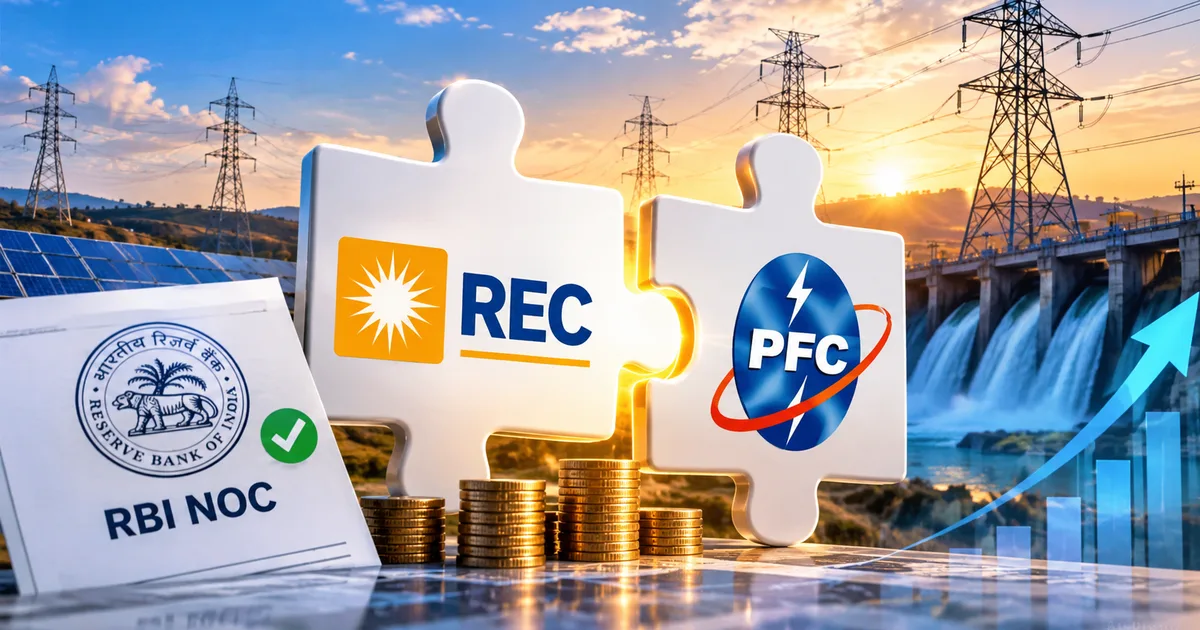
Whenever you switch on an air conditioner during a sweltering May afternoon in Delhi or plug your electric scooter into a home socket, you tap into an electrical grid backed by massive institutional debt. Most of us rarely think about who funds the transmission towers running across rural highways or the solar farms spreading across Rajasthan. Behind those transformers sit two government-owned lenders: Rural Electrification Corporation and Power Finance Corporation. The proposed REC Limited and PFC merger just cleared its biggest regulatory gate yet. On October 15, 2026, the Reserve Bank of India officially issued its no-objection certificate for the amalgamation. That clears the way for the next phase of India's largest public sector financial consolidation.
If you track PSU stocks, you probably hold one or both in your demat account for their dividend yields. Most retail investors do. But this move reaches way beyond Dalal Street trading screens.
Power financing in India is changing fast. The central government wants a single, massive balance sheet that can raise billions of dollars abroad at lower interest rates to fund clean energy projects. Honestly, if you ask me, having two state-backed giants compete against each other for the exact same foreign loans never made much sense anyway. And now that the central bank has signed off on the deal, the road ahead is wide open.
Scale changes everything.
Why the RBI NOC approval matters right now
To understand why everyone on Dalal Street was waiting for this specific letter, look at how these companies are regulated. Both REC and PFC are Maharatna public sector enterprises registered with the Reserve Bank of India as Non-Banking Financial Companies, specifically classified as Infrastructure Finance Companies. When two large NBFCs plan an amalgamation, the central bank checks every single detail of capital adequacy and systemic risk before giving any green signal. It takes time.
Here's the deal:
According to regulatory filings submitted to the BSE and NSE on October 15, 2026, the Reserve Bank of India conveyed its no-objection certificate for the proposed scheme of amalgamation of REC Limited into Power Finance Corporation Limited, subject to customary statutory compliances.
This clearance didn't happen out of nowhere. Back in March 2019, PFC bought the government of India's entire 52.63% controlling stake in REC for around ₹14,500 crore. Since then, REC has operated as a subsidiary of PFC. Yet, for seven full years, both lenders kept separate management teams, distinct treasury desks, independent boardrooms, and separate bond issuances. They even competed for loans to the exact same state power utilities. I'm not sure exactly why the government waited this long to finish the job, but that strange sibling rivalry is finally ending (which makes sense, actually, if you ask me).
Finance Minister Nirmala Sitharaman previously talked about this consolidation during the Union Budget, and Presidential assent followed shortly after. But without the banking regulator signing off, nothing could move to the National Company Law Tribunal or the stock exchanges. Now that the RBI letter is in hand, the actual legal paperwork can start rolling.
The ₹11 lakh crore power financing impact
When you combine these two balance sheets, the scale is massive. Their combined loan book is over ₹11 lakh crore. That is a staggering number. In fact, the merged entity is one of the biggest specialized power infrastructure financiers on the planet. And if you follow our detailed tech explainers on Indian digital infrastructure, you know that physical power generation and data transmission always go hand in hand.
Size gives infrastructure lenders some very real practical advantages:
- A larger combined net worth increases single-borrower and single-group exposure limits, allowing the lender to bankroll massive multi-gigawatt green energy parks without syndication delays.
- The consolidated balance sheet commands stronger credit ratings on international debt exchanges in London, Singapore, and Frankfurt, directly trimming borrowing costs by several basis points.
- Eliminating duplicate administrative expenses, treasury operations, and competing bond issuances saves hundreds of crores annually in overheads.
- Consolidated balance sheets make it easier to syndicate multi-billion-dollar international credit lines from multilateral institutions like the World Bank and Asian Development Bank.
Think about what this means for India's 500-gigawatt non-fossil energy goal by 2030. Building colossal solar arrays in Khavda and putting up offshore wind turbines along the Tamil Nadu coast takes patient capital. Thing is, private lenders like HDFC Bank or ICICI Bank prefer short-tenure credit because their retail deposits mature in just two or three years. In my experience, commercial banks hate locking up cash in twenty-year power station projects. They just won't do it. That's why a dedicated state financier has to step in.
A single treasury desk managing an ₹11 lakh crore loan book can float massive green bond issuances abroad. Overseas pension funds and sovereign wealth funds that manage hundreds of billions of dollars prefer writing one giant cheque to a mega-institution rather than evaluating two separate entities. Cheaper dollar funding means cheaper loans for Indian green energy developers. It is that straightforward.
Scale talks.
How this restructuring impacts state discoms and solar grids
Look, if you've ever sat through an unannounced power cut in a tier-2 Indian town or wondered why your state electricity board can't maintain basic feeder lines, the culprit is almost always discom finances. State distribution utilities have lost money for decades. If you ask me, that cash crunch has always been the real bottleneck in Indian power.
Over the past five years, both REC and PFC are the operational backbone for the Ministry of Power's Revamped Distribution Sector Scheme. That is the central program modernising state electricity infrastructure. They fund everything from prepaid smart meters to upgraded distribution transformers. In cities, these smart meters talk over cellular networks to log hourly electricity use, and they send that data straight to utility billing servers.
With a merged lender, state discoms will deal with one institution instead of juggling dual loan covenants and duplicate compliance paperwork (which was always a mess, honestly). When a utility in Uttar Pradesh or Maharashtra applies for grid modernisation capital, the credit review happens once under a single risk framework. That cuts out months of useless back-and-forth.
And rooftop solar uptake under PM Surya Ghar Muft Bijli Yojana depends on quick grid upgrades. When rooftop solar panels push surplus units onto the neighbourhood feeder, local substations have to handle electricity flowing both ways. Paying for those local substation retrofits is exactly the kind of spending this consolidated lender has to handle.
Just as we've seen in big media tech moves like the JioHotstar merger consolidation plans, putting two massive state organizations together means merging legacy software systems and loan management databases. It won't happen overnight. Expect some friction along the way.
What happens to retail shareholders and dividend payouts
Now let's talk about your portfolio. If you own shares of REC or PFC, you're probably wondering what happens to your stock. In my experience, retail investors panic whenever a big public sector firm restructures, and I get asked about this constantly.
Because PFC already owns over half of REC, this is a parent-subsidiary merger where REC dissolves into PFC. REC shares will eventually get delisted from the National Stock Exchange and the BSE. Once that happens, REC shareholders will get newly issued shares of PFC directly in their demat accounts.
Don't panic yet.
Understanding the share swap mechanism
The exact share swap ratio hasn't been officially announced yet (annoying, I know). Independent valuation firms and merchant bankers are still putting together their reports, so the numbers here are a bit fuzzy right now. Once both boards approve the recommendation, they'll file the exact formula with the exchanges. Much like the restructuring dynamics we analyzed during the Tata Motors demerger for investors, that swap ratio depends on historical market prices and discounted cash flows.
Will your dividend income drop? Probably not. I think the payouts will stay fairly solid. Both REC and PFC historically trade at low price-to-earnings multiples while yielding between 6% and 9% in annual dividends. Since the cash flows from existing power projects are steady, the combined entity has every reason to keep paying out healthy dividends. And a leaner corporate structure could improve net interest margins down the road.
Short-term price swings are completely normal here. Arbitrage traders often buy one stock and sell the other betting on the swap ratio. That creates temporary volatility in share prices until the final valuation formula is out in the open.
Why lower borrowing costs matter for your power tariff
Will this merger make your monthly electricity bill cheaper next month? No, of course not. That isn't how utility pricing works in India.
State electricity regulatory commissions fix retail power tariffs based on the total revenue needs of local distribution utilities. A big part of that cost is interest paid on capital loans. When distribution utilities borrow at 9.5% instead of 10.5% to upgrade transmission lines, their costs drop over time. If you ask me, that saving won't cut your bill tomorrow, but it acts as a handy buffer against steep tariff hikes down the line.
So you won't see an instant ₹200 discount on your power bill next month. But a more efficient national power lender helps keep baseline generation and transmission costs steady across the country.
The remaining hurdles before the final merger takes effect
Getting the RBI NOC on October 15, 2026, was the hardest regulatory hurdle, but the process is far from finished. Several mandatory steps are still on the calendar:
- Both company boards must meet to review independent valuation reports and formally approve the swap ratio.
- Stock exchanges and SEBI must issue their observation letters and formal clearances.
- The merger scheme must receive sanction from the Ministry of Corporate Affairs or NCLT depending on the administrative route prescribed for CPSEs.
- Shareholders and secured creditors of both companies must vote on the proposed amalgamation scheme in court-convened meetings.
In practice, getting through all these corporate hoops in India takes anywhere between nine and eighteen months (bureaucracy moves at its own pace). In my experience with public sector deals, timelines stretch. So while the merger is basically locked in, both stocks will keep trading separately on the exchanges for several quarters. If you hold either stock or track the latest tech news across energy and infrastructure, just watch the exchange filings for that formal swap ratio announcement.