Picture this. You're cruising down the Delhi-Jaipur highway, or grinding up the steep hairpins towards Rohtang Pass on a loaded touring bike. You want to pass a smoke-belching truck doing 70 km/h. Trouble is, your single-cylinder motor is already buzzing at high revs, and the handlebars are buzzing your palms to sleep. If you ask me, that exact highway headache explains why the upcoming Royal Enfield Himalayan 750 has created massive excitement among Indian motorcycle enthusiasts.
For years, Indian riders who loved long-distance touring faced a frustrating gap. You could buy a capable single-cylinder bike. Or you had to jump straight to imported adventure bikes costing upwards of ₹8 lakh, where routine servicing alone punches a hole through your savings. Royal Enfield cracked highway touring with the 650cc Interceptor and Continental GT twins, but touring riders kept asking for an adventure chassis built around that smooth twin motor. Now, with test mules running across Indian roads and the UK, that bike is finally turning into metal.
Here's what the hardware changes mean in practice, and what you can expect when the bike lands in Indian showrooms.
What makes a twin-cylinder engine different from a single cylinder?
To understand why riders are eager for this bike, look at what happens under the fuel tank.
Most adventure tourers sold in India, including the Himalayan 450, run on a single cylinder. Just one piston. It moves up and down inside a single chamber, and every time the fuel-air mixture ignites, that piston drives down hard to make power. Trouble is, slamming a heavy chunk of metal up and down thousands of times every minute creates stubborn vibration. Engineers use counterbalancers to tame the buzz. Still, past 100 km/h on an open highway, you'll feel that tingle through the footpegs and handlebars after four straight hours in the saddle.
(I took a single-cylinder 400 across Rajasthan last winter, and while it handled the desert trails well, four straight hours at 110 km/h on the highway left my fingers buzzing for half an hour after I stopped.)
A parallel-twin engine splits that displacement between two smaller cylinders sitting side by side.
Instead of one heavy piston hammering away, two lighter pistons share the work. When one moves, the other counters it. Pure physics. On modern Royal Enfield platforms, the company uses a 270-degree crankshaft configuration. Think of it like two drummers playing an uneven beat instead of hitting the snare at the exact same millisecond. That rhythm delivers a deep exhaust rumble. And it feeds smooth torque down low so you don't stall on tricky climbs.
Thing is, there's always a trade-off. Two cylinders generate more heat than one. In bumper-to-bumper city traffic, like crawling through Silk Board junction in Bengaluru or getting stuck on the Western Express Highway in Mumbai on a humid afternoon, your shins will feel that heat coming off the engine block. It gets toasty. That's why twin-cylinder tourers belong on open tarmac rather than daily office commutes.
If you've spent time reading our motorcycle tech explainers, you know that smoother engines mean less physical fatigue. On a weekend sprint from Bengaluru to Ooty or Pune to Goa, that lack of vibration keeps your arms and shoulders fresh after hours on the road.
Engine specs and power delivery of the new 750cc motor
The engine in this new adventure tourer is a bored-out version of Royal Enfield's existing 648cc air-oil-cooled motor.
Royal Enfield has kept official dyno figures under wraps, so the exact numbers here are a bit fuzzy, but leaked testing data and mule sightings give us a clear picture:
- Displacement of approximately 750cc with a dual overhead camshaft layout.
- Estimated power output of around 55 horsepower, up from 47 horsepower on the current 650 twins.
- Torque output expected to reach nearly 60 Nm, tuned specifically for lower-rpm pulling power.
- A six-speed gearbox paired with an assist and slipper clutch to prevent rear-wheel hopping during quick downshifts.
- Dual high-exit exhaust pipes designed to clear water crossings while maintaining the signature twin burble.
Those 55 horses might sound modest if you compare them to 100-horsepower European adventure motorcycles. But on Indian roads, peak horsepower figures rarely tell the whole story. Not by a long shot.
In my experience, roll-on torque between 60 km/h and 110 km/h makes the biggest practical difference on Indian highways. Peak power is just for spec sheets. When you're fully loaded with metal panniers and a pillion climbing through the Western Ghats, you don't want to dance on the gear shifter all afternoon. You want an engine that pulls cleanly in fourth gear without knocking. By stretching displacement to 750cc, Royal Enfield can deliver thicker torque down low, right where heavy touring bikes live.
Leaked features: cruise control, TPMS, and touring accessories
Spy images published by automotive outlets like Autocar India and ZigWheels show several major hardware upgrades beyond the bigger engine.
The biggest update here is electronic cruise control.
If you've ever ridden five hundred kilometers across the straight stretches of NH44 or the Samruddhi Mahamarg, your right wrist knows the pain of holding a throttle open against spring tension for hours. Cruise control lets you lock in your speed with a switch on the left handlebar cluster. It gives your wrist a break. The bike uses a ride-by-wire throttle (which makes sense, actually), where an electronic sensor reads the throttle grip and commands the engine computer, instead of an old-fashioned steel cable physically pulling a throttle valve.
Spy photographs from Autocar India and ZigWheels confirm that test mules in both India and the UK feature factory-fitted cruise control buttons, dual front disc brakes, and tubeless cross-spoke wheels.
Another practical feature spotted on test bikes is a factory-fitted Tyre Pressure Monitoring System (TPMS).
Small sensors inside the wheel rims beam tyre pressure and temperature data straight to the round TFT dash. That matters. If you pick up a slow puncture from a stray nail on a state highway, the console warns you before the tyre loses enough air to feel sketchy. If you ask me, anyone who's had to push a two-hundred-kilo motorcycle in remote Spiti Valley will tell you early puncture warnings are worth their weight in gold.
Other leaked equipment spotted on the test mules includes:
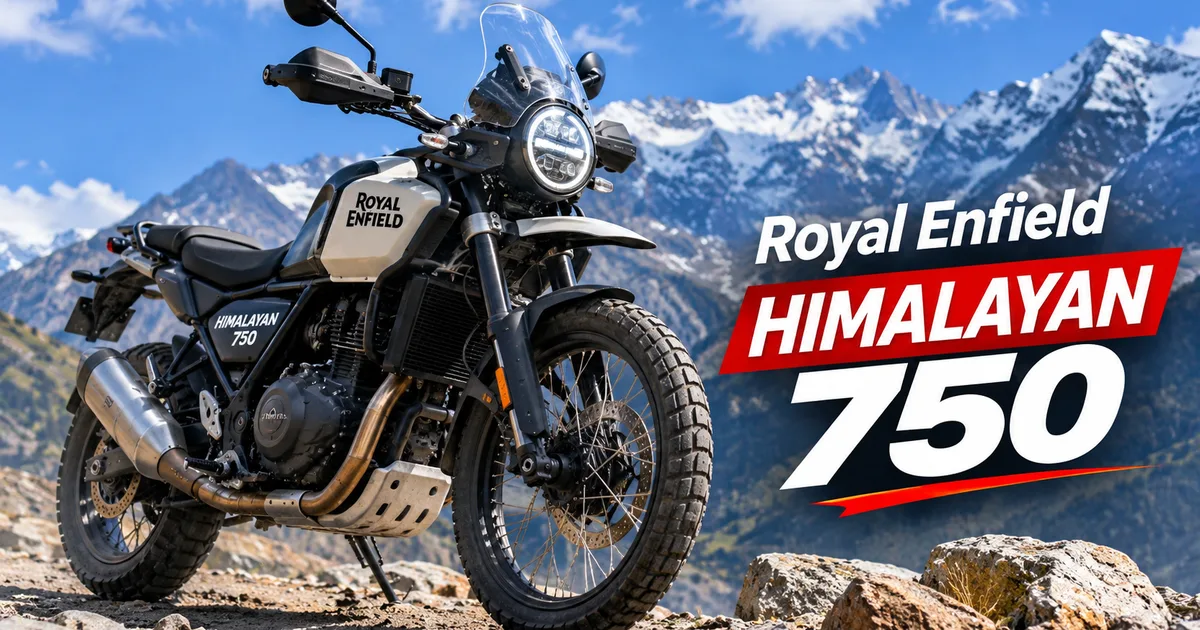
- Full LED lighting with a rugged circular headlamp protected by a factory metal grille.
- Hard mounting points for heavy-duty aluminium panniers and a top luggage rack.
- A tall, clear touring windscreen to deflect buffeting air over the rider's helmet.
- Sturdy wrap-around engine crash guards and a thick aluminium bash plate guarding the sump.
- Dual front disc brakes with radial calipers for stopping power when carrying heavy touring payloads.
Chassis, suspension, and wheels for Indian road conditions
In my experience, an adventure tourer is only as good as its frame. You learn that fast when dealing with Indian road surprises like sudden speed breakers or deep monsoon ruts.
The Himalayan 750 uses a dedicated steel cradle frame paired with a beefy swingarm. Up front, spy shots show heavy-duty upside-down forks with generous travel, likely around 190mm to 200mm. At the rear, an adjustable monoshock handles suspension duties. This setup isolates the rider from sharp road imperfections, and it keeps the chassis planted through high-speed sweepers.
Rider ergonomics are just as important. Staying comfortable all day takes an upright posture paired with wide handlebars and neutral footpegs. That's a relief. Spy shots show a split-seat design with generous padding for both rider and pillion. Given typical Indian rider heights, seat height will likely sit around 825mm to 840mm, with an optional low-seat accessory for riders who want firmer footing in stop-and-go traffic.
Then there's the wheel setup.
Test mules have been seen on the road with two distinct setups. Some test bikes roll on cast alloy wheels, while others have cross-spoked rims designed for tubeless tyres. In our in-depth touring guides, we always stress the advantage of tubeless spoke wheels. Traditional spoked wheels handle harsh impacts well on rocky trails, but if you get a flat, you have to remove the entire wheel and patch an inner tube (annoying, I know). Tubeless cross-spoke wheels give you the impact resistance of spokes with the quick plug-and-ride repair convenience of tubeless tyres.
Royal Enfield will likely offer alloys on a road-biased touring variant and cross-spokes on a rugged adventure model, similar to how they handled earlier launches.
Expected India launch date and showroom price
So, when will you actually be able to book one, and how much cash will you need to part with?
Royal Enfield plans to unveil the motorcycle globally at the EICMA motor show in Milan in November 2026. Testing readiness shows an Indian market debut will follow shortly after, with bikes arriving in showrooms between late December 2026 and early 2027.
When it comes to pricing, Royal Enfield's biggest advantage has always been local manufacturing in Tamil Nadu.
I think the Himalayan 750 will carry an ex-showroom price between ₹4 lakh to ₹4.5 lakh in India. That's competitive. On-road prices across major cities like Delhi and Bengaluru should hover around ₹4.8 lakh to ₹5.3 lakh, depending on local RTO road tax and insurance brackets.
To put that into perspective, competing twin-cylinder adventure motorcycles from European and Japanese brands currently retail between ₹7.5 lakh and ₹12 lakh. If Royal Enfield hits that ₹4.2 lakh sweet spot, it'll create an entirely uncontested category in India. You can also track competing options like the Kawasaki Ninja 500 India launch or the lighter single-cylinder Royal Enfield Himalayan 440 updates to see how pricing compares across displacements.
Who should wait for the Himalayan 750?
Look, not every rider needs a 750cc twin. Honestly, if ninety percent of your riding involves crawling through choked traffic in Bengaluru or Mumbai, a heavy twin-cylinder ADV will tire you out with its physical bulk and engine heat.
Still, if you ask me, this machine makes total sense if:
- You regularly take on multi-day highway journeys across states with luggage and a pillion.
- You want effortless 120 km/h cruising all day without engine vibrations wearing you down.
- You want touring tech like electronic cruise control and built-in TPMS without spending luxury car money.
- You're upgrading from a smaller 250cc or 400cc motorcycle and want genuine touring capability without exorbitant imported spare part costs.
For long-haul Indian motorcyclists, the Himalayan 750 looks set to fill the exact gap riders have been talking about for half a decade. If you can hold off on buying your next touring bike for a few months, waiting for the official unveil at EICMA might be your smartest move.