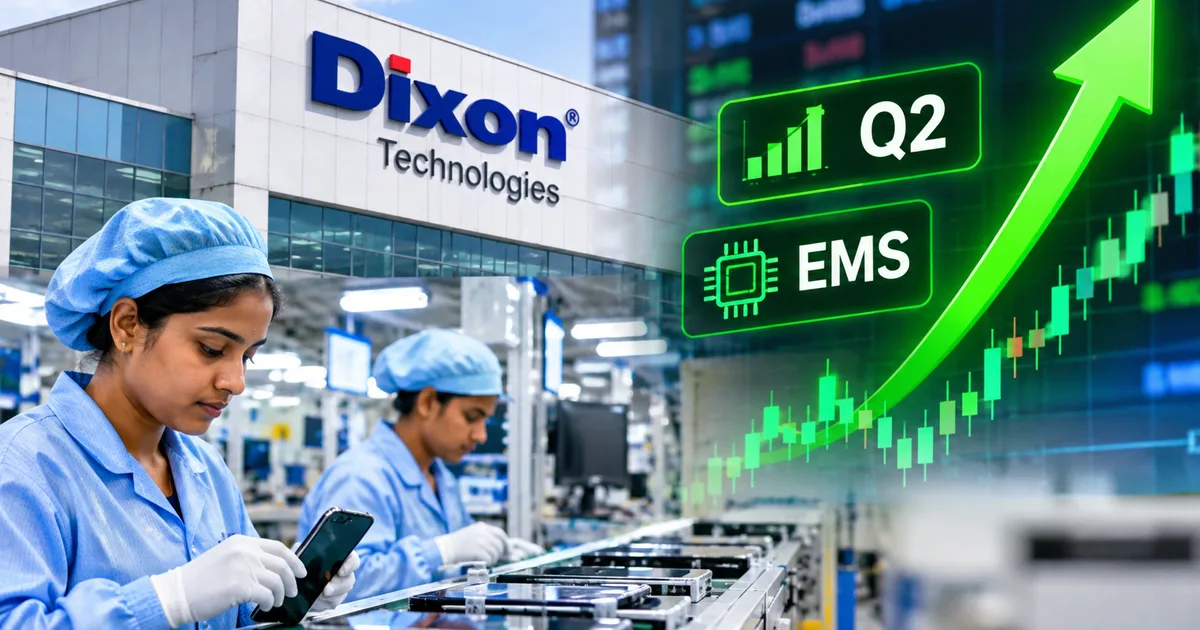
If you recently picked up a budget 5G phone or a smart TV in India, flip the retail box over. Right beneath the brand logo, you'll probably spot tiny printed text: manufactured in plants across Noida, Tirupati, Dehradun, or other local hubs by Dixon Technologies. Most people assume consumer brands own the factories that solder and box their gadgets. They don't. That distinction explains why the Dixon Technologies share price surge captured headline attention on Dalal Street in November 2026. The stock leaped nearly 8 percent in opening trade right after quarterly earnings. It put India's electronics manufacturing engine back into the spotlight.
You might wonder why retail investors and brokerages get this worked up over a contract assembly business. (Honestly, assembling circuit boards sounds pretty dull next to writing software or building digital platforms.) If you ask me, the scale here is what changes everything. If you track our tech explainers, you know that physical hardware assembly across India changed fast over the past five years. What started as basic assembly turned into a massive industrial pipeline. And today, it touches everything from budget phones to smart home gear.
Basically, the whole thing boils down to volume. Relentless, massive volume.
What is Dixon Technologies and how does electronics contract manufacturing work?
Look at it like a commercial kitchen for the electronics world. If you want to launch a food brand across Delhi or Bengaluru, you don't need to build fifty individual kitchens from scratch. You can partner with a certified cloud kitchen operator that already has commercial ovens, trained cooking staff, municipal permits, and bulk grocery supply chains. You provide the recipe and the packaging. They cook the food and pack the containers before handing everything to delivery riders.
In the tech world, Dixon is an electronic manufacturing services company, or EMS for short. Big global brands like Motorola, Xiaomi, Acer, and Samsung hire Dixon to put together smartphones, LED television panels, washing machines, and lighting systems. Dixon gets the parts, runs the assembly lines, handles automated quality checks, and boxes up the finished goods. Meanwhile, the brand owner focuses on software updates, marketing, store distribution, and customer support.
I remember talking to an electronics hardware engineer back in 2018 who laughed off Indian electronics assembly as superficial screw-tightening. (He was partly right at the time, honestly.) Back then, factories mostly imported pre-assembled boards from Shenzhen and snapped them into plastic shells. But today, things are completely different. Indian assembly floors run fast surface-mount technology machines that place thousands of microscopic resistors, capacitors, chips, and connectors onto bare green boards every single minute.
Why the Dixon Technologies share price surge happened after Q2 results
The immediate spark for the November 2026 market rally was simple: second-quarter financial numbers. Dalal Street expected steady growth, but Dixon delivered a 47 percent revenue jump year-on-year. That's huge for an industrial contract manufacturer running at this scale. When Dalal Street Investment Journal and scanx.trade named Dixon among their top stocks to watch on November 2, 2026, investors jumped in right away.
Here's the crazy part: one single division drove almost the entire expansion.
Mobile phones and contract manufacturing brought in around 92 percent of total revenue during the quarter. In my view, Dixon basically turned from a diversified home appliance assembler into an aggressive mobile phone factory. Big deals with global phone brands looking for alternatives to Chinese factories filled Dixon's order books with multi-million unit contracts.
Brokerages noticed fast. HSBC upgraded its outlook on Dixon stock because of growing production volumes under national manufacturing programs. We saw similar market excitement during the PB Fintech share price surge, and big institutional backing usually pushes retail buyers into action. When global investment banks get bullish on Indian factory capacity, buying snowballs in a hurry.
The price hike paradox and rising memory chip costs
Still, the quarterly report wasn't all good news. If you read the earnings call transcripts, there's a weird tension that financial analysts call the price hike paradox. Sure, revenue jumped 47 percent. But profit margins didn't follow. In my experience, when revenue runs way ahead of actual margins, you need to look much closer. Operating margins actually took a noticeable hit.
Thing is, why do margins shrink while revenue shoots up? It comes down to the bill of materials inside modern smartphones. Global prices for memory chips and display screens shot up across late 2026. When component parts cost more, contract assemblers just pass that higher bill to the client for each finished phone. That makes the reported top-line revenue look huge. I'm not sure exactly how much memory prices will fluctuate next quarter, but Dixon only earns a fixed assembly fee or a tiny percentage margin on each phone, not a windfall from pricey semiconductors.
Business Standard reported that Dixon has near-term margin headwinds because component expenses keep climbing. And NDTV Profit pointed out that while revenue looks massive thanks to chip price inflation, actual box volumes grew at a much calmer pace. Put simply, each phone cost more to build. That pumped up the total revenue numbers, but it didn't create a matching jump in actual profit.
Analyst commentary from domestic brokerages highlighted that while higher component pass-through costs inflate headline turnover, long-term investor returns depend on deepening domestic value addition rather than relying on raw revenue spikes.
That's why the market reaction had two layers to it. The stock jumped 8 percent on initial earnings excitement, but experienced traders started digging into operational margins right away. (I know, accounting details sound dry, but tracking where margins go tells you if a rally has real legs.)
How mobile PLI growth built this domestic factory floor
You can't understand how Indian contract manufacturers got here without looking at government policy. For decades, India simply imported finished gadgets. Local factories struggled with high power tariffs, freight delays, a mess of logistics bottlenecks, and steep import duties on parts. If you bought a decent Android phone back in 2014, your money paid for assembly lines in Dongguan or Vietnam.
That reality changed when the Ministry of Electronics and Information Technology rolled out the Production Linked Incentive scheme. Instead of giving unconditional subsidies, the PLI model pays manufacturers cash incentives between 4 percent and 6 percent on extra sales of goods made locally. Produce more phones in Noida this year than you did last year? The government puts cash straight into your company bank account.
The scale of this support is massive. Government allocations for mobile devices, electronic components, display panels, and semiconductor packaging currently exceed ₹1.9 lakh crore across phased packages. In my view, that financial cushion gave companies like Dixon, Kaynes Technology, Cyient DLM, and other local players the confidence to pour capital into big new plants.
Look at how these policy pieces fit together:
- Direct production linked cash incentives reward domestic production milestones each fiscal quarter.
- Phased manufacturing programs raise customs duties on fully assembled phones while lowering tariffs on bare printed circuit boards and camera modules.
- State industrial corridors in Uttar Pradesh, Andhra Pradesh, and Tamil Nadu provide dedicated power feeders and streamlined industrial clearances.
- Rapid domestic adoption of 5G networks creates consistent consumer demand for upgraded handsets priced under ₹20,000.
This setup also explains why phone brands partner with domestic assemblers instead of importing full boxes. When phones like the Vivo T5 5G India launch land on store shelves, building them in India avoids painful import taxes. That keeps retail prices low on Flipkart and Amazon India. Both the phone maker and regular buyers win here.
What the India EMS boom means for everyday phone buyers
When you read about factory stocks in our latest tech news updates, it's easy to dismiss them as distant corporate noise for mutual fund managers. But this shift actually changes your day-to-day tech experience in very real ways.
First, local assembly keeps smartphone prices steady. If a phone gets built in Uttar Pradesh rather than imported from overseas, the retail sticker doesn't swing wildly with every move in the Indian Rupee against the US Dollar. That protects shoppers from sudden price jumps whenever the Rupee slides.
Second, spare parts and warranty repairs are much faster now. When service centers need new motherboards or screen units, parts come from local warehouse hubs instead of waiting three weeks for customs clearance at Mumbai air cargo. Anyone who's had their phone sit at a service center for a month waiting on a board knows how annoying that is.
Third, the jobs created across these electronics hubs are real. Dixon alone hires tens of thousands of assembly workers, line supervisors, testing staff, and warehouse handlers across its plants. For young diploma holders from industrial training institutes in Tier-2 and Tier-3 towns, these factories provide steady formal jobs with provident fund benefits and direct bank transfers. If you ask me, that's where the real impact lands.
The hurdles ahead for local component makers
Does this mean India won the global electronics race? Not even close. Let's be honest about where the industry is today. Dixon and its peers know how to box up phones, but actual value addition inside India is still pretty small, sitting around 15 percent to 22 percent for most handsets.
The priciest parts of any smartphone, like the processor, memory chips, camera sensors, and OLED panels, still come from Taiwan, South Korea, Japan, and China. When you spend ₹15,000 on a phone, only a tiny slice stays in India for assembly wages and local plastic parts. The rest flows straight abroad for imported silicon.
To climb higher up the value chain, Indian electronics makers need to build complex components locally:
- Multilayer printed circuit boards and flexible printed circuits need domestic fabrication facilities.
- Precision mechanical enclosures, camera module packaging, and vibration motors must be sourced from nearby vendor parks.
- Semiconductor packaging and testing units funded under national chip subsidies must begin commercial output on schedule.
Until those local supply chains mature, Indian assemblers are stuck dealing with global part shocks. If chip plants overseas hike their prices, Indian factory margins feel the squeeze right away. (I'm not sure exactly when local supply chains will catch up, but the timeline is definitely years out.) Still, going from practically zero domestic phone production ten years ago to assembling almost every handset sold in India is genuine progress.
Dixon's November rally shows just how big local factory scale has gotten. When global brands want out of China, contract revenue jumps in a hurry. But keeping profits steady when component prices swing all over Dalal Street is a completely different game, and that's the real test for Dixon going forward.