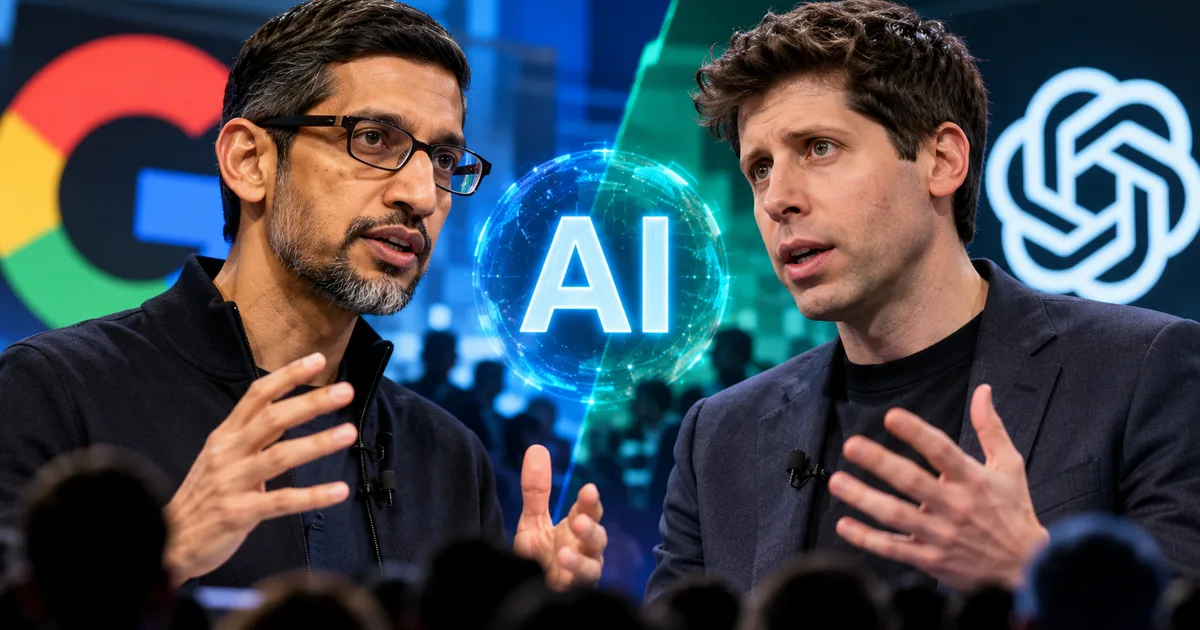
If you watched the stage at the India AI Impact Summit in New Delhi this week, you probably caught that awkward moment when tech leaders raised their hands with Prime Minister Narendra Modi. Sam Altman and Dario Amodei hesitated and went with an awkward fist gesture. They looked like they'd rather be anywhere else. If you ask me, the real friction was happening offstage. The Sundar Pichai and Sam Altman AI debate 2026 has turned into a sharp clash over how artificial intelligence will actually work and what happens to software jobs in hubs like Bengaluru and Hyderabad.
Altman spent weeks before the summit talking about how OpenAI has to fend Google off. His pitch was simple enough: OpenAI builds clean, native systems while older giants just patch over legacy software. Pichai didn't let that slide. He spoke to reporters and fired back with his own question. If Google is just bolting AI onto search and Docs, what is OpenAI up to? Are agents truly native inside ChatGPT, or did OpenAI just glue them onto a plain chat box?
It was a sharp spat. Honestly, it cut straight through the marketing fluff that usually surrounds these tech summits.
The bolt-on argument and what it reveals about Google vs OpenAI
Look, Altman's argument sounds clever on a keynote stage. Silicon Valley loves this narrative where fresh startups build pristine tools while older giants haul around messy legacy code. But think about how you actually use software every morning in India. You check Gmail for college updates. Then you open Google Maps to crawl through Mumbai traffic. If Google puts a working Gemini model right inside those apps without making you learn a whole new layout, that's just good engineering (which makes sense, actually).
Pichai pointed out that Google built Gemini from scratch. He raised a fair question about ChatGPT:
'Gemini was built from the ground up as a product. Or tomorrow, as all of us are adapting to agents, are you bolting agents onto ChatGPT, or are they building it natively? How would you think about that? You can always flip these questions back.'
He's right. Sticking autonomous agents into a chat box that was built for autocomplete is just as much of a patch as putting AI buttons into Google Docs. In my experience, tech battles don't turn on purity tests. They turn on utility. You just want something that solves your headache today, whether you're asking a bot for advice or fixing a broken formula in Google Sheets.
Pichai's point is that you need both approaches right now. You need fresh AI platforms. But you also have to update the everyday apps that billions of people depend on each morning.
AGI timelines and why Sam Altman and Sundar Pichai disagree
When you check out Sam Altman's AI singularity predictions, he speaks like artificial general intelligence is arriving next week. He keeps insisting that models capable of automated science and full software engineering will land before 2030. I'm not sure exactly why he sounds so confident. But that optimism sells subscriptions and justifies billions in fresh data center bets.
Pichai takes a much quieter line. Google's daily reality is serving three billion people across the globe. Models hallucinate. They give garbage answers on local tax rules, or stumble hard on Indian languages like Marathi, Tamil, Telugu, and Bengali. Pichai keeps reminding everyone that reliable production output matters far more than declaring an early victory.
I think Pichai is right about this. It's easy to demo a model cracking an Olympiad puzzle in a sanitized California lab. But it's an entirely different beast to make that model reconcile bank statements on an Indian enterprise platform without charging ₹50 per API call (annoying, I know, but true).
The split really comes down to risk. OpenAI behaves like a startup that has to chase superintelligence to defend its massive valuation. Google is an infrastructure utility. It can't afford broken search pages or bad enterprise answers.
Tech jobs impact on Indian software engineers and IT services
For India, this isn't some theoretical debate. It lands right on the desks of over five million people working in the IT services sector.
When Altman talks about agents writing production code, he's talking about replacing the exact work junior Indian developers tackle every day. Maintenance, data migrations, basic API plumbing, unit tests, and routine bug squashing. For decades, giants like TCS, Infosys, Wipro, and HCLTech built their entire engine by onboarding tens of thousands of fresh graduates at ₹3.5 lakh to ₹4.5 lakh per year. Freshers spent their first two years grinding through repetitive coding tasks. Now? AI agents knock that stuff out in minutes.
Thing is, as laid out in Sridhar Vembu's tech job warnings, local software shops can't pretend this shift will be painless. Campus hiring is already drying up from Pune to Chennai. The exact numbers here are a bit fuzzy, but IT firms are clearly pulling cash out of mass recruitment drives and putting it into dedicated AI systems.
Here is how both leaders see the shift:
- Altman argues that human software engineers will evolve into system architects who direct swarms of AI agents, producing ten times more code.
- Pichai frames AI as an assistant inside developer workflows, noting that Google already writes more than a quarter of its own code with AI assistance while keeping human engineers in the loop.
- Indian IT leaders warn that while total software demand may grow, the traditional entry-level hiring pipeline will shrink permanently.
If you're a student or a junior coder today, basic syntax won't protect you. Python and Java basics aren't enough for a long career anymore. If you ask me, you have to master system architecture and learn how to debug messy code written by machines.
The New Delhi Declaration and the reality for Indian developers
During the summit, Union IT Minister Ashwini Vaishnaw shared that eighty-six countries and two international organisations backed the New Delhi Declaration on AI. The document centers on human-focused AI, job market shocks, algorithmic transparency, and opening up compute power for developing nations.
'While operational details are thin, as is expected from a multilateral declaration, the agreement has consensus from so many countries, including the two AI superpowers.'
Balaraman Ravindran, Centre for Responsible AI at IIT Madras
The declaration reads well on paper. But anyone following the latest tech news knows that signed statements don't spin up GPU clusters.
India has a massive practical bottleneck here. We've got the world's deepest pool of engineering talent and hundreds of millions of citizens streaming data through UPI, Aadhaar, DigiLocker, and FASTag. Yet nearly all serious compute sits inside American server farms owned by Google, Microsoft, Amazon, and Oracle. Whenever Indian founders try to train regional language models, they end up wiring painful amounts of foreign currency overseas (and those invoices hurt, believe me).
Vaishnaw mentioned that the government is rolling out subsidized compute under the IndiaAI Mission to help domestic teams. That's a solid step forward. But if you ask me, until local universities and builders get direct, cheap access to high-end chips, our engineers will stay paying users of overseas models rather than creators of their own.
What Indian tech workers should do right now
So where does this leave you?
Don't panic, but don't sit still either. This debate between Pichai and Altman proves that even tech titans don't agree on where the finish line sits. But they both know software engineering is moving faster than ever.
Here are a few concrete steps to take:
- Stop writing boilerplate code by hand. Start using tools like Gemini Code Assist or GitHub Copilot to understand how agentic coding works in practice.
- Focus on problem definition, systems design, and security. AI generates code quickly, but it frequently introduces subtle security flaws and compliance problems under India's Digital Personal Data Protection Act.
- Learn how data pipelines work. Indian enterprises need professionals who can connect internal databases to AI models without leaking confidential customer information.
- Follow in-depth tech explainers to track how regulatory standards and enterprise adoption unfold across Indian banking, healthcare, and IT services.
In my experience, the coders who thrive won't be the ones fighting AI or blindly worshipping it. Practical builders who understand clean code and real business problems will always run the show.