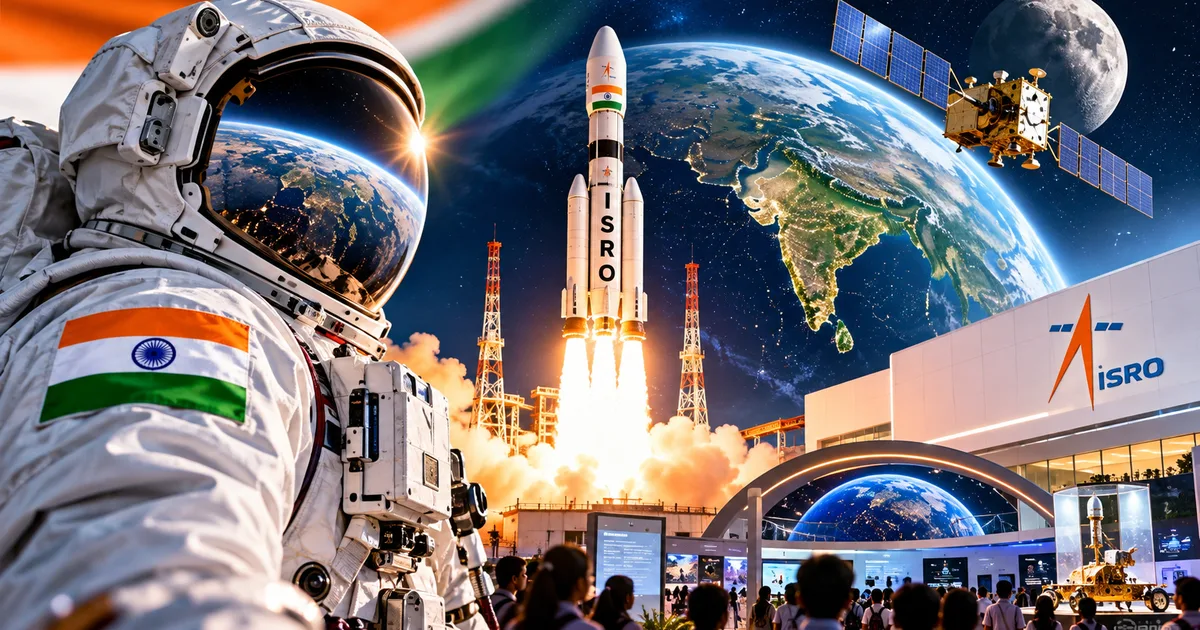
Look, most of the time, the space industry feels like a closed club. You see a rocket launch on the news, feel a quick burst of pride, and go back to your day. But World Space Week 2026 India is set up differently this year. Running from October 4 to 10, the events are actively pulling regular people into the mix. I've been following ISRO's public outreach efforts for a while. They're pushing harder than ever right now. If you or your kids have any interest in what happens above the atmosphere, you need to pay attention this week.
The official global theme for 2026 is "Rocket Revolution". It's a massive topic. Honestly, we're looking back at the 69 years since the Soviet Union launched Sputnik 1 in 1957. That single metal sphere changed everything. Since then, rocket technology has shifted from government-exclusive, single-use vehicles to reusable rockets built by private companies (which makes sense, actually, given the costs). Getting to orbit is becoming routine. The barriers are dropping. And India is sitting right at the center of this shift.
We've got a lot to talk about locally. The Indian space sector is moving fast. A senior ISRO official recently confirmed to The Times of India that 95 percent of the initial phase tests for the Gaganyaan human spaceflight programme are complete. Think about that for a second. We're finishing the groundwork to send Indian astronauts into space on Indian hardware. And in my experience, hitting that 95 percent mark is the hardest part.
So because of this momentum, the World Space Week celebrations hit harder. ISRO centers in Keralam, especially around Thiruvananthapuram, are going all out. They're hosting public lectures and running massive student programs. They're even launching a sounding rocket for the public to watch.
The push for real science education
You don't have to be in Kerala to see this happen. Smaller cities are getting involved too. In Nandyal, Andhra Pradesh, Collector G Rajakumari inaugurated a major World Space Week event at SVR Engineering College. ISRO scientists actually organized it. They focused it specifically on the "Rocket Revolution" theme.
"The goal is to get students directly engaged with the science. You have to bring the technology to the students, not wait for them to find it."
During a separate event, the Deputy Director of the U. R. Rao Satellite Centre made a very specific point. They told students they need to develop a scientific temperament. Basically, this is a direct demand for the next generation of engineers. Building reusable rockets is hard. Designing life support systems for Gaganyaan is hard. They need kids who actually care about how machines work. Memorizing for an exam isn't enough.
This demand for technical literacy is everywhere. You can see it in how millions of Indians are hunting for stable technical jobs. Just look at the traffic on our India Post GDS Recruitment 2026: Step-by-Step Apply Guide. Young people want solid careers. The space sector and the broader tech sector are going to be massive employers in the next decade. If you read our Latest Tech News hub, you'll notice how often space startups are getting major funding rounds right now. The numbers here are a bit fuzzy, but the trend is clear. If you want a more grounded example of new technology reaching people, look at the Ayushman Bharat Card Download 2026: Apply Online Guide. It shows how massive digital infrastructure systems are finally working for the average citizen.
How students can participate online (step-by-step)
I know what you're thinking. It's great that Thiruvananthapuram gets a rocket launch, but what about everyone else? Well, you're in luck. A huge portion of the 2026 events are digital. Here's exactly how you can get involved from your living room.
- Open YouTube and search for live streams scheduled between October 4 and 10 under the ISRO Space Tutor banner. ISRO has a network of recognized Space Tutors across the country. You will find engineers breaking down rocket propulsion into concepts a twelve-year-old can understand. Set reminders for these streams so you can ask questions in the live chat.
- Go to the MyGov India website on your browser and register for the official space quizzes. The platform runs official competitions for World Space Week. You will need to log in using an Indian phone number and verify with an OTP. Some advanced certificate programs might ask you to link your DigiLocker or use Aadhaar for identity verification. Take the quiz. You usually get a digital certificate right away.
- Find amateur astronomy clubs in cities like Delhi, Pune, or Bengaluru on Facebook or Meetup. Send a message asking for their virtual event links. Many clubs will hook a camera up to a high-powered telescope and stream the feed over Zoom or Google Meet. You can see lunar craters live from your couch.
- Watch the Thiruvananthapuram sounding rocket launch online. The ISRO centers in Kerala will launch a sounding rocket as part of their celebrations. Find the official ISRO social media handles on X or YouTube. They typically provide a livestream link on the morning of the launch. Watching a live countdown is always a good time.
- Search your phone's app store for space agency-approved orbital mechanics simulators. These are games that force you to build a rocket and calculate the thrust needed to reach orbit. Spend an hour playing this with your kids. It is frustrating at first, but it teaches physics better than a whiteboard ever could.
- Explore the National Space Day archives. India recently celebrated National Space Day in August to mark the Chandrayaan-3 landing. Many of the resources, documentaries, and interactive modules from that day are still available online. Dig into those archives. They have excellent breakdowns of how the rover navigated the lunar south pole.
You don't need to spend any money to do this. You just need an internet connection and the willingness to learn something new.
Why the rocket revolution theme matters
Let's go back to that 1957 Sputnik launch. I was reading an article on Moneycontrol about this exact history. From the Soviet Union's early wins to the modern era of SpaceX's Starship, the engineering jumps are massive. The early rockets were basically modified intercontinental ballistic missiles. They were built for war. Then they were repurposed for science.
For decades after that, the space race was a huge drain on national budgets. You built a rocket for millions of dollars. You launched it once. Then you let the first stages crash into the ocean (which is wild to think about now). It was entirely unsustainable.
The revolution we're seeing now is all about reuse. Today's rockets are designed from the ground up for commercial logistics. They're basically cargo trucks for low Earth orbit. When a company can launch a rocket, land the booster, inspect it, and launch it again a few weeks later, the math changes completely. The cost of putting a kilogram of cargo into orbit is dropping fast.
We're seeing this transition happen in real-time. If you look at the news from the World Space Congress happening in Turkey right now, the discussions are heavy on artificial intelligence in orbit and new satellite deployments. Space is getting crowded. And it's getting commercialized fast.
This means smaller companies can suddenly afford to launch satellites. Universities can launch research instruments. The sky is literally opening up to people who aren't government billionaires.
India is in a very strong position here. ISRO has always operated on tight budgets. They know how to squeeze every drop of efficiency out of a mission. Now, Indian private space startups are building on that legacy. They're testing 3D-printed engines. They're building smaller, more flexible launch vehicles.
I highly recommend checking out some of our Tech Explainers to see how this kind of hardware innovation is trickling down into everyday consumer electronics. The materials and software being developed for space eventually end up in our phones. They end up in our cars, too.
The Gaganyaan factor and ISRO events
The timing of World Space Week 2026 is perfect for India. The Gaganyaan program is dominating the conversation. The fact that 95 percent of the initial phase tests are done is huge.
These initial tests are the most demanding part of the program. They include testing the crew escape system under various extreme conditions. Think about it. If a rocket fails on the pad or during the early stages of ascent, the crew module has to physically rip itself away from the explosion and parachute to safety. You can't put a human in that seat until you're absolutely sure that escape system works flawlessly.
They've tested it. It works. The next steps involve uncrewed orbital flights. These flights test the life support systems in the vacuum of space.
What parents should actually do this week
If you have children, please don't just hand them an encyclopedia article about the solar system and walk away. That's a mess. It's boring.
Sit down with them and watch a livestream. Ask them questions. When you watch a rocket launch, ask them why it starts tilting sideways after it clears the tower. I'm not sure exactly why so many people miss this detail. If neither of you knows the answer, go look it up. For the record, it's to gain horizontal speed to stay in orbit. You don't just go straight up and fall back down.
We complain a lot about how distracted kids are today. We worry about their screen time. But screens aren't the enemy if you use them to show something real. A live feed of an Indian rocket tearing through the atmosphere is real.
Take thirty minutes this evening. Go to the ISRO YouTube channel. Watch an engineer explain how they track a satellite millions of kilometers away. It will remind you that human beings are capable of some highly impressive engineering when we actually try. It's just a matter of showing up.