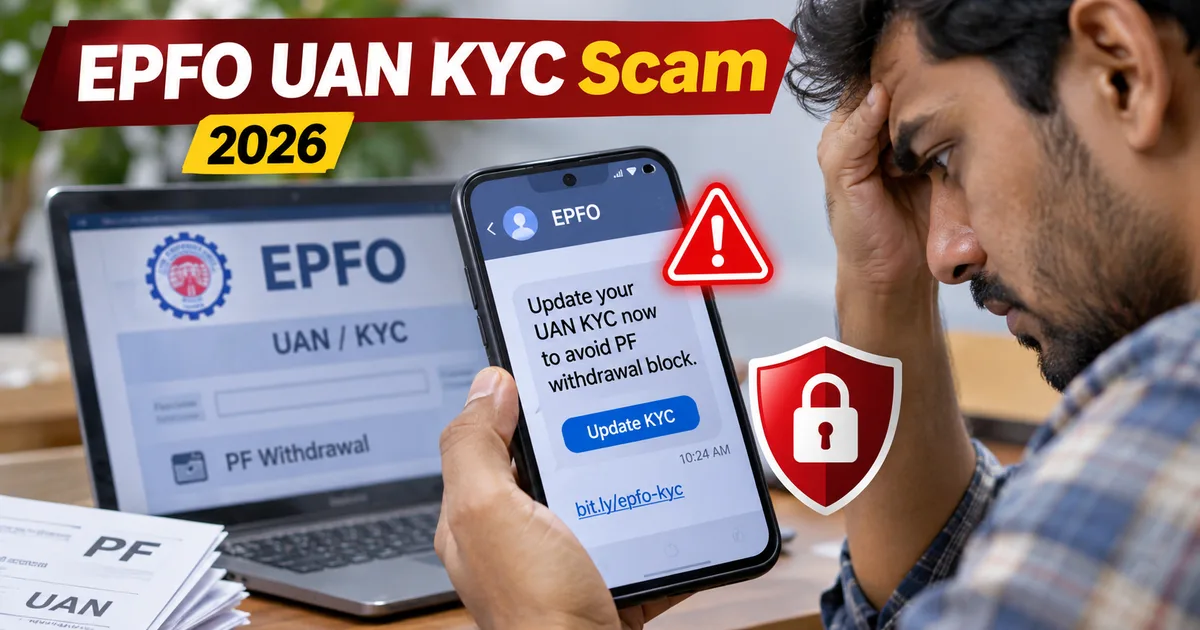
If you got a WhatsApp forward or SMS this morning warning that your Provident Fund will be blocked unless you finish a quick verification, stop right there. The fake EPFO UAN KYC update and PF withdrawal scam is making the rounds again across India in 2026, and it's targeting salaried workers with ugly precision. Scammers are pretending to be officials from the Employees' Provident Fund Organisation. They're pushing lookalike websites and tricking people into handing over their 12-digit Universal Account Number and Aadhaar details along with bank OTPs. One wrong tap can put years of hard-earned savings at serious risk.
Honestly, this scam ticks me off way more than the usual lottery traps.
You can ignore a fake prize text in two seconds. But PF money hits differently, if you ask me. It sits quietly in the background, cut from your paycheck every single month, meant for retirement or an unexpected family medical emergency.
And scammers know panic works better than greed. India has around 8 crore active EPFO members, and the numbers on how many get targeted are a bit fuzzy, yet even a tiny slice falling for a fake text turns into huge cash for these gangs. Just look at a CBI case reported by Business Standard. One fraudster named Priyanshu Kumar in Delhi targeted just 11 EPF members using 39 fake claims and walked away with Rs 1.83 crore before getting caught. Eleven accounts. Imagine what organized gangs running automated phishing links are pulling off right now.
What the fake EPFO UAN KYC update scam actually is
At its simplest, this scam is all about impersonation and panic. Scammers blast out mass SMS alerts, emails, WhatsApp texts, and social media ads pretending to be official EPFO notices.
These texts usually fall into two buckets. The first group uses fear. They claim your UAN KYC is incomplete or your Aadhaar link has expired, and warn that your PF account will be frozen by midnight if you don't update your profile right away. The second group uses bait instead, promising instant PF withdrawal approvals or faster claim settlements (plus special pension benefits, apparently) if you submit your details through a priority link.
Thing is, neither type of message is from EPFO. We've seen a wave of similar fake EPFO WhatsApp KYC scams over the past few months, right alongside fake KYC update SMS scams hitting stock market investors. I think scammers basically just swap out the brand logo and recycle the exact same trap.
Look at why they want your UAN so badly. Your UAN is a permanent 12-digit number that stays with you across every job change in your career. By itself, it shouldn't drain your bank account. But when you pair it with your portal password and Aadhaar number, plus your PAN and an OTP, you're handing a stranger the keys to your Member ID and bank account linkage. They get straight into your claim submission portal too.
How the PF withdrawal scam works step by step
So how does clicking one message turn into missing money? I checked recent advisories from EPFO and Zee Business, and the playbook is pretty methodical. Once you tap that sketchy link, the trap unfolds fast:
- You receive an urgent SMS, WhatsApp text, or phone call claiming your UAN KYC update is pending or that an online PF withdrawal request requires immediate verification.
- You tap the attached link, which opens a cloned website designed to look almost identical to the official EPFO Unified Portal, complete with familiar government emblems, fonts, and login boxes.
- The fake page asks you to log in with your 12-digit UAN, password, and captcha, or tells you to enter your Aadhaar, PAN, date of birth, and bank account number to complete verification.
- On the next screen, the site asks for an OTP sent to your registered mobile number, or a caller stays on the line coaching you to read out the digits while claiming they are doing a backend sync.
- The moment you type or share that OTP, the fraudster uses your credentials on the real portal, alters your contact or bank details if possible, or initiates unauthorized withdrawals and identity theft using the stolen KYC data.
Sometimes they don't even stop at the fake site. A fake support executive might call right after you submit that first form, and in my experience reading these cases, they sound completely bored and polite like a real government clerk. They'll tell you to install a remote screen-sharing app or pay a Rs 500 processing fee over UPI to release a stuck claim. (People fall for that Rs 500 fee trick constantly because the amount looks tiny next to a Rs 3 lakh PF balance, which makes sense, actually.)
Warning signs of a fake EPFO website or message
Spotting these fake messages gets much easier once you pause for ten seconds and actually look at the screen. Advisories covered by Bhaskar English and Zee Business show that scammers make the same predictable mistakes every single time.
'Do not trust unknown SMS, emails, WhatsApp messages, or social media links. Check any link before clicking on it, carefully check the website URL, and do not share information like UAN, password, Aadhaar, PAN, bank details, or OTP with anyone.' - EPFO Advisory Summary
Rahul Mishra, Cyber Security Advisor with Uttar Pradesh Police, noted in a cyber literacy briefing that criminals target EPF accounts specifically because they hold long-term savings. So if a text mentions your PF account, watch out for these red flags:
- Weird domain names that imitate government sites, such as links ending in .com, .in, or .net instead of the official .gov.in domain.
- Threats of immediate account suspension, penalties, or permanent freezing unless you click within a few hours.
- Requests to complete KYC updates, submit bank passbook photos, or approve PF withdrawals over WhatsApp chat or a personal mobile number.
- Promises of guaranteed 24-hour PF claim settlement or extra bonus interest in exchange for a small verification transfer via UPI.
- Any website or caller asking for your UAN password, ATM PIN, UPI PIN, or live OTP to cancel or verify a transaction.
Look, EPFO never asks members to share UAN passwords, Aadhaar numbers, bank details, or OTPs over phone calls or via SMS and WhatsApp. Never. Not for KYC, and definitely not for pension updates or speeding up a withdrawal. If someone asks, hang up.
And check the URL bar twice if you open a link from Google Search. Scammers buy search ads now so their fake pages sit right above the real government site when you search for EPFO login in a hurry. Honestly, search ads being a mess like that is why I always bookmark the official portal in my browser instead of trusting random results.
How to protect your PF account right now
The good news is you don't need fancy paid antivirus software to protect your retirement savings. A few boring habits do the job.
First, only check your balance or update your KYC through official channels. Same goes for filing a withdrawal. Type epfindia.gov.in straight into your browser, or use the government UMANG app and DigiLocker for linked records. If you haven't kept up with recent portal changes, check out the EPFO overhaul 2026 PF rules so you know what the real interface looks like.
Second, fix your UAN login hygiene. Use a strong password you don't reuse on shopping apps or email. Change it every few months. Make sure the mobile number tied to Aadhaar and your UAN is active and strictly yours. Lots of older workers let a relative or local cyber cafe agent enter their own phone number during initial setup. That creates a huge blind spot later, if you ask me.
Third, check your KYC status right inside the Unified Member Portal instead of trusting some random alert. Log in cleanly first. Make sure your Aadhaar and PAN (plus your bank account) show Verified status. And never type your UAN and Aadhaar details, or any OTP, into a link from an SMS or WhatsApp text. You can also browse our tech safety guides for simple ways to spot sketchy URLs and lock down your main phone number.
What happens if your EPF account gets frozen for fraud checks
Because fake claims got so out of hand, EPFO rolled out strict Standard Operating Procedures (SOPs) for freezing and defreezing suspicious accounts, as reported by Business Standard. If their multi-stage checks catch sketchy activity on a Member ID or UAN (or even an employer profile), they can freeze the account for up to 30 days for verification. They can also tack on a 14-day extension for due diligence.
While it's frozen, nobody can log into the Unified Portal, change KYC details, link a new Member ID, or settle a PF withdrawal claim. Getting locked out is annoying when you actually need cash (we all know how slow government checks can be, which is frustrating), but I think it beats watching thieves drain your savings overnight. Once EPFO confirms you're the real owner, they defreeze the account. I'm not sure exactly how long the refund step takes in every case, though the SOP says criminal proceedings are launched if money was stolen and the funds go back to the member's account with interest.
Where to report EPFO fraud in India
Already clicked a sketchy link or typed in your UAN password? Maybe you even shared an OTP. Don't sit around hoping nothing happens, because speed is everything in financial cybercrime.
First, go to the official EPFO website and change your UAN portal password right away if you can still get in. If you entered bank details, call your bank immediately to warn them or freeze netbanking and UPI for a bit. Next, report the incident through these official channels:
- Call the National Cyber Crime Helpline at 1930 right away if money has been debited or a fraudulent claim is in motion.
- File a formal complaint online at cybercrime.gov.in with screenshots of the SMS, WhatsApp chat, caller number, and the fake website URL.
- Raise an official grievance with EPFO through EPFiGMS (epfigms.gov.in) or notify your company's HR department so they don't approve any fake employer-side KYC or claim requests.
- Report phishing domains and malicious links to CERT-In (https://www.cert-in.org.in/) so the Indian Computer Emergency Response Team can track and block the fake servers.
Save every bit of proof before you block the scammer on WhatsApp. Grab screenshots of the chat and the fake site's URL bar, plus any transaction IDs. Police can't trace a ghost if you wipe the thread out of embarrassment.
Scammers keep changing their scripts because salaried folks naturally worry about their PF savings, and honestly, I don't think these scams are slowing down anytime soon. Bookmark the real .gov.in portal right now, and check more scam alerts and safety updates so you spot the next fake text before you tap it.